Thursday, June 24, 2010
I'll be on Friday's "Week in Review"
I'll be on Friday's WPR Week in Review tomorrow (June 25) opposite former WI state senator and Lieutenant Governor Margaret Farrow. Gene Purcell will be hosting the show in place of Joy Cardin. You can call in live at 1-800-642-1234 or email talk@wpr.org


 I teach Communication Studies (First Amendment, Classical Rhetoric, Civic Engagement, Rhetoric of Rock Music) at UW Oshkosh. Served two terms on Oshkosh City Council. Originally from Brooklyn, NY.
Friday, June 04, 2010
Jim Joyce's Lessons For Politicians
By now everyone knows that umpire Jim Joyce's blown call cost the Tigers' Armando Galarraga a perfect game. Umpire Joyce's recognition of his error has earned him praise from Mr. Krause and many others.
They/we probably won't, but politicians can learn two important lessons from the Joyce Affair.
Lesson Number One: Don't Pander; Call 'em as you see 'em: Joyce's blown call occurred with two outs in the top of the 9th inning, in Galarraga's home park, with the crowd cheerleading for the perfect game. Especially on such a close play, the easiest thing for Joyce to do would have been to call the runner out even if his eyes and heart told him the runner was safe. Instead of pandering to the crowd, he called the play as he saw it and suffered the immediate consequences.
Contrast that behavior with the norm in contemporary American politics. Pandering to cheerleaders--who are frequently well connected insiders with a vested interest in the outcome of policy deliberations--is the way the game is too often played. (That's essentially Madison and Washington politics in a nutshell.).
No one should be surprised that pandering to the powerful is the norm in Madison and Washington, but one of my biggest wake-up calls since getting on the City Council has been the extent to which that dynamic plays out locally too. Just raising questions about Oshkosh Corporation, EAA, and other entities backed up by well connected cheerleaders is extremely difficult.
Lesson Number Two: Evidence Matters. What's significant about Joyce's change of mind on the call is not just that he admitted error, but that he changed his mind after being confronted with contrary evidence. Even though the video evidence seemed pretty conclusive, Joyce could have easily said something like, "the video is misleading; if you'd been standing where I was you would have agreed that the runner got there first." Instead of spinning and rationalizing, Joyce accepted that the video evidence suggested that the runner was probably out.
Contrast that with the "dumbassification" that we see in American politics. Facts and evidence often mean nothing, especially if they get in the way of a good smear or a catchy, poll-tested slogan. (Probably the best current example of this phenomenon is the repeated attempts by Obama's opponents to label him a "Socialist" in spite of the fact that his economic policies were developed by Wall St. insiders and outfits like Goldman Sachs and JP Morgan Chase have been among his biggest contributors.).
American politicians tend to change positions not because further study reveals powerful counter evidence, but because of some need to pander to a cheerleader perceived as powerful. That's why we justifiably refer to position-changing pols as "flip-floppers."
Integrity means not only the willingness to take heat for a controversial stand, but also the courage to change course when contrary evidence emerges. Jim Joyce showed that kind of integrity. How sad that the modern Democratic and Republican parties have no room for that kind of individual.
They/we probably won't, but politicians can learn two important lessons from the Joyce Affair.
Lesson Number One: Don't Pander; Call 'em as you see 'em: Joyce's blown call occurred with two outs in the top of the 9th inning, in Galarraga's home park, with the crowd cheerleading for the perfect game. Especially on such a close play, the easiest thing for Joyce to do would have been to call the runner out even if his eyes and heart told him the runner was safe. Instead of pandering to the crowd, he called the play as he saw it and suffered the immediate consequences.
Contrast that behavior with the norm in contemporary American politics. Pandering to cheerleaders--who are frequently well connected insiders with a vested interest in the outcome of policy deliberations--is the way the game is too often played. (That's essentially Madison and Washington politics in a nutshell.).
No one should be surprised that pandering to the powerful is the norm in Madison and Washington, but one of my biggest wake-up calls since getting on the City Council has been the extent to which that dynamic plays out locally too. Just raising questions about Oshkosh Corporation, EAA, and other entities backed up by well connected cheerleaders is extremely difficult.
Lesson Number Two: Evidence Matters. What's significant about Joyce's change of mind on the call is not just that he admitted error, but that he changed his mind after being confronted with contrary evidence. Even though the video evidence seemed pretty conclusive, Joyce could have easily said something like, "the video is misleading; if you'd been standing where I was you would have agreed that the runner got there first." Instead of spinning and rationalizing, Joyce accepted that the video evidence suggested that the runner was probably out.
Contrast that with the "dumbassification" that we see in American politics. Facts and evidence often mean nothing, especially if they get in the way of a good smear or a catchy, poll-tested slogan. (Probably the best current example of this phenomenon is the repeated attempts by Obama's opponents to label him a "Socialist" in spite of the fact that his economic policies were developed by Wall St. insiders and outfits like Goldman Sachs and JP Morgan Chase have been among his biggest contributors.).
American politicians tend to change positions not because further study reveals powerful counter evidence, but because of some need to pander to a cheerleader perceived as powerful. That's why we justifiably refer to position-changing pols as "flip-floppers."
Integrity means not only the willingness to take heat for a controversial stand, but also the courage to change course when contrary evidence emerges. Jim Joyce showed that kind of integrity. How sad that the modern Democratic and Republican parties have no room for that kind of individual.
I teach Communication Studies (First Amendment, Classical Rhetoric, Civic Engagement, Rhetoric of Rock Music) at UW Oshkosh. Served two terms on Oshkosh City Council. Originally from Brooklyn, NY.
Tuesday, June 01, 2010
Media Rants: Justice Stevens' Uneven First Amendment Legacy
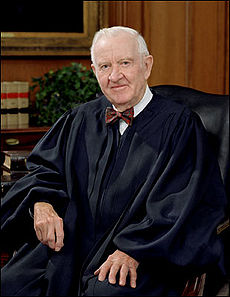 Update July 17, 2019: Yesterday Justice John Paul Stevens passed away at the age of 99. I wrote this piece in June of 2010, shortly after Stevens retired from the Supreme Court. Justice Stevens continued to have an impact on legal thinking after he left the Court, including what I believe to be a persuasive argument for repealing the Second Amendment. We should never forget that Justice Stevens, who the popular press insisted on calling "liberal" but was in fact a fierce independent, was appointed by a Republican president (Gerald Ford) who understood the terrible impact on representative democracy and the rule of law when judges were perceived as partisan hacks. Today it is virtually impossible to imagine someone like Stevens appointed by a Republican president. --Tony Palmeri
Justice Stevens’ Uneven First Amendment Legacy
Media Rants
By Tony Palmeri
From the June 2010 issue of The SCENE
Disgust with the Supreme Court’s rightist RATS (Roberts, Alito, Thomas, Scalia) often leads leftish legal pundits to exaggerate the accomplishments of the Court’s so-called liberal bloc.
Nowhere is this tendency clearer than in the reactions to Justice John Paul Stevens’ retirement announcement. Senator Dick Durbin’s (D-IL) comments were typical: ''Justice Stevens' commitment to expanding freedom, safeguarding our rights and liberties, and understanding the challenges faced by ordinary Americans will be his legal legacy. He has had no judicial agenda other than fidelity to the law and the Constitution."
Appointed by President Ford in 1975, Stevens labeled himself a “centrist” and early in his term authored conservative opinions on affirmative action, the death penalty, and other hot button issues. His views on the death penalty and coercive state power in general evolved over time, so that by the 1990s media depictions almost unanimously recognized him as the Court’s liberal leader. Indeed, Stevens deserves kudos for being a voice of reason against Bush-era executive branch excesses in Hamdan v. Rumsfeld (2006).
Disgust with the Supreme Court’s rightist RATS (Roberts, Alito, Thomas, Scalia) often leads leftish legal pundits to exaggerate the accomplishments of the Court’s so-called liberal bloc.
Nowhere is this tendency clearer than in the reactions to Justice John Paul Stevens’ retirement announcement. Senator Dick Durbin’s (D-IL) comments were typical: ''Justice Stevens' commitment to expanding freedom, safeguarding our rights and liberties, and understanding the challenges faced by ordinary Americans will be his legal legacy. He has had no judicial agenda other than fidelity to the law and the Constitution."
Appointed by President Ford in 1975, Stevens labeled himself a “centrist” and early in his term authored conservative opinions on affirmative action, the death penalty, and other hot button issues. His views on the death penalty and coercive state power in general evolved over time, so that by the 1990s media depictions almost unanimously recognized him as the Court’s liberal leader. Indeed, Stevens deserves kudos for being a voice of reason against Bush-era executive branch excesses in Hamdan v. Rumsfeld (2006).
As regards freedom of speech and the First Amendment, Stevens’ legacy is mixed. I believe his passionate and superbly argued dissenting opinion in the recent Citizens United v. FEC case will in future years have an impact not typical of minority opinions. In that case, the RATS were joined by Justice Anthony Kennedy in outlawing virtually all restrictions on corporate involvement in elections. Wrote Stevens: “The Court’s ruling threatens to undermine the integrity of elected institutions across the Nation. The path it has taken to reach its outcome will, I fear, do damage to this institution.”
Even more powerfully, Stevens dissent featured a rare example of a judge questioning the “personhood” of corporations:
“The fact that corporations are different from human beings might seem to need no elaboration, except that the majority opinion almost completely elides it . . . It might also be added that corporations have no consciences, no beliefs, no feelings, no thoughts, no desires. Corporations help structure and facilitate the activities of human beings, to be sure, and their ‘personhood’ often serves as a useful legal fiction. But they are not themselves members of ‘We the People’ by whom and for whom our Constitution was established.”

Should the Supreme Court ever break free of its dominant RATS/moderates coalition, Stevens’ cogent understanding of the nature of corporations might serve as a foundation on which to reclaim the Constitution for “We the People.”
Stevens First Amendment contribution with the most practical and positive impact is probably his majority opinion in Sony Corporation of America v. Universal City Studios (1984). In that case, a court majority led by Stevens rebuffed Hollywood’s attempt to outlaw video tape recorders on the grounds that they could be used for copyright infringement. In a victory for consumers, Stevens wrote: "the sale of copying equipment...does not constitute contributory infringement if the product is widely used for legitimate, unobjectionable purposes, or, indeed, is merely capable of substantial noninfringing uses."
Unfortunately Stevens did not apply the same logic in MGM Studios v. Grokster (2005), joining the majority in refusing to apply the Sony standard to file sharing technology. Holding narrowly that file sharing technology was legitimate but that Grokster’s “crime” was in encouraging copyright infringement, the Court guaranteed only that entertainment companies would continue to use the courts to stifle what they perceive as illegal downloading. The result? Tens of thousands of lawsuits filed against music fans, against everyone from teen students to grandmothers.
Stevens’ two worst First Amendment opinions dealt with flag desecration and “indecent” media, respectively. In Texas v. Johnson (1989), Stevens was one of four justices disagreeing with the majority opinion that flag desecration constituted expression worthy of First Amendment protection. In a dissent that sounded more like Archie Bunker than a great civil libertarian, Stevens insisted that requiring he who desires to burn a flag use an alternative method for expressing his ideas is a “trivial burden” on free expression.
Stevens’ First Amendment opinion with the most negative impact can be found in Federal Communications Commission v. Pacifica Foundation (1978). The case dealt with the FCC’s power to prevent broadcasters from airing “indecent” material such as George Carlin’s famous “Filthy Words” monologue. Writing for the majority, Stevens insisted that the pervasiveness of mass media, along with government’s legitimate interest in protecting children, allowed the FCC to restrain the broadcast of “indecent” materials without violating the First Amendment. Thanks to this decision, we’ve now lived through more than thirty years of the FCC in the role of a boorish Big Brother, anxious to level fines at broadcasts featuring penis jokes or anything else deemed “indecent” by bureaucrats and judges.
 |
| Perhaps Justice Stevens' worst First Amendment opinion was in FCC v. Pacifica Foundation. In that case five uptight old judges (including Stevens) demonstrated that they were . . . five uptight old judges. The decision turned a federal, politicized bureaucracy into a glorified Big Brother. The consequences have not been good for free speech. |
At his best, John Paul Stevens defended the Constitution against government and corporate attempts to bend and subvert it for their own purposes. Should Elena Kagan be confirmed as his replacement, let’s hope she is Stevens 2.0 instead of a RATS clone or Stevens-lite. [Update July 2019: In her recent dissent against the court majority's recent refusal to reign in hyper partisan gerrymandering, Justice Kagan showed signs of being a Stevens 2.0.].
I teach Communication Studies (First Amendment, Classical Rhetoric, Civic Engagement, Rhetoric of Rock Music) at UW Oshkosh. Served two terms on Oshkosh City Council. Originally from Brooklyn, NY.
Saturday, May 29, 2010
Amen
From Bob Herbert's latest column on the BP disaster:
"The U.S. will never get its act together until we develop the courage and the will to crack down hard on these giant corporations. They need to be tamed, closely monitored and regulated, and constrained in ways that no longer allow them to trample the best interests of the American people."
"The U.S. will never get its act together until we develop the courage and the will to crack down hard on these giant corporations. They need to be tamed, closely monitored and regulated, and constrained in ways that no longer allow them to trample the best interests of the American people."
I teach Communication Studies (First Amendment, Classical Rhetoric, Civic Engagement, Rhetoric of Rock Music) at UW Oshkosh. Served two terms on Oshkosh City Council. Originally from Brooklyn, NY.
Friday, May 28, 2010
Colin Crowley: Humanitarian Videographer From Oshkosh
Received a wonderful email yesterday from Colin Crowley. I first met Colin around 2004, when I was running for state assembly and he was doing a barista stint at the New Moon coffee shop. A gifted photographer and videographer, Colin has taken his talents around the globe. A few years ago many of us followed his gripping portrait of life in Afghanistan and Pakistan. As for what Colin's been up to in the last few years, I'll quote directly from his email:
I've been working for the British NGO Save the Children UK since April of 2008. I work for their emergencies team as a multimedia officer which means I create photo essays, make videos, write case studies,and very often contribute to international media pieces on humanitarian crises - sometimes acting as a chaperone for international journalists when they visit Save the Children's programs. The last two years have been great for me, and rather than feeling like a "weird" guy who speaks French and takes photos in Oshkosh - I've fallen into a role where those things are completely normal - expected even in my current milieu.Since I started, my travels have followed major humanitarian emergencies around the globe. China for the earthquake, Myanmar for the cyclone (terrible government, wonderful country and people), DR Congo for the war, Zimbabwe - cholera outbreak, Ethiopia - food crisis, Northeast Kenya - food crisis, South Sudan - everything, Haiti - right after the earthquake (very ugly situation) and a bunch of places in between for this and that. I'm currently in Niger documenting a really bad food crisis that will unfortunately probably pass under the media radar until the World Cup excitement is over with. But anyway, it's been an interesting ride and it's been a great way to see the world and meet people - kind of like a vacation to all the places where you'd never want to take a vacation.
Colin's wife is Kenyan, and they live in Nairobi with their baby daughter. He says that "living in Africa is fun, frustrating, inspiring, relaxed, frightening, easy-going and highly-stressful all at the same time, and very often all those things within the course of 24 hours."
Traveling in the third world has given Colin an interesting perspective on the American "Tea Party" movement: "I have spent the past two years working in countries where governments don't spend ANY money on ANYTHING for their people, and all I have found is overwhelming human suffering. Then I look back home and see all these people shouting about not wanting to pay taxes for this and that. I noted your reference to the "dumbassification" of the American Public and it made me think of just this sort of thing."
Colin spent some time in Haiti documenting the horrific after effects of the earthquake. His photo essay can be found here. He also emailed me a piece he write back in February on what it was like to be a photographer in Haiti after the event. I'll reproduce it here in full:
Some thoughts on the photographer situation in Haiti and what it was like to be a photographer/videographer in the weeks immediately following the earthquake:
…in a lot of ways, I think things got out of hand, because for the population who suffered through the earthquake, they saw about 3000 foreign photographers swarm into their city overnight - long before it was possible to get them any substantial aid in those circumstances. So it put out a lot of mixed messages to Haitians - they saw that foreign countries are able to send people to gawk faster than they are able to actually give out any help. By week two people started getting fed up with this and I certainly felt these repercussions in my own interactions with the Haitian public.
However, as a member of an aid organization, it gives me more flexibility. First off, I'm not under pressure to file the most sensationalistic story I can find so that I can beat out the hundred other photogs who were all within the same area I was when I was following a story. I was also able to take a lot of time to hang out with people and try to establish relationships before I started taking any pictures. Speaking French and enough Kreyol to break the ice helped a lot as well, and it was a bit embarrassing to see how many photographers had flown in without the least bit of French language background
Finally, whenever I was met with mild hostility I could diffuse some of the negativity directed towards me by explaining the relationship between the pictures and video I was taking to the tangible aid they were receiving. In particular, Save the Children was distributing household items, food, water, tents, medicines, doctors and putting up latrines showers and water points in the camps all within the first two weeks. So if anybody got angry asking what the hell I was doing taking photos, I could just take the time to point to these things out and explain very clearly and very slowly that I was trying to help our organization to get more donations so that we could continue providing more aid. Very often these conversations would become the starting points for friendly relationships and people who were initially hostile would end up being extremely helpful. I think it helped to understand that the hostility was born out of very real frustrations.
But it wasn't easy, and some days I would go out and visit the little girl and family I was following and I could just tell that they didn't want to have their picture taken. One aspect of being photographer in these situations that is difficult for me is that on my end there is a level of excitement about being able to document peoples' lives and tell their stories at this huge moment in history, and this is accompanied by adrenaline and an enthusiasm for my work. But the point of view of the people whose situations I’m documenting is completely different - they've just lived through a catastrophe that destroyed their homes, killed their friends and family, turned their city upside down, and put them out on the streets living shameful conditions - and now there's this guy here who wants to take pictures of us!?
So I definitely have some things to process and think about. This is actually my third post-earthquake trip and I have to admit I have a morbid fascination with the visual beauty of all this destruction. The figure of a human being standing amidst a pile of ugly, urban rubble is for me, this overwhelmingly powerful symbolic image.
But what it symbolizes exactly, is a question I'm still grappling with. For now, all I can really come up with is "the best laid plans of mice and men..." A lot of journos started getting rocks thrown at them in the second and third weeks - mostly with good reason - i.e. not knowing when to put the camera down, not attempting to communicate with people, and in some instances taking pictures of woman and girls while they were bathing in makeshift showers in the camps. I would like to think that I have some sort of immunity to this, and while I think having a good head on your shoulders and making judgment calls that incorporate a certain morality can help keep you out of trouble - there is always the unknown factor and randomness of a crowd of people that get pushed to an extreme and spontaneously degenerate into frenzy. Just look at Dan Eldon's example to see proof of that - no matter how careful you are or how good your intentions, there is always the possibility that you will get caught in the wrong place at the wrong moment.
Finally, after the initial period of voyeurism passes and the Haiti earthquake fades out of the 24-hour news cycle, we should consider the very real possibility of there being "too few" photographers in Haiti. While these immediate weeks have brought the eyes of the world onto Haiti, we all know how short the attention span of the international media can be. The response to this crisis is not going to be finished in five months, a year, or even five years, but is going to literally take a generation. How the world pays attention to this, and the kind of attention they pay will largely affect how well the people of Haiti are able to recover.
Finally, finally - as a French speaker and certified “Creolefile,” I would like to say that despite the sensationalistic reports of looting and rioting post-earthquake, Haitians are just an awesome people – resilient in ways that are unimaginable to us in the States, and strong in their ability to cope with unthinkable extremes. Haiti, despite its grave problems is still a wonderful place.
Santo Domingo, Dominican Republic
February 10, 2010
Colin says that "my goal is to just let people speak for themselves as much as possible and tell their story in their own words - without imposing too much of a spin onto what they're saying." Here are some examples:
A boy dealing with the food crisis in NE Kenya 2009
http://www.guardian.co.uk/world/video/2009/oct/27/kenya-drought-childs-eye
A former child soldier tells his story in South Sudan 2010
http://www.guardian.co.uk/world/video/2010/may/14/childs-eye-sudan-child-soldier
A girl talking about her experience of the Haiti Earthquake 2010
http://www.guardian.co.uk/world/video/2010/jan/25/haiti-earthquake
As noted, Colin is currently in Niger documenting a bad food crisis. He will soon be blogging from the area. I will put the link on T2T.
I've been working for the British NGO Save the Children UK since April of 2008. I work for their emergencies team as a multimedia officer which means I create photo essays, make videos, write case studies,and very often contribute to international media pieces on humanitarian crises - sometimes acting as a chaperone for international journalists when they visit Save the Children's programs. The last two years have been great for me, and rather than feeling like a "weird" guy who speaks French and takes photos in Oshkosh - I've fallen into a role where those things are completely normal - expected even in my current milieu.Since I started, my travels have followed major humanitarian emergencies around the globe. China for the earthquake, Myanmar for the cyclone (terrible government, wonderful country and people), DR Congo for the war, Zimbabwe - cholera outbreak, Ethiopia - food crisis, Northeast Kenya - food crisis, South Sudan - everything, Haiti - right after the earthquake (very ugly situation) and a bunch of places in between for this and that. I'm currently in Niger documenting a really bad food crisis that will unfortunately probably pass under the media radar until the World Cup excitement is over with. But anyway, it's been an interesting ride and it's been a great way to see the world and meet people - kind of like a vacation to all the places where you'd never want to take a vacation.
Colin's wife is Kenyan, and they live in Nairobi with their baby daughter. He says that "living in Africa is fun, frustrating, inspiring, relaxed, frightening, easy-going and highly-stressful all at the same time, and very often all those things within the course of 24 hours."
Traveling in the third world has given Colin an interesting perspective on the American "Tea Party" movement: "I have spent the past two years working in countries where governments don't spend ANY money on ANYTHING for their people, and all I have found is overwhelming human suffering. Then I look back home and see all these people shouting about not wanting to pay taxes for this and that. I noted your reference to the "dumbassification" of the American Public and it made me think of just this sort of thing."
Colin spent some time in Haiti documenting the horrific after effects of the earthquake. His photo essay can be found here. He also emailed me a piece he write back in February on what it was like to be a photographer in Haiti after the event. I'll reproduce it here in full:
Some thoughts on the photographer situation in Haiti and what it was like to be a photographer/videographer in the weeks immediately following the earthquake:
…in a lot of ways, I think things got out of hand, because for the population who suffered through the earthquake, they saw about 3000 foreign photographers swarm into their city overnight - long before it was possible to get them any substantial aid in those circumstances. So it put out a lot of mixed messages to Haitians - they saw that foreign countries are able to send people to gawk faster than they are able to actually give out any help. By week two people started getting fed up with this and I certainly felt these repercussions in my own interactions with the Haitian public.
However, as a member of an aid organization, it gives me more flexibility. First off, I'm not under pressure to file the most sensationalistic story I can find so that I can beat out the hundred other photogs who were all within the same area I was when I was following a story. I was also able to take a lot of time to hang out with people and try to establish relationships before I started taking any pictures. Speaking French and enough Kreyol to break the ice helped a lot as well, and it was a bit embarrassing to see how many photographers had flown in without the least bit of French language background
Finally, whenever I was met with mild hostility I could diffuse some of the negativity directed towards me by explaining the relationship between the pictures and video I was taking to the tangible aid they were receiving. In particular, Save the Children was distributing household items, food, water, tents, medicines, doctors and putting up latrines showers and water points in the camps all within the first two weeks. So if anybody got angry asking what the hell I was doing taking photos, I could just take the time to point to these things out and explain very clearly and very slowly that I was trying to help our organization to get more donations so that we could continue providing more aid. Very often these conversations would become the starting points for friendly relationships and people who were initially hostile would end up being extremely helpful. I think it helped to understand that the hostility was born out of very real frustrations.
But it wasn't easy, and some days I would go out and visit the little girl and family I was following and I could just tell that they didn't want to have their picture taken. One aspect of being photographer in these situations that is difficult for me is that on my end there is a level of excitement about being able to document peoples' lives and tell their stories at this huge moment in history, and this is accompanied by adrenaline and an enthusiasm for my work. But the point of view of the people whose situations I’m documenting is completely different - they've just lived through a catastrophe that destroyed their homes, killed their friends and family, turned their city upside down, and put them out on the streets living shameful conditions - and now there's this guy here who wants to take pictures of us!?
So I definitely have some things to process and think about. This is actually my third post-earthquake trip and I have to admit I have a morbid fascination with the visual beauty of all this destruction. The figure of a human being standing amidst a pile of ugly, urban rubble is for me, this overwhelmingly powerful symbolic image.
But what it symbolizes exactly, is a question I'm still grappling with. For now, all I can really come up with is "the best laid plans of mice and men..." A lot of journos started getting rocks thrown at them in the second and third weeks - mostly with good reason - i.e. not knowing when to put the camera down, not attempting to communicate with people, and in some instances taking pictures of woman and girls while they were bathing in makeshift showers in the camps. I would like to think that I have some sort of immunity to this, and while I think having a good head on your shoulders and making judgment calls that incorporate a certain morality can help keep you out of trouble - there is always the unknown factor and randomness of a crowd of people that get pushed to an extreme and spontaneously degenerate into frenzy. Just look at Dan Eldon's example to see proof of that - no matter how careful you are or how good your intentions, there is always the possibility that you will get caught in the wrong place at the wrong moment.
Finally, after the initial period of voyeurism passes and the Haiti earthquake fades out of the 24-hour news cycle, we should consider the very real possibility of there being "too few" photographers in Haiti. While these immediate weeks have brought the eyes of the world onto Haiti, we all know how short the attention span of the international media can be. The response to this crisis is not going to be finished in five months, a year, or even five years, but is going to literally take a generation. How the world pays attention to this, and the kind of attention they pay will largely affect how well the people of Haiti are able to recover.
Finally, finally - as a French speaker and certified “Creolefile,” I would like to say that despite the sensationalistic reports of looting and rioting post-earthquake, Haitians are just an awesome people – resilient in ways that are unimaginable to us in the States, and strong in their ability to cope with unthinkable extremes. Haiti, despite its grave problems is still a wonderful place.
Santo Domingo, Dominican Republic
February 10, 2010
Colin says that "my goal is to just let people speak for themselves as much as possible and tell their story in their own words - without imposing too much of a spin onto what they're saying." Here are some examples:
A boy dealing with the food crisis in NE Kenya 2009
http://www.guardian.co.uk/world/video/2009/oct/27/kenya-drought-childs-eye
A former child soldier tells his story in South Sudan 2010
http://www.guardian.co.uk/world/video/2010/may/14/childs-eye-sudan-child-soldier
A girl talking about her experience of the Haiti Earthquake 2010
http://www.guardian.co.uk/world/video/2010/jan/25/haiti-earthquake
As noted, Colin is currently in Niger documenting a bad food crisis. He will soon be blogging from the area. I will put the link on T2T.
I teach Communication Studies (First Amendment, Classical Rhetoric, Civic Engagement, Rhetoric of Rock Music) at UW Oshkosh. Served two terms on Oshkosh City Council. Originally from Brooklyn, NY.
Thursday, May 13, 2010
Rooting For Clegg and the Lib Dems, Part II
Even though the flawed plurality voting system resulted in his Liberal Democrats actually losing seats in the recent UK elections, Nick Clegg today sits as Deputy Prime Minister, Liberal Democrats now occupy a handful of cabinet seats in a coalition government led by Tory (conservative) David Cameron, AND the citizens will have an opportunity to vote in a referendum on an alternative voting system. The Tory/Lib Dem policy agreements can be found here.
The lesson for American third parties? Actually, there are a few lessons:
1. Televised Debate Participation: Third party participation in nationally televised debates greatly changes the campaign dynamic. Had Nick Clegg not been allowed to participate in the debates, it's doubtful that he would have had the credibility necessary to be part of coalition government--especially given the fact that his party actually lost seats in the election.
That third party participation in debates changes the campaign dynamic is not news. Indeed, Ross Perot's showing in 1992 and 1996 led to the Republicrats creating debate participation criteria that effectively rule out anyone but them from participation. It will be difficult for American third parties to make progress at the national level without such participation.
2. Coalition Politics: The Liberal Democrats were formed in the late 1980s when the Liberal Party and Social Democratic Party merged. The Social Democrats included former Labour Party politicians. The merged party had enough credibility to win seats in the Parliament.
I know it's difficult to imagine here in the US, but I can envision a scenario in which a variety of third parties coalesce , recruit former Democrats and Republicans, and win some seats in the Congress. There actually is some precedent for that here in Wisconsin, where the Progressive Party controlled state government for a brief period in the 1930s and won a few US House seats.
3. Voting Reform: Clegg's maneuvers resulted in the conservatives agreeing to have a national referendum on voting reform. It's not clear yet what kind of reform proposal will be voted on, but it will probably be along the lines of a system that will ensure that a seat cannot be won with less than fifty-percent of the vote.
In essence, Clegg has succeeded in putting the ball in the court of the UK citizens. If they want to see fairer, more representative elections, they will have to support the referendum. Expect Labour and the Tories to fight like hell to defeat whatever proposal comes forward.
In the US, we're seeing a growing number of establishment politicians running as Independents. Most want to follow the Lieberman Model in Connecticut: take advantage of one's name recognition to score a narrow victory in the rotted plurality voting system.
All the Democratic Party outrage at Lieberman doesn't seem to translate into any action on their part to change the voting system. Consequently (and as is typically the case in American politics), it's going to be up to grassroots activists to do the heavy lifting.
The lesson for American third parties? Actually, there are a few lessons:
1. Televised Debate Participation: Third party participation in nationally televised debates greatly changes the campaign dynamic. Had Nick Clegg not been allowed to participate in the debates, it's doubtful that he would have had the credibility necessary to be part of coalition government--especially given the fact that his party actually lost seats in the election.
That third party participation in debates changes the campaign dynamic is not news. Indeed, Ross Perot's showing in 1992 and 1996 led to the Republicrats creating debate participation criteria that effectively rule out anyone but them from participation. It will be difficult for American third parties to make progress at the national level without such participation.
2. Coalition Politics: The Liberal Democrats were formed in the late 1980s when the Liberal Party and Social Democratic Party merged. The Social Democrats included former Labour Party politicians. The merged party had enough credibility to win seats in the Parliament.
I know it's difficult to imagine here in the US, but I can envision a scenario in which a variety of third parties coalesce , recruit former Democrats and Republicans, and win some seats in the Congress. There actually is some precedent for that here in Wisconsin, where the Progressive Party controlled state government for a brief period in the 1930s and won a few US House seats.
3. Voting Reform: Clegg's maneuvers resulted in the conservatives agreeing to have a national referendum on voting reform. It's not clear yet what kind of reform proposal will be voted on, but it will probably be along the lines of a system that will ensure that a seat cannot be won with less than fifty-percent of the vote.
In essence, Clegg has succeeded in putting the ball in the court of the UK citizens. If they want to see fairer, more representative elections, they will have to support the referendum. Expect Labour and the Tories to fight like hell to defeat whatever proposal comes forward.
In the US, we're seeing a growing number of establishment politicians running as Independents. Most want to follow the Lieberman Model in Connecticut: take advantage of one's name recognition to score a narrow victory in the rotted plurality voting system.
All the Democratic Party outrage at Lieberman doesn't seem to translate into any action on their part to change the voting system. Consequently (and as is typically the case in American politics), it's going to be up to grassroots activists to do the heavy lifting.
I teach Communication Studies (First Amendment, Classical Rhetoric, Civic Engagement, Rhetoric of Rock Music) at UW Oshkosh. Served two terms on Oshkosh City Council. Originally from Brooklyn, NY.
Wednesday, May 12, 2010
CSI
That stands for "Citizen Statement Irony." At last night's Common Council meeting, for the first time the Council allowed citizen statements at the end AND at the beginning of the meeting. The only caveat is that if a person speaks at the beginning, they cannot speak at the end and vice versa.
Some were concerned that allowing statements at both ends of the meeting would result in more speakers and thus, longer meetings.
That still could happen, but I found it ironic that at last night's meeting we had a grand total of zero comments during the citizen statement period(s).
In this age of extremes, we'll probably have 100 statements at the next meeting.
Some were concerned that allowing statements at both ends of the meeting would result in more speakers and thus, longer meetings.
That still could happen, but I found it ironic that at last night's meeting we had a grand total of zero comments during the citizen statement period(s).
In this age of extremes, we'll probably have 100 statements at the next meeting.
I teach Communication Studies (First Amendment, Classical Rhetoric, Civic Engagement, Rhetoric of Rock Music) at UW Oshkosh. Served two terms on Oshkosh City Council. Originally from Brooklyn, NY.
Thursday, May 06, 2010
Rooting for Clegg and the Lib Dems
UK citizens go to the polls today, and have an opportunity to send a loud message that could be heard across the Atlantic. Dominated for generations by two major parties (Labour and Tories; roughly the equivalent of the Democrats and Republicans), the star of the campaign season has been Nick Clegg of the opposition Liberal Democrats. Should Clegg end up as Prime Minister, it would represent a stunning rejection of the "Coke v. Pepsi" politics that has dominated Britain and the US since, well, the 19th century.
Why the Clegg surge this year? Because he was allowed to participate in national televised debates. Clegg persuasively argued that Labour's Gordon Brown and the Tories David Cameron are merely more business as usual, "making the same promises and breaking the same promises." John Nichols examines the phenomenon here.
Given the British parliamentary system, the odds of Clegg actually becoming PM this year are not great. But whatever the result, his performance has been a wake-up call for the establishment parties. Additionally, it is now clear that in the US, the so-called "Commission on Presidential Debates" must no longer be allowed to exclude legitimate third-party candidates from nationally televised debates.
Another lesson we should learn from the Brits is to shorten our campaign season. The general-election season in Britain is 30 days; less time for the monied interests and political hacks to undermine the process. Also less money wasted on big media advertising and less chance of the voters just getting sick of the candidates.
Why the Clegg surge this year? Because he was allowed to participate in national televised debates. Clegg persuasively argued that Labour's Gordon Brown and the Tories David Cameron are merely more business as usual, "making the same promises and breaking the same promises." John Nichols examines the phenomenon here.
Given the British parliamentary system, the odds of Clegg actually becoming PM this year are not great. But whatever the result, his performance has been a wake-up call for the establishment parties. Additionally, it is now clear that in the US, the so-called "Commission on Presidential Debates" must no longer be allowed to exclude legitimate third-party candidates from nationally televised debates.
Another lesson we should learn from the Brits is to shorten our campaign season. The general-election season in Britain is 30 days; less time for the monied interests and political hacks to undermine the process. Also less money wasted on big media advertising and less chance of the voters just getting sick of the candidates.
I teach Communication Studies (First Amendment, Classical Rhetoric, Civic Engagement, Rhetoric of Rock Music) at UW Oshkosh. Served two terms on Oshkosh City Council. Originally from Brooklyn, NY.
Saturday, May 01, 2010
Media Rants: Health Care, Dumbassification, and the Fairness Doctrine
Health Care, Dumbassification, and the Fairness Doctrine
Media Rants
By Tony Palmeri
From the May 2010 edition of The SCENE
Did you catch any of the broadcast “debate” over the “historic” health care “reform” legislation? On television and talk radio, health care news and commentary sounded so detached from reality that I half expected to see the “expert” pundits escorted out of broadcast studios in straitjackets.
Being a corporate media expert or talk show host these days requires being or acting delusional. For health care discourse, this means Democrat-leaning flaks must refer to Obamacare as akin to Social Security and Medicare. Republican flaks, meanwhile, find “socialism” in everything Obama.
Rather than expose delusional talking points as fraudulent, corporate media uncritically present partisan propaganda as “mainstream” thinking. Fact: Obamacare is neither socialist nor even FDR or LBJ lite. Former Clinton Labor Secretary Robert Reich is spot on: "Don't believe anyone who says Obama's healthcare legislation marks a swing of the pendulum back toward the Great Society and the New Deal. Obama's health bill is a very conservative piece of legislation, building on a Republican (a private market approach) rather than a New Deal foundation. The New Deal foundation would have offered Medicare to all Americans or, at the very least, featured a public insurance option."
Obamacare is a Mitt Romneyish, Wall St. friendly health care scheme that will coerce 30 million people into purchasing a defective private insurance company product. The private insurance industry becomes another “too big to fail” operation. In the topsy-turvy world of modern partisan politics, Democrats call this a great progressive achievement while the GOP condemns it as socialist. Such absurdities are part and parcel of what hip-hop icon Chuck D calls the “dumbassification” of American popular culture.
Too bad Dr. Obama’s health care plan doesn’t treat our ailing, dumbassified discourse. Perhaps a revival of the Fairness Doctrine is the necessary medicine.
The Communications Act of 1934 created the Federal Communications Commission (FCC). The 1934 Act and 1996 update empower the FCC to revoke the licenses of broadcasters not operating in the “public interest.” License revocation is extremely rare, and almost never the result of incompetent or incomplete news programming. (Threats to revoke licenses are usually the result of broadcasts defined by the FCC as “obscene, indecent, or profane.”).
In 1949 the FCC adopted the “Fairness Doctrine” as a formal rule to promote balanced coverage of controversial issues. The Congress in 1959 amended the 1934 Act to endorse the Fairness Doctrine: “A broadcast licensee shall afford reasonable opportunity for discussion of conflicting views on matters of public importance.”
In a landmark 1969 decision (Red Lion Broadcasting v. FCC), the Supreme Court unanimously upheld the constitutionality of the Fairness Doctrine. Justice Byron White argued that, “A license permits broadcasting, but the licensee has no constitutional right to be the one who holds the license or to monopolize a . . . frequency to the exclusion of his fellow citizens. There is nothing in the First Amendment which prevents the Government from requiring a licensee to share his frequency with others . . . It is the right of the viewers and listeners, not the right of the broadcasters, which is paramount.”
The FCC never enforced the Fairness Doctrine in a heavy handed manner; Fairness and Accuracy in Reporting essayist Steve Rendall writes that “Stations were given wide latitude as to how to provide contrasting views: It could be done through news segments, public affairs shows or editorials . . . The Fairness Doctrine simply prohibited stations from broadcasting from a single perspective, day after day, without presenting opposing views.” Yet Ronald Reagan’s deregulation friendly 1980s FCC revoked the Doctrine, aided by a US Court of Appeals ruling (written by Justice Robert Bork and concurred with by soon-to-be Supreme Court Justice Antonin Scalia) that Congress’ 1959 amendment did not obligate the FCC to enforce it.
Fairness Doctrine opponents argue that cable television, the Internet, and satellite radio make it irrelevant. That is, anyone upset by one-sided coverage or commentary only need to find alternative views somewhere else. Sounds plausible, except for the fact that most citizens do not “opinion shop” for balanced views, nor should they have to purchase cable, Internet, or satellite services because the media they do have access to selfishly broadcasts a narrow spectrum of reporting and commentary.
Republicans and conservatives tend to be virulently opposed to the Fairness Doctrine, yet ironically they suffer the most from its absence. Conservatives could have established that Obama and the Democrats were pushing a Republican health care bill, while the GOP could have negotiated stronger market reforms. Instead, following the lead of the one-sided echo chamber that is right wing talk radio, they were reduced to renouncing “death panels,” “socialism,” and other absurdities. Said former George W. Bush speechwriter David Frum,“We followed the most radical voices in the party and the movement, and they led us to abject and irreversible defeat.”
Delusional Democrat and Republican leaders needn’t worry about the Fairness Doctrine coming back. President Obama’s FCC Chair Julius Genachowski says “I don’t think the FCC should be involved in censorship of content based on political speech or opinion.” Requiring more voices and balance is “censorship of content?” I suppose it shouldn’t surprise anyone that dumbassification exists at the highest levels of the federal government.
I teach Communication Studies (First Amendment, Classical Rhetoric, Civic Engagement, Rhetoric of Rock Music) at UW Oshkosh. Served two terms on Oshkosh City Council. Originally from Brooklyn, NY.
Sunday, April 25, 2010
City Manager Evaluation Documents
Councilor Jessica King will serve as Deputy Mayor (DM) this year on the Oshkosh Common Council. The major responsibility of that position is to facilitate the annual evaluation of the City Manager (CM).
During my term as DM, I said that the CM evaluation should be guided by three principles: fairness, rigor, and transparency. All the principles are crucial, but without transparency there really is no way for the public to know if the evaluation process was in fact fair or rigorous.
Several months ago, when the Council in open session discussed the CM evaluation process, it seemed clear that the majority were not comfortable with releasing evaluation information that linked evaluative comments or survey scores to individual councilors. At that time City Attorney Lorenson provided us with a memo that [in my opinion] did not take a clear stand on what could or could not be released as part of the process.
In March, I released to the press a memo that summarized the Council's evaluation scores.
Early this month, the local corporate press filed an open records request (which to this day I have not seen) asking for additional materials (I found this somewhat interesting since this is the same outfit that said that we should "praise in public and criticize in private" or some such worn cliche'). I provided Director of Personnel John Fitzpatrick all the material I compiled in the process, which included survey scores attached to individual councilors and summary comments that were made in closed session. The materials can be found here.
An objective reading of these materials will show that the evaluation of Mr. Rohloff was in fact fair and rigorous. The documents do not indicate any cheap shots or attempts to minimize Mr. Rohloff's accomplishments. Nor do the documents reveal any kind of old boy network sweeping under the rug of legitimate concerns. Indeed, my perception during the entire process was that all councilors and Mr. Rohloff took it very seriously and appreciated the interaction.
My hope is that the release of these material will go a long way toward ending what I think has been, for too many years, unnecessary secrecy in the evaluation process. I'm confident that Councilor King will continue to keep the process open and in fact look for ways to increase the transparency.
During my term as DM, I said that the CM evaluation should be guided by three principles: fairness, rigor, and transparency. All the principles are crucial, but without transparency there really is no way for the public to know if the evaluation process was in fact fair or rigorous.
Several months ago, when the Council in open session discussed the CM evaluation process, it seemed clear that the majority were not comfortable with releasing evaluation information that linked evaluative comments or survey scores to individual councilors. At that time City Attorney Lorenson provided us with a memo that [in my opinion] did not take a clear stand on what could or could not be released as part of the process.
In March, I released to the press a memo that summarized the Council's evaluation scores.
Early this month, the local corporate press filed an open records request (which to this day I have not seen) asking for additional materials (I found this somewhat interesting since this is the same outfit that said that we should "praise in public and criticize in private" or some such worn cliche'). I provided Director of Personnel John Fitzpatrick all the material I compiled in the process, which included survey scores attached to individual councilors and summary comments that were made in closed session. The materials can be found here.
An objective reading of these materials will show that the evaluation of Mr. Rohloff was in fact fair and rigorous. The documents do not indicate any cheap shots or attempts to minimize Mr. Rohloff's accomplishments. Nor do the documents reveal any kind of old boy network sweeping under the rug of legitimate concerns. Indeed, my perception during the entire process was that all councilors and Mr. Rohloff took it very seriously and appreciated the interaction.
My hope is that the release of these material will go a long way toward ending what I think has been, for too many years, unnecessary secrecy in the evaluation process. I'm confident that Councilor King will continue to keep the process open and in fact look for ways to increase the transparency.
I teach Communication Studies (First Amendment, Classical Rhetoric, Civic Engagement, Rhetoric of Rock Music) at UW Oshkosh. Served two terms on Oshkosh City Council. Originally from Brooklyn, NY.
Friday, April 23, 2010
Maybe The Pittsburgh Pirates Will Win World Series This Year
Having a "My Two Cents moment" (i.e. Mr. Krause frequently writes about sports).
Imagine being on the Pittsburgh Pirates roster today. After having just taken a 20-0 beating, AT HOME, at the hands of [let's admit it fellow Wisconsinites] a so-so Milwaukee Brewers team, you'd think that not even an over-inflated salary would cure the anguish and embarrassment.
On the other hand, a beating like yesterday's could become a real test of character. Today the Pirates should make a decision: should we (1) play out the season as lousy as the media pundits and fans expect or (2) pledge to rise from the ashes and provide the entire nation a lesson in pride and character. The latter will require every man on the roster to play each remaining game as if it was his last.
If the Pirates do win the World Series this year, great stories can be told about how that 20-0 shellacking was a transformative event. That game could become a metaphor for everyone who's been beaten down, laughed at, and told they didn't have chance.
Okay, so the Pirates will probably finish in last place.
Imagine being on the Pittsburgh Pirates roster today. After having just taken a 20-0 beating, AT HOME, at the hands of [let's admit it fellow Wisconsinites] a so-so Milwaukee Brewers team, you'd think that not even an over-inflated salary would cure the anguish and embarrassment.
On the other hand, a beating like yesterday's could become a real test of character. Today the Pirates should make a decision: should we (1) play out the season as lousy as the media pundits and fans expect or (2) pledge to rise from the ashes and provide the entire nation a lesson in pride and character. The latter will require every man on the roster to play each remaining game as if it was his last.
If the Pirates do win the World Series this year, great stories can be told about how that 20-0 shellacking was a transformative event. That game could become a metaphor for everyone who's been beaten down, laughed at, and told they didn't have chance.
Okay, so the Pirates will probably finish in last place.
I teach Communication Studies (First Amendment, Classical Rhetoric, Civic Engagement, Rhetoric of Rock Music) at UW Oshkosh. Served two terms on Oshkosh City Council. Originally from Brooklyn, NY.
Thursday, April 15, 2010
Friday Week in Review
I'll be on WPR's Week in Review on Friday with host Joy Cardin and conservative blogger Dave Blaska. You can join the conversation from 8 - 9 a.m. at 1-800-642-1234. You can also email questions or comments at talk@wpr.org
I teach Communication Studies (First Amendment, Classical Rhetoric, Civic Engagement, Rhetoric of Rock Music) at UW Oshkosh. Served two terms on Oshkosh City Council. Originally from Brooklyn, NY.
Tuesday, March 30, 2010
Media Rants: Earth Day at 40
Earth Day At 40
By Tony Palmeri
On April 22 Earth Day, the brainchild and legacy of the late Wisconsin Senator Gaylord Nelson, celebrates its 40th birthday. With the word “sustainability” now part of everyday speech, and with record numbers of people seeking “green” options on everything from appliances to food choices, one could say that the Earth Day ethic of environmental preservation prevailed. On the other hand, corporate “greenwashing” and the generally awful state of big media reporting on the science and fact of global climate change do not inspire confidence that Earth Day will enjoy a robust middle age.
Which is not to say that big media were much better in 1970. Earth Day coverage generally sucked. Bill Christofferson’s excellent biography The Man From Clear Lake: Earth Day Founder Gaylord Nelson (University of Wisconsin Press, 2004) summarizes the national print media mood of the time
“The nation’s news media were uncertain what to make of Earth Day. Newsweek was bemused, and somewhat dismissive, calling Earth Day ‘a bizarre nationwide rain dance’ and the nation’s ‘biggest street festival since the Japanese surrendered in 1945.’ Time said the day ‘had aspects of a secular, almost pagan holiday…’ The question, Newsweek asked, was ‘whether the whole uprising represented a giant step forward for contaminated Earthmen or just a springtime skipalong.’ The event lacked the passion of antiwar and civil rights movements, Newsweek said, and the issues were so unfocused as to give rise to ‘the kind of nearly unanimous blather usually reserved for the flag.’ Time said the real question was whether the movement was a fad or could sustain the interest and commitment it would take to bring about real change. ‘Was it all a passing fancy…?’ The New York Times asked in a morning-after editorial, then answered its own question: ‘We think not. Conservation is a cause … whose time has come because life is running out. Man must stop pollution and conserve his resources, not merely to enhance existence but to save the race from intolerable deterioration and possible extinction.’ . . .”
Northeast Wisconsin print media weren’t as dismissive, though certainly did not heavily promote Earth Day events. On April 21, 1970 the Oshkosh Northwestern had this announcement buried on page 4:
Will Air Teachin (sic)
The university radio station, WRST, will provide extensive coverage of the environmental teachin (sic) Wednesday. The station will carry programs live from 9 a.m. to 5 p.m. It will also broadcast a kickoff speech tonight at 7.
We can excuse the Northwestern copy editor for not knowing how to express “teach-in,” but they couldn’t see fit to announce the speakers or panels? The paper did present two good editorials on April 22: “Everyone Can Help” and “Man Faces Extinction.” The former said that “Today the bell is sounding. Hopefully everyone will take up the challenge.”
The afternoon Northwestern of April 22 carried an above the fold story headlined “Condition of Environment ‘Sad Commentary’ on Man.” Turns out that the Earth Day keynote speaker at the Wisconsin State University Oshkosh was Dr. James Flannery, Assistant to the Secretary of the Interior. Flannery told the audience that “the condition of the environment is a sad commentary on man’s stewardship,” and that “this period in history may well be regarded as the period of conscience.”
Below the fold the paper chose to print correspondent Sarah McClendon’s “Nelson has some Earth Day Doubts.” That story was part of a nationwide press trend to place Senator Nelson on the defensive by forcing him to respond to inanities suggesting, for example, that April 22 was chosen for the celebration because it was the commie V.I Lenin’s birthday.
The Neenah/Menasha edition of the Northwestern actually had some of the best pre-Earth Day reporting in 1970. On April 20, the paper announced some of the UW Fox “Survival 70’s” events. They announced the participants in a panel called “Problems of Pollution in the Fox Cities.” The paper also presented fair treatment of the efforts of UWGB and UW-Fox Valley students to launch a petition drive to amend the Wisconsin Constitution. They even printed the proposed amendment language:
“The people have a right to a clean and healthy environment and this right has priority over any use of the environment for private or public purposes. To secure and maintain this right there shall be an immediate, permanent and continuous end to any degradation of the environment by individuals, public agencies, and private corporations or individuals.”
The amendment never found its way to the Constitution, but students at more than 75 Wisconsin colleges, universities, and tech schools were rallied to the cause.
Student environmental activism was actively encouraged by Senator Nelson and Earth Day national coordinator Denis Hayes. Wisconsin responded enthusiastically and with much idealism. At WSU Oshkosh, weekly programs were held from February until the April event. At Stevens Point, April 21-23 was called “Project Survival.”
At the Oshkosh campus, the “Environmental Crisis Organization” was chaired by Harley Christensen (who was also the first News Director at WRST). On Earth Day 1970 the Northwestern quoted him as saying something that still holds today: “We have a moral obligation to air . . . to the water, the land, and the generations to come.”
Happy Earth Day.
By Tony Palmeri
On April 22 Earth Day, the brainchild and legacy of the late Wisconsin Senator Gaylord Nelson, celebrates its 40th birthday. With the word “sustainability” now part of everyday speech, and with record numbers of people seeking “green” options on everything from appliances to food choices, one could say that the Earth Day ethic of environmental preservation prevailed. On the other hand, corporate “greenwashing” and the generally awful state of big media reporting on the science and fact of global climate change do not inspire confidence that Earth Day will enjoy a robust middle age.
Which is not to say that big media were much better in 1970. Earth Day coverage generally sucked. Bill Christofferson’s excellent biography The Man From Clear Lake: Earth Day Founder Gaylord Nelson (University of Wisconsin Press, 2004) summarizes the national print media mood of the time
“The nation’s news media were uncertain what to make of Earth Day. Newsweek was bemused, and somewhat dismissive, calling Earth Day ‘a bizarre nationwide rain dance’ and the nation’s ‘biggest street festival since the Japanese surrendered in 1945.’ Time said the day ‘had aspects of a secular, almost pagan holiday…’ The question, Newsweek asked, was ‘whether the whole uprising represented a giant step forward for contaminated Earthmen or just a springtime skipalong.’ The event lacked the passion of antiwar and civil rights movements, Newsweek said, and the issues were so unfocused as to give rise to ‘the kind of nearly unanimous blather usually reserved for the flag.’ Time said the real question was whether the movement was a fad or could sustain the interest and commitment it would take to bring about real change. ‘Was it all a passing fancy…?’ The New York Times asked in a morning-after editorial, then answered its own question: ‘We think not. Conservation is a cause … whose time has come because life is running out. Man must stop pollution and conserve his resources, not merely to enhance existence but to save the race from intolerable deterioration and possible extinction.’ . . .”
Northeast Wisconsin print media weren’t as dismissive, though certainly did not heavily promote Earth Day events. On April 21, 1970 the Oshkosh Northwestern had this announcement buried on page 4:
Will Air Teachin (sic)
The university radio station, WRST, will provide extensive coverage of the environmental teachin (sic) Wednesday. The station will carry programs live from 9 a.m. to 5 p.m. It will also broadcast a kickoff speech tonight at 7.
We can excuse the Northwestern copy editor for not knowing how to express “teach-in,” but they couldn’t see fit to announce the speakers or panels? The paper did present two good editorials on April 22: “Everyone Can Help” and “Man Faces Extinction.” The former said that “Today the bell is sounding. Hopefully everyone will take up the challenge.”
The afternoon Northwestern of April 22 carried an above the fold story headlined “Condition of Environment ‘Sad Commentary’ on Man.” Turns out that the Earth Day keynote speaker at the Wisconsin State University Oshkosh was Dr. James Flannery, Assistant to the Secretary of the Interior. Flannery told the audience that “the condition of the environment is a sad commentary on man’s stewardship,” and that “this period in history may well be regarded as the period of conscience.”
Below the fold the paper chose to print correspondent Sarah McClendon’s “Nelson has some Earth Day Doubts.” That story was part of a nationwide press trend to place Senator Nelson on the defensive by forcing him to respond to inanities suggesting, for example, that April 22 was chosen for the celebration because it was the commie V.I Lenin’s birthday.
The Neenah/Menasha edition of the Northwestern actually had some of the best pre-Earth Day reporting in 1970. On April 20, the paper announced some of the UW Fox “Survival 70’s” events. They announced the participants in a panel called “Problems of Pollution in the Fox Cities.” The paper also presented fair treatment of the efforts of UWGB and UW-Fox Valley students to launch a petition drive to amend the Wisconsin Constitution. They even printed the proposed amendment language:
“The people have a right to a clean and healthy environment and this right has priority over any use of the environment for private or public purposes. To secure and maintain this right there shall be an immediate, permanent and continuous end to any degradation of the environment by individuals, public agencies, and private corporations or individuals.”
The amendment never found its way to the Constitution, but students at more than 75 Wisconsin colleges, universities, and tech schools were rallied to the cause.
Student environmental activism was actively encouraged by Senator Nelson and Earth Day national coordinator Denis Hayes. Wisconsin responded enthusiastically and with much idealism. At WSU Oshkosh, weekly programs were held from February until the April event. At Stevens Point, April 21-23 was called “Project Survival.”
At the Oshkosh campus, the “Environmental Crisis Organization” was chaired by Harley Christensen (who was also the first News Director at WRST). On Earth Day 1970 the Northwestern quoted him as saying something that still holds today: “We have a moral obligation to air . . . to the water, the land, and the generations to come.”
Happy Earth Day.
I teach Communication Studies (First Amendment, Classical Rhetoric, Civic Engagement, Rhetoric of Rock Music) at UW Oshkosh. Served two terms on Oshkosh City Council. Originally from Brooklyn, NY.
Wednesday, March 24, 2010
TIF Standards
Due to a bout with pneumonia, I missed the city council meeting last night.
Former councilor Kevin McGee wrote a great commentary for the NWestern on TIF standards (or the lack thereof) in Oshkosh. Money quote:
Without standards, without strict rules identifying what TIF money can and cannot be used for, we're easy marks. If you were a developer or an expanding business, and you knew you could extort a few grand from the public coffers to improve your bottom line, you'd do it too, wouldn't you? Of course you would. Unless of course you had ethical principles, a sense of public spiritedness, a belief in asking what you can do for your country, or something nonsensical like that. Not much risk of that happening around here.
Too bad that commentary didn't appear before the council's vote on the Oshkosh Corp TIF proposal. The corporate press had no interest in looking at the matter seriously; perhaps McGee's commentary could have influenced the vote outcome. We'll never know.
Former councilor Kevin McGee wrote a great commentary for the NWestern on TIF standards (or the lack thereof) in Oshkosh. Money quote:
Without standards, without strict rules identifying what TIF money can and cannot be used for, we're easy marks. If you were a developer or an expanding business, and you knew you could extort a few grand from the public coffers to improve your bottom line, you'd do it too, wouldn't you? Of course you would. Unless of course you had ethical principles, a sense of public spiritedness, a belief in asking what you can do for your country, or something nonsensical like that. Not much risk of that happening around here.
Too bad that commentary didn't appear before the council's vote on the Oshkosh Corp TIF proposal. The corporate press had no interest in looking at the matter seriously; perhaps McGee's commentary could have influenced the vote outcome. We'll never know.
I teach Communication Studies (First Amendment, Classical Rhetoric, Civic Engagement, Rhetoric of Rock Music) at UW Oshkosh. Served two terms on Oshkosh City Council. Originally from Brooklyn, NY.
Monday, March 15, 2010
New Politics Site
Launched by Milwaukee Magazine, and called MilwaukeeNewsBuzz. Seems like a clearinghouse for mainstream reporting and commentary from around the state.
I teach Communication Studies (First Amendment, Classical Rhetoric, Civic Engagement, Rhetoric of Rock Music) at UW Oshkosh. Served two terms on Oshkosh City Council. Originally from Brooklyn, NY.
Sunday, March 14, 2010
Sunshine Week 2010: March 14-20
A Scripps poll conducted for Sunshine Week shows that the majority of Americans do not believe that the federal government has become more open under President Obama:
A new survey of 1,001 adult residents of the United States found that 70 percent believe that the federal government is either “very secretive” or “somewhat secretive.” The largest portion of respondents, 44 percent, said it is “very secretive.”
That matches the worst rating the federal government received during the final year of George W. Bush's presidency.
Surprisingly, people believe that local government is somewhat more open. In response to the question, "Is your local government open or secretive?" 60 percent said "somewhat or very open." 36 percent said "somewhat or very secretive."
The Oshkosh Northwestern on Friday rightly took the Oshkosh Common Council to task for not being more forthcoming in our assessment of City Manager Mark Rohloff.
I teach Communication Studies (First Amendment, Classical Rhetoric, Civic Engagement, Rhetoric of Rock Music) at UW Oshkosh. Served two terms on Oshkosh City Council. Originally from Brooklyn, NY.
Thursday, March 04, 2010
UW Madison Student Rips Feingold For Oshkosh Corp. Support
I don't agree with everything that UW Madison student Steve Horn says in this op-ed piece about Senator Feingold's support for Oshkosh Corporation. What I like about the piece, however, is the fact that Mr. Horn is still at the point in his life where he has not accepted that political reality in this country involves hard-to-dismantle old boys networks, a corporate press that enables those old fellers, and sell-out politicians who go along for the ride. For young Mr. Horn, something like the "military industrial complex" actually means something; it's more than a punch line to a Jon Stewart joke. Money quote:
Many more productive jobs for society, which are much less deadly, could be created with the money we spend on waging war, so the argument that to oppose Oshkosh Corp. is to oppose Wisconsin workers doesn’t hold its weight in a debate. With that same money we could employ people to build a national rail line that would help save the environment; we could be putting more money into improving our schools and paying teachers higher salaries; we could be opening factories to mass-produce electric cars. The point is, there are few jobs less productive and more dangerous for society than working for a war contractor, and those same bodies could be used to do things that actually enhance humanity rather than diminish it.
Horn's essay does suggest an interesting question: in the (unlikely as it may seem now) event that genuine peace breaks out in the world, what are we going to do with the war infrastructure that we've created? We just spent lots of time and energy figuring out a way to give Oshkosh Corp. 5 million bucks. Perhaps we should be spending some time trying to figure out what to do when we come to the realization that war economy just isn't sustainable.
Many more productive jobs for society, which are much less deadly, could be created with the money we spend on waging war, so the argument that to oppose Oshkosh Corp. is to oppose Wisconsin workers doesn’t hold its weight in a debate. With that same money we could employ people to build a national rail line that would help save the environment; we could be putting more money into improving our schools and paying teachers higher salaries; we could be opening factories to mass-produce electric cars. The point is, there are few jobs less productive and more dangerous for society than working for a war contractor, and those same bodies could be used to do things that actually enhance humanity rather than diminish it.
Horn's essay does suggest an interesting question: in the (unlikely as it may seem now) event that genuine peace breaks out in the world, what are we going to do with the war infrastructure that we've created? We just spent lots of time and energy figuring out a way to give Oshkosh Corp. 5 million bucks. Perhaps we should be spending some time trying to figure out what to do when we come to the realization that war economy just isn't sustainable.
I teach Communication Studies (First Amendment, Classical Rhetoric, Civic Engagement, Rhetoric of Rock Music) at UW Oshkosh. Served two terms on Oshkosh City Council. Originally from Brooklyn, NY.
Sunday, February 28, 2010
March Media Rant: Jo Egelhoff Reviews the Post-Crescent
 Last month at the annual meeting of the Wisconsin Newspaper Association (WNA), the Appleton Post-Crescent (PC) was named the state's “Daily Newspaper of the Year” in the WNA’s Better Newspaper Contest. Judges from the Illinois Press Association said this about the PC:
“The Post-Crescent is everything a great newspaper can and should be . . . The Post-Crescent is a champion of the communities it serves, as both a watchdog of local government and a fundraiser for those in need. Readers in Appleton and the Fox Cities have to know that their daily newspaper has tremendous heart and is, very likely, one of the best of its circulation size in America.”
Those remarks struck me as grossly inflated, but not being a regular PC reader I’m not in the best position to know. So I asked former Appleton Common Councilor Jo Egelhoff, publisher of the TONY Award winning foxpoliticsnews.net site, what she thought of the PC. [Note: For purposes of space I had to edit some of Jo’s responses for the print edition of The SCENE; the unedited interview follows below.]
Media Rants: The WNA Better Newspaper contest judges say the following about the Post-Crescent:
"The Post-Crescent is everything a great newspaper can and should be. Each section is filled with local news and advertising and offers a great variety of storytelling, from indepth series on important topics such as domestic abuse to well-thought opinions on the state budget crunch to fun lifestyle stories told in graphic form without a lick of text . .. The Post-Crescent is a champion of the communities it serves, as both a watchdog of local government and a fundraiser for those in need. Readers in Appleton and the Fox Cities have to know that their daily newspaper has tremendous heart and is, very likely, one of the best of its circulation size in America."
Do you agree with the gist of that statement? Specifically, would you call the PC a "community champion" and "local government watchdog?"
Egelhoff: A community champion? Perhaps. But a local government watchdog? No, that’s a reach. The Post-Crescent is the kind of cozy hometown newspaper that will drive serious readers to FoxPoliticsNews.net, where they can find serious policy and politics news from the Fox Valley and throughout Wisconsin. I see the Post-Crescent like a 3 Musketeers bar – fluffy on the inside and not real stuffy, leaving an appetite for real news.
Media Rants: You served on the Appleton Common Council for quite a few years. During that time, did the Post-Crescent in your judgment provide accurate, fair, and complete coverage of issues facing the city? Did you sense that the paper was playing a rigorous watchdog role?
Egelhoff: Accurate, yes. And yes, most often “fair” if that means they include two sides of a story. Complete? No. A rigorous watchdog role? No.
A good example is the Appleton water plant. I called foul on it almost from the beginning. (Here’s just one of the several blogs I did on the subject.) I asked the Post-Crescent to report on it, bringing them a stack of supporting evidence. Finally, with a third or fourth request, a second alderperson accompanying me, P/C editors and the P/C’s Council reporter on hand, the P/C finally agreed to look into it – and subsequently did quite an expose'.
Then there’s the story of what was then termed the “Co-Gen” – a $2 million boondoggle that two of us objected to repeatedly with quality documentation at Council, and ultimately took to the Post-Crescent. Not a thing was done. Two months after this $2 million white elephant was up and running it was shut down by the Finance Director as not being cost efficient. Unbelievable.
Today, the P/C doesn’t have the time or money or inclination to dig into critical issues, such as:
- Does it make sense for the city to contract out asphalt paving – or to own its own paver?
- Why did the City of Appleton’s 2010 tax levy not increase as much as surrounding municipalities? (Not because they decreased spending – but because a large TIF was brought back on the tax roles.)
- How do public employee benefits compare with comparable private sector benefits? How do wages compare?
- How do the City of Appleton’s 3% increases in 2009 and 2010 compare with increases (or more likely decreases) in compensation in private sector jobs?
- Exactly what do school district salaries and benefits look like? If school district employees’ compensation was frozen, would that allow for keeping more teachers, keeping class sizes from growing?
- What do experts think about the $2 million of contributions every year needed to supplement earned income at the Performing Arts Center (PAC)? What do experts think about the compensation package of the PAC’s Executive Director? What is the compensation for the E.D. of this large and significant 501(c)(3) in our community (well over $250K)? What do experts think about an unusual $36,700,000 mortgage carried on the PAC building, that isn’t being paid off (payment terms are a highly unusual interest-only requirement through 2035)? Is the PAC using endowment or reserve funds to fund annual operations?
Media Rants: What critical issues, if any, do you feel are not getting the right amount of coverage in the PC?
Egelhoff: Several specific examples are mentioned above. Public spending, budgets and public sector compensation packages and settlements could be looked into in further detail. This is critical information for taxpayers – and time consuming stuff; that kind of time is seemingly just not available at the Post-Crescent. Or a series on accountability – what are the standards set up for a specific department or sub-department and are those standards being met? The City of Appleton has clearly defined standards – what of other municipalities – do they even have standards and whether or not they do, how is accountability carried out? How about campaigning for putting a city or county’s checkbook on line? Cook County just did it. http://www.govtech.com/gt/articles/746190. Public spending vs. contracting out. The cost to Appleton and indeed, of the Fox Cities, to comply with water quality and quantity NR 151 regs. Or how about questioning a Kagen news release once in a blue moon?
(Larry Bivins, covering D.C., does an ok job, digging effectively occasionally, but doesn’t necessarily aspire to greatness; doesn’t probe or aim to stretch minds. Ben Jones, Gannett’s (and USA Today’s) man in Madison, has done some helpful investigative work.)
Media Rants: What is your general opinion of the PC editorials? Are they well informed and fair?
Egelhoff: The P/C’s editorials are informed enough to sound well-informed, but don’t often challenge readers to think and understand. The editorials are mushier than I like to read, never hard-hitting and stay away from those very controversial, tough issues. More often than not, it’s 3 Musketeers stuff.
“Fair” isn’t an adjective I use for editorials. Accurate, informative, in-depth, convincing. Teach me something, in 400 words or less.
Media Rants: What would you like to see the PC do that it is currently not doing?
Egelhoff: You’ve hit it – and I’ve referenced it – I’d like to see the PC be a watchdog for us taxpayers, a serious questioner. Dedicate a reporter to local government, preferably someone with some first-hand government experience. I know that can be hard, the newspaper business and budgets being what they are, but the P/C needs an insider who can pull news out from between the toes of local government.
Media Rants: Your own media activism requires you to be familiar with many newspapers across the state. Which ones, in your judgment, are the best?
Egelhoff: Understandably, the most frequent in-depth work is done by the Journal-Sentinel, with the largest circulation in the state. It’s lamentable that the J/S is no longer delivered on weekdays in the Fox Valley, though is available delivered on Sundays and at newsstands during the week. The news from the State Journal is ok, though skimpier, less inquiring than from the Journal Sentinel. Sean Ryan and Paul Snyder at The Daily Reporter do thorough work.
The editorials that come out of the Journal Sentinel editorial board are more fluff than stuff. I like the editorial sensibilities at the Beloit Daily News. The Tomah Journal and Racine Journal Times have written some surprisingly thoughtful editorials in the past year – and the Cap Times, left-leaning or not, does a good job calling ‘em as it sees ‘em.
Media Rants: Many thanks to Jo Egelhoff for taking the time to respond to the questions. Be sure to sign up for Jo’s daily news alert at foxpoliticsnews.net.
I teach Communication Studies (First Amendment, Classical Rhetoric, Civic Engagement, Rhetoric of Rock Music) at UW Oshkosh. Served two terms on Oshkosh City Council. Originally from Brooklyn, NY.
Thursday, February 25, 2010
Sunlight and the Health Care Summit
Kudos to the Sunlight Foundation for their brilliant live coverage of today's White House Health Care Summit. As each wealthy special interest sycophant (i.e. elected members of the US Congress) speaks, the Foundation reveals what financial interests are in their campaign accounts. Excellent.
I teach Communication Studies (First Amendment, Classical Rhetoric, Civic Engagement, Rhetoric of Rock Music) at UW Oshkosh. Served two terms on Oshkosh City Council. Originally from Brooklyn, NY.
Thursday, February 18, 2010
I'll be on Week in Review Tomorrow
AnnAlthouse and I will be on Wisconsin Public Radio's "Week in Review" tomorrow from 8-9 a.m. Questions/comments can be called in at 1-800-642-1234 or email: talk@wpr.org
I teach Communication Studies (First Amendment, Classical Rhetoric, Civic Engagement, Rhetoric of Rock Music) at UW Oshkosh. Served two terms on Oshkosh City Council. Originally from Brooklyn, NY.
Subscribe to:
Posts (Atom)