The Dane County Board of Supervisors currently has 37 members. Supervisor Dave de Felice wants to reduce it to 19. Today the Madison Capital Times came out against reducing the size of the Board, citing three major reasons: (1) larger districts require more money to win competive elections and thus make elected officials more responsive to special interests than to the grassroots; (2) a smaller Board empowers the executive branch of government; (3) downsizing would make the board less diverse.
Reason #2 on increasing the power of the executive is an interesting one that I had never really thought that much about. Perhaps there is something to it. The 38 member Winnebago County Board has often been accused of rubber-stamping Executive budgets, yet in 2005 the Board found $1.3 million in cuts, enough to avoid implementing County Executive Mark Harris' favored sales tax solution.
Contrast that with the 7 members Oshkosh Common Council, which left City Manager Dick Wollangk's proposed budget essentially untounched. They even gave him floating docks at the same time the rest of us will be paying a new garbage fee.
I think one of the reasons why the Board size debate is so difficult to have is because most people, quite naturally I think based on the way mainstream media reports on government activities, think that "big government" is the same thing as "big legislature." They are not the same thing, and in fact history shows that government gets bigger and more oppressive as the number of elected officials gets smaller.
The most extreme example of course is a dictatorship. There you have no legislature, or perhaps a rubber stamp legislature. Government is therefore very small, highly centralized, and very efficient (Mussolini made the trains run on time), but the people have no meaningful freedoms.
The United States House of Representatives (the branch of the federal government that is supposed to be most responsive to the people) has been stuck at 435 members since 1911. And what have we seen since then? A dramatic increase in the power of the executive branch of government as well as the courts. Today the average House member represents anywhere from 450,000 to 700,000 citizens, which in my opinion makes a mockery of the idea of representative government. Not to mention the fact that most incumbents are there for life if they want the job, and many face no opposition or token opposition each election cycle.
Contrast that with the United Kingdom, which has a population of just under 59 million yet 646 members of the House of Commons. Germany has a population of around 80 million with a 603 member Bundestag (parliament). The United States has a population of about 282 million with a 435 member House of Representatives. Do US citizens get better representation from their relatively small legislature than the British and Germans get from their large parliaments? I don't think anyone can say "yes" to that with a straight face.
I realize that the large Winnebago County Board has too many incumbents who do not face challengers. But it always strikes me as odd that a solution to that problem would be to eliminate the office! A much better solution is for community organizations, schools, political parties, the press and other institutions to take much more responsibility for creating a "civic culture." Someday I'll expand on that--enough rambling for now!
Friday, January 27, 2006
Cap Times Against Reducing Board Size


 I teach Communication Studies (First Amendment, Classical Rhetoric, Civic Engagement, Rhetoric of Rock Music) at UW Oshkosh. Served two terms on Oshkosh City Council. Originally from Brooklyn, NY.
Great Piece on McGovern--By a Conservative
 Because establishment political party hacks, flacks, and propagandists have reduced public discussion of politics to a big pile of incumbent protection crap, it's almost impossible to have an intelligent discussion of political ideology. Liberal, Conservative, and Radical have become nothing but political God and Devil terms, reduced to bullet points in pathetic campaign literature. I tried to resuscite these terms last year in a piece for the Valley Scene.
In the latest American Conservative magazine, Bill Kauffman does a wonderful job of showing how former South Dakota Senator and 1972 Democratic Presidential nominee George McGovern--long demonized by the Right and reduced to a peace movement era icon on the Left--is actually misunderstood by both camps. The real McGovern, argues the conservative Kauffman, is best summed up in a quote from biographer Robert Sam Anson:
"To the extent that his vision of life is bounded by certain, immutable values—the importance of family, the dependence on nature, the strength of community, the worth of living things—he is a conservative. He seeks not so much to change America as to restore it, to return it to the earliest days of the Republic, which he believes, naively or not, were fundamentally decent, humane, and just. Like the Populists, he is willing to gamble with radical means to accomplish his end. There remains in him, though, as it remained in the Populists, a lingering distrust of government, a suspicion of bigness in all its forms.”
As described by Kauffman, the liberal McGovern stood and stands not against real conservatives (he admits to admiring Bob Taft and liking Barry Goldwater and Bob Dole), but against the reactionary, arrogant approach to politics and power represented by the Bush Administration neocons. The neocons are a dangerous force that Kauffman realizes should be of worry to real conservatives as much as liberals. Says McGovern of the Bush neocons:
"They have this view that we are so much more powerful than any other country in the world that we need to run the world—none of this business of coexistence. I think that’s just terrible. It’s not conservatism, and it’s not liberalism, either. It’s a new doctrine that I find frightening. If Iraq hadn’t gone sour, there was a whole string of countries they were gonna knock off. That’s not conservatism to me.”
Like all real liberals and real conservatives (and real radicals too), Kauffman's McGovern is not the one-dimensional man constructed by the establishment party hacks and flacks.
I teach Communication Studies (First Amendment, Classical Rhetoric, Civic Engagement, Rhetoric of Rock Music) at UW Oshkosh. Served two terms on Oshkosh City Council. Originally from Brooklyn, NY.
Thursday, January 26, 2006
Hentz: Open Letter To Common Council
Just before 4 p.m. this afternoon Cheryl Hentz faxed this letter over to City Hall and requested that it be distributed in tomorrow's packet going out to City Council members.
January 26, 2006
Open Letter to the Mayor William Castle and the Members of the Oshkosh Common Council:
I think we all agree taxes should be paid, whether we like them or agree with them or not. Also, some of you have been outspoken about pursuing those who owe the State of Wisconsin money in unpaid income taxes. I hope that you will also agree that here in Oshkosh we should be just as vigilant and aggressive in collecting unpaid property taxes.
As you may be aware, Ben Ganther and his partners in the 100 block of North Main Street are still more than $100,000 delinquent in paying their 2004 property taxes, despite previous promises to the city and in the media to have the debt paid in full by September of 2005. Clearly, that has not happened, according to the city’s own web site. There also has not been anything paid on the 2005 property taxes for this parcel, just as an aside note.
I don’t need to remind any of you that this property is in a TIF district, so when the taxes don’t get paid, it would make sense to say that we are not getting the TIF paid off either. But whatever the various nuances and mechanics of this are, the simple fact remains that this is a man who is given a lot of business from the city and, many of us believe, a lot of preferential treatment. I want to see that the taxes this city is owed are collected. Therefore I am asking the following of you individually and collectively as a Common Council, representing this community and her people at large:
I would implore you and your fellow council members to (1) see that this delinquency is resolved immediately or instruct the city to file suit against Ben Ganther and his partners in this project for the full outstanding debt they owe, plus interest and penalties and legal costs; (2) to adhere to the city ordinance [Chapter 4, Sec. 4-6(A)] and not issue a liquor license for this property until the past due taxes are paid in full; and finally (3) to bring an immediate halt to the City of Oshkosh doing business with Ganther Construction on projects where any public funds are involved, until such time as his taxes are current. Frankly, I think that is a policy that should be established and maintained, no matter who the contractor is.
This situation is an insult and an outrage and, I believe, that to not honor the above requests would be to thumb the “city council nose” at every decent and hardworking taxpayer in this community. I am asking you to do the right thing. Thank you!
Cheryl Hentz
January 26, 2006
Open Letter to the Mayor William Castle and the Members of the Oshkosh Common Council:
I think we all agree taxes should be paid, whether we like them or agree with them or not. Also, some of you have been outspoken about pursuing those who owe the State of Wisconsin money in unpaid income taxes. I hope that you will also agree that here in Oshkosh we should be just as vigilant and aggressive in collecting unpaid property taxes.
As you may be aware, Ben Ganther and his partners in the 100 block of North Main Street are still more than $100,000 delinquent in paying their 2004 property taxes, despite previous promises to the city and in the media to have the debt paid in full by September of 2005. Clearly, that has not happened, according to the city’s own web site. There also has not been anything paid on the 2005 property taxes for this parcel, just as an aside note.
I don’t need to remind any of you that this property is in a TIF district, so when the taxes don’t get paid, it would make sense to say that we are not getting the TIF paid off either. But whatever the various nuances and mechanics of this are, the simple fact remains that this is a man who is given a lot of business from the city and, many of us believe, a lot of preferential treatment. I want to see that the taxes this city is owed are collected. Therefore I am asking the following of you individually and collectively as a Common Council, representing this community and her people at large:
I would implore you and your fellow council members to (1) see that this delinquency is resolved immediately or instruct the city to file suit against Ben Ganther and his partners in this project for the full outstanding debt they owe, plus interest and penalties and legal costs; (2) to adhere to the city ordinance [Chapter 4, Sec. 4-6(A)] and not issue a liquor license for this property until the past due taxes are paid in full; and finally (3) to bring an immediate halt to the City of Oshkosh doing business with Ganther Construction on projects where any public funds are involved, until such time as his taxes are current. Frankly, I think that is a policy that should be established and maintained, no matter who the contractor is.
This situation is an insult and an outrage and, I believe, that to not honor the above requests would be to thumb the “city council nose” at every decent and hardworking taxpayer in this community. I am asking you to do the right thing. Thank you!
Cheryl Hentz
I teach Communication Studies (First Amendment, Classical Rhetoric, Civic Engagement, Rhetoric of Rock Music) at UW Oshkosh. Served two terms on Oshkosh City Council. Originally from Brooklyn, NY.
Melanie Bloechl on Friday Radio Commentary
 Former Oshkosh Mayor Melanie Bloechl will be the guest on this Friday's Radio Commentary. The show airs from 6:20 - 7:00 p.m. on WRST 90.3 FM. Radio Commentary is a live call-in show. You can call 424-0444 or 424-3113 to participate. I'll ask Melanie about whether she is still considering a run for the 54th assembly district. We'll also get her take on the common council race, the latest 100 block news, and whatever other issues we have time for. Feel free to post a comment or question for Bloechl here on the blog. Past Radio Commentary shows can be found here. --Tony
I teach Communication Studies (First Amendment, Classical Rhetoric, Civic Engagement, Rhetoric of Rock Music) at UW Oshkosh. Served two terms on Oshkosh City Council. Originally from Brooklyn, NY.
Former Oshkosh Mayor Melanie Bloechl will be the guest on this Friday's Radio Commentary. The show airs from 6:20 - 7:00 p.m. on WRST 90.3 FM. Radio Commentary is a live call-in show. You can call 424-0444 or 424-3113 to participate. I'll ask Melanie about whether she is still considering a run for the 54th assembly district. We'll also get her take on the common council race, the latest 100 block news, and whatever other issues we have time for. Feel free to post a comment or question for Bloechl here on the blog. Past Radio Commentary shows can be found here. --Tony
I teach Communication Studies (First Amendment, Classical Rhetoric, Civic Engagement, Rhetoric of Rock Music) at UW Oshkosh. Served two terms on Oshkosh City Council. Originally from Brooklyn, NY.
100 Block: Tax Deadbeat Timeline
Cheryl Hentz is reporting on the Eye on Oshkosh site that developer Ben Ganther is still way behind on tax payments for the 100 North Main St. apartments. The numbers can be found here and here. I think a little timeline can help us to connect some of the dots connecting development and politics in Oshkosh. It isn't pretty:
*On January 25th, 2005 "Progress Oshkosh" held a $100 per person fundraiser at the home of developer Ben Ganther. Progress Oshkosh/Ganther stood in opposition to "Cobblestoner" candidates critical of many of the city's redevelopment efforts.
*On March 3, 2005 Oshkosh News reported that 100 North Main was in arrears. According to the report: "In a Feb. 22 letter to the city, developer Ben Ganther said the owners of the building would make their first quarter payment to the city by March 15 and clear up the outstanding taxes by Sept. 15." Ganther contacted "some" members of the Council and "some" candidates about the situation (i.e. none of the "Cobblestoners" were kept informed). In responses to the report, then candidate Meredith Scheuermann said:
"It is unfortunate that Ben Ganther has not made his tax payments timely. However, he has made plans to make payment by March 15 and then final payments by September 15, including any penalties and interest charges. I do not believe one misstep should be an indicator for future shortfall. Ben Ganther has made adjustments to his original plan and for that he should be commended. I am confident this situation will be taken care of in a timely manner and should not reflect negatively on future downtown development."
Then candidate Bryan Bain said:
"This is an unfortunate situation that is concerning and should be addressed. However, this one incident should not be used to misrepresent the strides being made in downtown Oshkosh. From what I read in this article, Mr. Ganther has taken appropriate steps to notify city staff of his plan to pay all owed taxes. I encourage him to make public the full payment of taxes to eliminate any public doubt and concern (e.g. another interview with Oshkosh News) . . . Furthermore, I am excited to read that Mr. Ganther plans to announce a new commercial tenant and restaurant for the building. This is good news for downtown and the city of Oshkosh."
On March 16, 2005 Ganther made a $38, 637.41 payment to the city. No payments have been made since.
In April of 2005, all the Ganther endorsed candidates were elected to the Council, spending record amounts of money for Oshkosh Common Council races.
February of 2006: We learn that Ganther has not made a payment since March of 2005.
You connect the dots.
*On January 25th, 2005 "Progress Oshkosh" held a $100 per person fundraiser at the home of developer Ben Ganther. Progress Oshkosh/Ganther stood in opposition to "Cobblestoner" candidates critical of many of the city's redevelopment efforts.
*On March 3, 2005 Oshkosh News reported that 100 North Main was in arrears. According to the report: "In a Feb. 22 letter to the city, developer Ben Ganther said the owners of the building would make their first quarter payment to the city by March 15 and clear up the outstanding taxes by Sept. 15." Ganther contacted "some" members of the Council and "some" candidates about the situation (i.e. none of the "Cobblestoners" were kept informed). In responses to the report, then candidate Meredith Scheuermann said:
"It is unfortunate that Ben Ganther has not made his tax payments timely. However, he has made plans to make payment by March 15 and then final payments by September 15, including any penalties and interest charges. I do not believe one misstep should be an indicator for future shortfall. Ben Ganther has made adjustments to his original plan and for that he should be commended. I am confident this situation will be taken care of in a timely manner and should not reflect negatively on future downtown development."
Then candidate Bryan Bain said:
"This is an unfortunate situation that is concerning and should be addressed. However, this one incident should not be used to misrepresent the strides being made in downtown Oshkosh. From what I read in this article, Mr. Ganther has taken appropriate steps to notify city staff of his plan to pay all owed taxes. I encourage him to make public the full payment of taxes to eliminate any public doubt and concern (e.g. another interview with Oshkosh News) . . . Furthermore, I am excited to read that Mr. Ganther plans to announce a new commercial tenant and restaurant for the building. This is good news for downtown and the city of Oshkosh."
On March 16, 2005 Ganther made a $38, 637.41 payment to the city. No payments have been made since.
In April of 2005, all the Ganther endorsed candidates were elected to the Council, spending record amounts of money for Oshkosh Common Council races.
February of 2006: We learn that Ganther has not made a payment since March of 2005.
You connect the dots.
I teach Communication Studies (First Amendment, Classical Rhetoric, Civic Engagement, Rhetoric of Rock Music) at UW Oshkosh. Served two terms on Oshkosh City Council. Originally from Brooklyn, NY.
Wednesday, January 25, 2006
UW Oshkosh Prof Calls For Municipal Sales Tax Option
Craig Maher, an assistant professor of Public Administration at UW Oshkosh who also serves on the Wauwatosa Common Council, calls on state government to allow municipalities the option of instituting a sales tax. Maher's sugggestion is the result of his years of research on Wisconsin fiscal policy which identifies problems with the state's shared revenue program and demonstrates the limited options available to local officials to raise revenue.
On the basis of one study of the Chicago metropolitan area, Maher claims that municipalities with multiple revenue options act more efficiently and thus end up lowering taxes. I for one would like to see much more evidence before accepting this claim. On the other hand, Maher sensibly wants local governments to examine their budgeting practices before getting authority to raise revenue from more sources. His experience as a Wauwatosa councilor seems to mirror the experience of many Oshkosh officials:
I believe that before such authority is granted, local governments need to reevaluate their budgeting processes. I have served onWauwatosa Wisconsin communities for the entire budgeting process to be driven by the Council/Board’s comfort level with the amount of tax rate growth. Given the obvious response from policy makers that they want to see minimal growth in the tax rate, Department Heads get their marching orders to hold operation-related expenses to a minimum. Once the requests are received, budget deliberations begin. This is typically a process that lasts several weeks where percent changes in line-items are painstakingly scrutinized. What is missing from most of these deliberations is a discussion of the broader, and I believe, more important matters such as whether services/programs are necessary. How well services are being provided? What are the expected outcomes from programs? How well did the program meet its outcome objectives the previous year? James Rowen wrote an article in the November 20, 1995 MJS Crossroads Section saying much the same. Interestingly, many communities in states throughout the nation have or are developing budgets along these lines. I have tried to move Wauwatosa
For me personally, I would have a hard time supporting a regressive local sales tax at the same time the state of Wisconsin continues to provide generous tax breaks to corporations without demanding accountability, has an income tax rate that is essentially flat (and actually regressive if one considers total income paid in taxes after federal itemized deductions), and has yet to even begin a serious discussion of reversing what has now been a 20-year trend of moving the weight of paying for services off the wealthiest citizens and corporations and on to the backs of the middle-class and poor.
Hopefully Maher's work can get started a discussion of tax fairness in our state.
On the basis of one study of the Chicago metropolitan area, Maher claims that municipalities with multiple revenue options act more efficiently and thus end up lowering taxes. I for one would like to see much more evidence before accepting this claim. On the other hand, Maher sensibly wants local governments to examine their budgeting practices before getting authority to raise revenue from more sources. His experience as a Wauwatosa councilor seems to mirror the experience of many Oshkosh officials:
I believe that before such authority is granted, local governments need to reevaluate their budgeting processes. I have served on
For me personally, I would have a hard time supporting a regressive local sales tax at the same time the state of Wisconsin continues to provide generous tax breaks to corporations without demanding accountability, has an income tax rate that is essentially flat (and actually regressive if one considers total income paid in taxes after federal itemized deductions), and has yet to even begin a serious discussion of reversing what has now been a 20-year trend of moving the weight of paying for services off the wealthiest citizens and corporations and on to the backs of the middle-class and poor.
Hopefully Maher's work can get started a discussion of tax fairness in our state.
I teach Communication Studies (First Amendment, Classical Rhetoric, Civic Engagement, Rhetoric of Rock Music) at UW Oshkosh. Served two terms on Oshkosh City Council. Originally from Brooklyn, NY.
Tuesday, January 24, 2006
Circle Closing in on Doyle?
On Thursday a 55-year old Department of Administration employee was indicted on two felony counts: "causing misapplication of funds and participating in a scheme to defraud the state of Wisconsin of the right to honest services." More detail is in the Journal-Sentinel. A copy of the indictment is here. All of this is in connection to allegations that Adelman Travel Services was awarded a $750,000 state contract as a result of making campaign contributions to Governor Doyle.
The indictment alleges that DOA employee Georgia Thompson
- Intentionally inflated the scores of Adelman Travel, which was in competition with other agencies to be named the state’s “travel partner”
- Suggested that committee members change scores when evaluating the agencies.
- Prevented the contract from being awarded to another agency despite the other committee members’ unanimous decision.
Ms. Thompson is of course innocent until proven guilty. But does anyone, with the exception of Doyle flacks and Democratic party hacks, honestly think a DOA bureaucrat would do these things without being ordered to do so by the DOA Secretary or Doyle himself?
Georgia Thompson could face 20 years in prison if convicted. My guess is that state and federal prosecutors have focused their attentions on mid and low level DOA bureaucrats in the hope that they will sing. Doyle may not like the tune.
The indictment alleges that DOA employee Georgia Thompson
- Intentionally inflated the scores of Adelman Travel, which was in competition with other agencies to be named the state’s “travel partner”
- Suggested that committee members change scores when evaluating the agencies.
- Prevented the contract from being awarded to another agency despite the other committee members’ unanimous decision.
Ms. Thompson is of course innocent until proven guilty. But does anyone, with the exception of Doyle flacks and Democratic party hacks, honestly think a DOA bureaucrat would do these things without being ordered to do so by the DOA Secretary or Doyle himself?
Georgia Thompson could face 20 years in prison if convicted. My guess is that state and federal prosecutors have focused their attentions on mid and low level DOA bureaucrats in the hope that they will sing. Doyle may not like the tune.
I teach Communication Studies (First Amendment, Classical Rhetoric, Civic Engagement, Rhetoric of Rock Music) at UW Oshkosh. Served two terms on Oshkosh City Council. Originally from Brooklyn, NY.
Xoff Slaps Kaeding

Democratic Party consultant and staunch Doyle/Falk supporter Bill Christofferson took a slap at Joan Kaeding in his blog today. Most readers of this blog know that Oshkosh Public Library employee Joan Kaeding is a long time Democratic Party and labor union activist. Commenting on the "intrigue" in the AFSCME split over whether to support Falk or Lautenschlager for AG, Xoff writes:
"But the real shocker was when the representative of AFSCME Council 40, the county and municipal employees, voted for Lautenschlager. Council 40 had endorsed Falk the day before the AFL meeting, but their rep, Joan Kaeding, voted the other way. Kaeding apparently fell on her sword for Lautenschlager; the assumption is that Council 40 will replace her on the exec board with someone who will vote to represent their opinions."
Hmm . . . Here's a crazy thought: Maybe Joan voted her conscience? I mean, I realize that in the world of establishment party realpolitik and flackery conscience is not supposed to play a role, but every now and then we still do see some acts of integrity.
I teach Communication Studies (First Amendment, Classical Rhetoric, Civic Engagement, Rhetoric of Rock Music) at UW Oshkosh. Served two terms on Oshkosh City Council. Originally from Brooklyn, NY.
Monday, January 23, 2006
Smaller County Boards In The Real World
It's clear that County government--like all other units of government in America from local school boards to the federal legislature--is a mess. Representative government by its very nature will be messy because it is charged with making public policy in an environment sometimes featuring fierce disagreement between affected citizens, interest groups, etc.
A good definition of Clean Government is that form which does not try to hide the mess, but allows maximum citizen participation in it and insists that all participants play by the same set of rules. We do not have Clean Government in Madison because the mess is hidden in closed partisan caucuses, while elite lobbyists get disproportionate access to the system and the ears of the representatives. The same is true in Washington.
Let's bring this down to the local level. We are living in a time when some very well-meaning individuals believe that reducing the size of the Winnebago County Board of Supervisors would actually produce cleaner government. There are also some very not-so-well-meaning people who understand that smaller boards mean bigger districts, which means more expensive election campaigns, which means greater access for those able to fund campaigns, which ultimately means public policy that shows even greater deference than is currently the case to real estate, corporate, and other private interests.
A good example is Loudon County, Virginia. According to today's Christian Science Monitor, Loudon is the "poster child for development run amok." The region is the worst example of the "hypergrowth" afflicting many regions in the country. And what have been the effects? According to the story:
The effects of such rapid development have been intense. At rush hour, rural Loudoun's scenic two-lane byways crawl with traffic that moves more slowly than the new six-lane access road to the east. Air quality has worsened as smog levels have shot up. As thousands of new houses go up each year ahead of water and sewer lines, residents face water shortages and newly polluted streams. If current growth continues, the county estimates it will need 125 grammar schools in the next 15 years.
Loudon is 25 miles outside of Washington, D.C. I just spoke to a Loudon County government employee, who told me that her husband is a construction worker who each day commutes 90 minutes to get to D.C., and 90 minutes back. Think about that: 180 minutes to travel 50 miles.
So does Loudon County have an unwieldly, 38 member Winnebago County style Board of Supervisors that helped create this mess? Nope. Loudon County has a 9 member board. But surely the 9-member board must be much less expensive to run, right? Nope. The Board Chair makes $40,000 per year, while the other 8 supervisors make $22,000 each. Each supervisor is also provided a full-time legislative aid. The supervisors have full-time careers outside of county government. It's clear that real estate and other pro-sprawl interests have gotten pretty much everything they've wanted from Loudon County government.
There is going to be a strong push in the next few years to reduce the size of the Winnebago County Board of Supervisors. Think we have sprawl problems now? Wait until the smaller board becomes more accessible to, and easier to manipulate by, sprawl interests. Do we really want Loudon County style hypergrowth?
A good definition of Clean Government is that form which does not try to hide the mess, but allows maximum citizen participation in it and insists that all participants play by the same set of rules. We do not have Clean Government in Madison because the mess is hidden in closed partisan caucuses, while elite lobbyists get disproportionate access to the system and the ears of the representatives. The same is true in Washington.
Let's bring this down to the local level. We are living in a time when some very well-meaning individuals believe that reducing the size of the Winnebago County Board of Supervisors would actually produce cleaner government. There are also some very not-so-well-meaning people who understand that smaller boards mean bigger districts, which means more expensive election campaigns, which means greater access for those able to fund campaigns, which ultimately means public policy that shows even greater deference than is currently the case to real estate, corporate, and other private interests.
A good example is Loudon County, Virginia. According to today's Christian Science Monitor, Loudon is the "poster child for development run amok." The region is the worst example of the "hypergrowth" afflicting many regions in the country. And what have been the effects? According to the story:
The effects of such rapid development have been intense. At rush hour, rural Loudoun's scenic two-lane byways crawl with traffic that moves more slowly than the new six-lane access road to the east. Air quality has worsened as smog levels have shot up. As thousands of new houses go up each year ahead of water and sewer lines, residents face water shortages and newly polluted streams. If current growth continues, the county estimates it will need 125 grammar schools in the next 15 years.
Loudon is 25 miles outside of Washington, D.C. I just spoke to a Loudon County government employee, who told me that her husband is a construction worker who each day commutes 90 minutes to get to D.C., and 90 minutes back. Think about that: 180 minutes to travel 50 miles.
So does Loudon County have an unwieldly, 38 member Winnebago County style Board of Supervisors that helped create this mess? Nope. Loudon County has a 9 member board. But surely the 9-member board must be much less expensive to run, right? Nope. The Board Chair makes $40,000 per year, while the other 8 supervisors make $22,000 each. Each supervisor is also provided a full-time legislative aid. The supervisors have full-time careers outside of county government. It's clear that real estate and other pro-sprawl interests have gotten pretty much everything they've wanted from Loudon County government.
There is going to be a strong push in the next few years to reduce the size of the Winnebago County Board of Supervisors. Think we have sprawl problems now? Wait until the smaller board becomes more accessible to, and easier to manipulate by, sprawl interests. Do we really want Loudon County style hypergrowth?
I teach Communication Studies (First Amendment, Classical Rhetoric, Civic Engagement, Rhetoric of Rock Music) at UW Oshkosh. Served two terms on Oshkosh City Council. Originally from Brooklyn, NY.
Sunday, January 22, 2006
21st Century Crisis In Waterown
 Back in August I wrote a Media Rant called "The Revolutionary Church", a review of Lynn Eden's Crisis in Watertown. The book chronicles how the twit-dominated establishment of Watertown, Wisconsin ran activist Congregational Church minister Alan Kromholz out of town in 1969 after he had the audacity to link the Church with a progressive political platform.
Almost 40 years later, it's sad to see that the Watertown establishment is still twit-dominated. Citizens seeking to place a troop withdrawal referendum on the April ballot were able to obtain enough signatures to force direct legislation, but the twits are forcing the citizens to go to court to get the measure on the ballot. Quite possibly this is what would have happened in Oshkosh (itself not immune from high-level twit influence) had signature gatherers garnered enough signatures to force direct legislation.
In this story from the Watertown Daily Times, it's clear that Watertown Aldermen Ron Krueger, Fred Smith, Augie Tietz, Steve Zgonc and Ken Zindars have a complete contempt for democratic processes. Remember, lack of sufficient signatures--the canard used in Oshkosh to deny placing the question on the ballot--cannot be used in Watertown as a reason to deny the will of the people. The co-chair of the Bring the Troops Home referendum effort emailed the following to supporters across the state:
I co-chaired the Bring the Troops Home referemdum effort in Watertown. We collected the necessary signatures. After we amended the form of the petition the City Clerk certified the petition as legal. As you may have heard, one overbearing alderman lead a 1 vote majority to rule our petition illegal. We have a pro bono lawyer and are suing the city. Our chances look good . . .
This has been a roller coaster ride for us. We really sweated getting enough signatures. We needed 980. We collected 1000 and 986 were certified. I went out the night before I turned them in and got 20 signatures to put us over the top. This seemed like a miracle, because usually I would only get around 10 signatures a night. So far we have had 2 council hearings. And now we worry until the court hearing Feb 7.
I teach Communication Studies (First Amendment, Classical Rhetoric, Civic Engagement, Rhetoric of Rock Music) at UW Oshkosh. Served two terms on Oshkosh City Council. Originally from Brooklyn, NY.
Saturday, January 21, 2006
What are the Powers of a Plan Commission?
In comments responding to my Joan Rivers Resort post, Cheryl Hentz and an anonymous responder have a disagreement over the role of the city Plan Commission. Cheryl asked:
How in the world does a plan commission approve a plan for which no financing is in place? Inasmuch as there the most important "plan" seems to be missing, the words "plan commission" seem to be a contradiction in terms. Talk about putting the cart before the horse! Can we assume by their action that the plan commission is nothing more than a rubber stamp for any developer who dangles promises of the sun, moon and stars in front of the city in exchange for a huge chunk of public financing?
To which anonymous, referring to city of Oshkosh Principal Planner Darryn Burrich as an authority, replied:
The Plan Commission is not a financial review commission, they are a land use review body. Whether a developer comes in with money coming out of his ears or not a penny to his name does not, and should not, matter to the plan commission. They are charged with simply reviewing the compliance with land use statutes, efficacy of development goals and enforcement of zoning standards.
Municipal Plan Commission powers are found in Wisconsin Statutes 62.23. I think a review of those powers suggests strongly that a Plan Commission DOES have a financial review function or, at the very least, the Common Council or other governing authority can ask for a Plan Commission's recommendations on financial matters. Consider 62.23(4) on the Miscellaneous Powers of the Commission:
(4) Miscellaneous powers of the commission. The commission may make reports and recommendations relating to the plan and development of the city to public officials and agencies, public utility companies, civic, educational, professional and other organizations, and citizens. It may recommend to the mayor or council, programs for public improvements and the financing thereof. All public officials shall, upon request, furnish to the commission, within a reasonable time, such available information as it may require for its work. The commission, its members and employees, in the performance of its functions, may enter upon any land, make examinations and surveys, and place and maintain necessary monuments and marks thereon. In general, the commission shall have such powers as may be necessary to enable it to perform its functions and promote municipal planning.
Note the part that says "It may recommend to the mayor or council, programs for public improvements and financing therof," especially the "financing therof" part. How can a Plan Commission recommend financing if it is not supposed to be concerned with financial review?
Statutes 62.23(5) say the following about "matters referred to the city plan commission":
(5) Matters referred to city plan commission. The council, or other public body or officer of the city having final authority thereon, shall refer to the city plan commission, for its consideration and report before final action is taken by the council, public body or officer, the following matters: The location and architectural design of any public building; the location of any statue or other memorial; the location, acceptance, extension, alteration, vacation, abandonment, change of use, sale, acquisition of land for or lease of land for any street, alley or other public way, park, playground, airport, area for parking vehicles, or other memorial or public grounds; the location, extension, abandonment or authorization for any public utility whether publicly or privately owned; all plats of lands in the city or within the territory over which the city is given platting jurisdiction by chapter 236; the location, character and extent or acquisition, leasing or sale of lands for public or semipublic housing, slum clearance, relief of congestion, or vacation camps for children; and the amendment or repeal of any ordinance adopted pursuant to this section. Unless such report is made within 30 days, or such longer period as may be stipulated by the common council, the council or other public body or officer, may take final action without it.
I think it is clear from this statute language that a Plan Commission may be charged with much more than "simply reviewing the compliance with land use statutes, efficacy of development goals and enforcement of zoning standards."
The anonymous person responding to Cheryl Hentz and possibly Principal Planner Burich if his views have been accurately represented, are relying on the most narrow possible interpretation of the statutes--an interpretation that of course benefits developers because it means they get to ask for City Council approval of a financial plan without any prior citizen review. The reason for the creation of Commissions, Advisory Boards, etc. was to ensure that ALL elements of development, including finances, would get at least some formal citizen review. While financial review may not be a requirement of a planning commission, a Common Council can certainly request that the Plan Commission make recommendations in that area.
Indeed, Statutes require that citizen members of the Plan Commission "shall be persons of recognized experience and qualification."[62.23(1)]. If financial issues--which are often the key issues in play in determining whether a development is appropriate for a city--are taken completely out of Plan Commission deliberations, then one is left wondering why the Commission needs to have citizens of "recognized experience and qualification."
Let me close by saying that there appears to be disagreement even within the Oshkosh Plan Commission about the Commission's role in addressing financial issues. In the minutes of the January 3rd, 2006 meeting, Commission members Borsuk and Dell'Antonia have a clear disagreement about whether "good use of the land" should be the Commission's only consideration when trying to decide whether to recommend acquisition of a lot (scroll down to page 2).
How in the world does a plan commission approve a plan for which no financing is in place? Inasmuch as there the most important "plan" seems to be missing, the words "plan commission" seem to be a contradiction in terms. Talk about putting the cart before the horse! Can we assume by their action that the plan commission is nothing more than a rubber stamp for any developer who dangles promises of the sun, moon and stars in front of the city in exchange for a huge chunk of public financing?
To which anonymous, referring to city of Oshkosh Principal Planner Darryn Burrich as an authority, replied:
The Plan Commission is not a financial review commission, they are a land use review body. Whether a developer comes in with money coming out of his ears or not a penny to his name does not, and should not, matter to the plan commission. They are charged with simply reviewing the compliance with land use statutes, efficacy of development goals and enforcement of zoning standards.
Municipal Plan Commission powers are found in Wisconsin Statutes 62.23. I think a review of those powers suggests strongly that a Plan Commission DOES have a financial review function or, at the very least, the Common Council or other governing authority can ask for a Plan Commission's recommendations on financial matters. Consider 62.23(4) on the Miscellaneous Powers of the Commission:
(4) Miscellaneous powers of the commission. The commission may make reports and recommendations relating to the plan and development of the city to public officials and agencies, public utility companies, civic, educational, professional and other organizations, and citizens. It may recommend to the mayor or council, programs for public improvements and the financing thereof. All public officials shall, upon request, furnish to the commission, within a reasonable time, such available information as it may require for its work. The commission, its members and employees, in the performance of its functions, may enter upon any land, make examinations and surveys, and place and maintain necessary monuments and marks thereon. In general, the commission shall have such powers as may be necessary to enable it to perform its functions and promote municipal planning.
Note the part that says "It may recommend to the mayor or council, programs for public improvements and financing therof," especially the "financing therof" part. How can a Plan Commission recommend financing if it is not supposed to be concerned with financial review?
Statutes 62.23(5) say the following about "matters referred to the city plan commission":
(5) Matters referred to city plan commission. The council, or other public body or officer of the city having final authority thereon, shall refer to the city plan commission, for its consideration and report before final action is taken by the council, public body or officer, the following matters: The location and architectural design of any public building; the location of any statue or other memorial; the location, acceptance, extension, alteration, vacation, abandonment, change of use, sale, acquisition of land for or lease of land for any street, alley or other public way, park, playground, airport, area for parking vehicles, or other memorial or public grounds; the location, extension, abandonment or authorization for any public utility whether publicly or privately owned; all plats of lands in the city or within the territory over which the city is given platting jurisdiction by chapter 236; the location, character and extent or acquisition, leasing or sale of lands for public or semipublic housing, slum clearance, relief of congestion, or vacation camps for children; and the amendment or repeal of any ordinance adopted pursuant to this section. Unless such report is made within 30 days, or such longer period as may be stipulated by the common council, the council or other public body or officer, may take final action without it.
I think it is clear from this statute language that a Plan Commission may be charged with much more than "simply reviewing the compliance with land use statutes, efficacy of development goals and enforcement of zoning standards."
The anonymous person responding to Cheryl Hentz and possibly Principal Planner Burich if his views have been accurately represented, are relying on the most narrow possible interpretation of the statutes--an interpretation that of course benefits developers because it means they get to ask for City Council approval of a financial plan without any prior citizen review. The reason for the creation of Commissions, Advisory Boards, etc. was to ensure that ALL elements of development, including finances, would get at least some formal citizen review. While financial review may not be a requirement of a planning commission, a Common Council can certainly request that the Plan Commission make recommendations in that area.
Indeed, Statutes require that citizen members of the Plan Commission "shall be persons of recognized experience and qualification."[62.23(1)]. If financial issues--which are often the key issues in play in determining whether a development is appropriate for a city--are taken completely out of Plan Commission deliberations, then one is left wondering why the Commission needs to have citizens of "recognized experience and qualification."
Let me close by saying that there appears to be disagreement even within the Oshkosh Plan Commission about the Commission's role in addressing financial issues. In the minutes of the January 3rd, 2006 meeting, Commission members Borsuk and Dell'Antonia have a clear disagreement about whether "good use of the land" should be the Commission's only consideration when trying to decide whether to recommend acquisition of a lot (scroll down to page 2).
I teach Communication Studies (First Amendment, Classical Rhetoric, Civic Engagement, Rhetoric of Rock Music) at UW Oshkosh. Served two terms on Oshkosh City Council. Originally from Brooklyn, NY.
Wisconsin Woman Seeks Conscientious Objector Status
The Milwaukee Journal Sentinel (registration required) tells the story of Katherine Jashinski, a 23-year-old soldier from Wautoma seeking conscientious objector status so as to get discharged from the Army. The saddest part of the story is the fact the Ms. Jashinski appears to be receiving no support from her father and only grudging support from her mother. They ought to listen to John Brown by Bob Dylan.
I teach Communication Studies (First Amendment, Classical Rhetoric, Civic Engagement, Rhetoric of Rock Music) at UW Oshkosh. Served two terms on Oshkosh City Council. Originally from Brooklyn, NY.
Friday, January 20, 2006
How To Deal With Classroom Spies
Our friends over at Babblemur are upset at a group of wingnuts in California that are paying students to spy on professors for the purpose of detecting radical classroom bias. Something similar happened in the 1980s, when a group called "Accuracy in Academia" (an offshoot of the late Reed Irvine's far right media watchdog organization "Accuracy in Media") announced an intention to send spies into the nation's classrooms in search of leftist bias.
Like any other professor pegged as "leftist," I knew that I would be a possible target of such organizations and I wondered how to deal with it. The solution for me came from a wonderful book by the late, great media scholar Neil Postman called Conscientious Objections (New York: Alfred A. Knopf, 1988). Postman was an outspoken liberal who spent many years on the advisory board of the left-leaning Nation magazine. In an essay in the book called "Columbusity" (pp. 128-135), Postman announced that his way of dealing with Accuracy in Academia was to put this statement in his course syllabus:
During the semester, I will be doing a great deal of talking. I will be giving lectures, answering questions, and conducting discussions. Since I am an imperfect scholar and, even more certainly, a fallible human being, I will inevitably be making factual errors, drawing some unjustifiable conclusions, and perhaps passing along my opinions as facts. I should be very unhappy if you were unaware of these mistakes. To minimize that possibility, I am going to make you all honorary members of Accuracy in Academia. Your task it to make sure that none of my errors go by unnoticed. At the beginning of each class I will, in fact, ask you to reveal whatever errors I made in the previous session. You must, of course, say why these are errors, indicate the source of your authority, and, if possible, suggest a truer or more useful or less biased way of formulating what I said . . . And to be sure that you do not fall into the torpor that is so common among students, I will, from time to time, deliberately include some patently untrue statements and some outrageous opinions.
There is no need for you to do this alone. You should consult with your classmates, perhaps even form a study group which can collectively review the things I have said. Nothing would please me more than for one or several of you to ask for class time in which to present a corrected or alternative version of one of my lectures.
I placed that statement in my syllabi every semester from around 1991-1998, and I really don't remember why I stopped. In those seven years I had two students ask for class time to correct what they perceived as inaccurate statements I had made about whatever, and while I did not agree with their "corrected" versions it did make for fascinating class discussion.
Perhaps in the current climate it is time to put that statement back in the syllabus?
Like any other professor pegged as "leftist," I knew that I would be a possible target of such organizations and I wondered how to deal with it. The solution for me came from a wonderful book by the late, great media scholar Neil Postman called Conscientious Objections (New York: Alfred A. Knopf, 1988). Postman was an outspoken liberal who spent many years on the advisory board of the left-leaning Nation magazine. In an essay in the book called "Columbusity" (pp. 128-135), Postman announced that his way of dealing with Accuracy in Academia was to put this statement in his course syllabus:
Statement of Honorary Membership in Accuracy in Academia
During the semester, I will be doing a great deal of talking. I will be giving lectures, answering questions, and conducting discussions. Since I am an imperfect scholar and, even more certainly, a fallible human being, I will inevitably be making factual errors, drawing some unjustifiable conclusions, and perhaps passing along my opinions as facts. I should be very unhappy if you were unaware of these mistakes. To minimize that possibility, I am going to make you all honorary members of Accuracy in Academia. Your task it to make sure that none of my errors go by unnoticed. At the beginning of each class I will, in fact, ask you to reveal whatever errors I made in the previous session. You must, of course, say why these are errors, indicate the source of your authority, and, if possible, suggest a truer or more useful or less biased way of formulating what I said . . . And to be sure that you do not fall into the torpor that is so common among students, I will, from time to time, deliberately include some patently untrue statements and some outrageous opinions.
There is no need for you to do this alone. You should consult with your classmates, perhaps even form a study group which can collectively review the things I have said. Nothing would please me more than for one or several of you to ask for class time in which to present a corrected or alternative version of one of my lectures.
I placed that statement in my syllabi every semester from around 1991-1998, and I really don't remember why I stopped. In those seven years I had two students ask for class time to correct what they perceived as inaccurate statements I had made about whatever, and while I did not agree with their "corrected" versions it did make for fascinating class discussion.
Perhaps in the current climate it is time to put that statement back in the syllabus?
I teach Communication Studies (First Amendment, Classical Rhetoric, Civic Engagement, Rhetoric of Rock Music) at UW Oshkosh. Served two terms on Oshkosh City Council. Originally from Brooklyn, NY.
Monte Says Pull The Plug On Five Rivers
On Thursday night Cheryl Hentz and I interviewed Common Council candidates Kent Monte, Mike Domke, and Michelle Bogden for an Eye on Oshkosh show that will have its initial airing on Monday, January 30th at 7 p.m. on Oshkosh Cable Access Channel 2. (In Oshkosh it will also air the following Thursday at 1 p.m. and Saturday at 6 p.m.).
In response to a question about the Joan Rivers, er, I mean Five Rivers Resort, Monte said that given the fact that the developer did not secure financial commitments by the January 16th deadline, the time to pull the plug on the project is now. To my knowledge he is the first candidate to call for pulling the plug on the project based on the developer's financial situation as reported in Thursday's Northwestern.
Candidates Domke and Bogden supported giving the developer and the city a little more time to work out the finances. But each said they would support pulling the plug if the financial situation is not resolved in the very near future.
In response to a question about the Joan Rivers, er, I mean Five Rivers Resort, Monte said that given the fact that the developer did not secure financial commitments by the January 16th deadline, the time to pull the plug on the project is now. To my knowledge he is the first candidate to call for pulling the plug on the project based on the developer's financial situation as reported in Thursday's Northwestern.
Candidates Domke and Bogden supported giving the developer and the city a little more time to work out the finances. But each said they would support pulling the plug if the financial situation is not resolved in the very near future.
I teach Communication Studies (First Amendment, Classical Rhetoric, Civic Engagement, Rhetoric of Rock Music) at UW Oshkosh. Served two terms on Oshkosh City Council. Originally from Brooklyn, NY.
Thursday, January 19, 2006
The Joan Rivers Resort
Today we learn that the Five Rivers Resort management are "still working on finances" as the city gets ready to approve a nearly $16 million TIF (or in Orwellian terms, "redevelopment loan package").
Perhaps this project should be called the Joan Rivers Resort: Overrated, Not Very Funny, and Quite Possibly Washed Up.
Let's see if the most expensive Common Council in Oshkosh history, six of whom forced the most stringent possible crossing of every t and dotting of every i on the troop withdrawal referendum, apply that same standard to the Joan Rivers Group.
Perhaps this project should be called the Joan Rivers Resort: Overrated, Not Very Funny, and Quite Possibly Washed Up.
Let's see if the most expensive Common Council in Oshkosh history, six of whom forced the most stringent possible crossing of every t and dotting of every i on the troop withdrawal referendum, apply that same standard to the Joan Rivers Group.
I teach Communication Studies (First Amendment, Classical Rhetoric, Civic Engagement, Rhetoric of Rock Music) at UW Oshkosh. Served two terms on Oshkosh City Council. Originally from Brooklyn, NY.
Wednesday, January 18, 2006
MLK: Beyond Vietnam -- A Time To Break The Silence
Martin Luther King, Jr. is most known for his "I Have A Dream" speech, but his speech on Vietnam delivered in New York City's Riverside Baptist Church is far superior in moral force and force of argument. An audio and text of the speech can be found here.
For me, the 1967 speech represents Dr. King's complete break with the politics of "lesser evilism." From 1961 to 1965 he had worked closely with the Kennedy and Johnson Administrations, working within the system to help achieve the passage of the Civil Rights Act of 1964 and the Voting Rights Act of 1965.
From 1964 until King's untimely death in 1968, Democrats controlled both house of the United States Congress and a Democrat sat in the White House. The federal government in those years was arguably the most liberal in history. Some of King's closest friends urged him to stay silent on Vietnam so as to stay in favor with the Democrats and help a liberal majority stay in power. But by 1967 he had reached a dramatically different conclusion:
As I have walked among the desperate, rejected, and angry young men, I have told them that Molotov cocktails and rifles would not solve their problems. I have tried to offer them my deepest compassion while maintaining my conviction that social change comes most meaningfully through nonviolent action. But they ask -- and rightly so -- what about Vietnam? They ask if our own nation wasn't using massive doses of violence to solve its problems, to bring about the changes it wanted. Their questions hit home, and I knew that I could never again raise my voice against the violence of the oppressed in the ghettos without having first spoken clearly to the greatest purveyor of violence in the world today -- my own government.
The April 1967 speech put King permanently on the bad side of President Lyndon Johnson and many congressional Democrats. Such is the price of rejecting the politics of lesser evilism, a price too many are not willing to pay.
For me, the 1967 speech represents Dr. King's complete break with the politics of "lesser evilism." From 1961 to 1965 he had worked closely with the Kennedy and Johnson Administrations, working within the system to help achieve the passage of the Civil Rights Act of 1964 and the Voting Rights Act of 1965.
From 1964 until King's untimely death in 1968, Democrats controlled both house of the United States Congress and a Democrat sat in the White House. The federal government in those years was arguably the most liberal in history. Some of King's closest friends urged him to stay silent on Vietnam so as to stay in favor with the Democrats and help a liberal majority stay in power. But by 1967 he had reached a dramatically different conclusion:
As I have walked among the desperate, rejected, and angry young men, I have told them that Molotov cocktails and rifles would not solve their problems. I have tried to offer them my deepest compassion while maintaining my conviction that social change comes most meaningfully through nonviolent action. But they ask -- and rightly so -- what about Vietnam? They ask if our own nation wasn't using massive doses of violence to solve its problems, to bring about the changes it wanted. Their questions hit home, and I knew that I could never again raise my voice against the violence of the oppressed in the ghettos without having first spoken clearly to the greatest purveyor of violence in the world today -- my own government.
The April 1967 speech put King permanently on the bad side of President Lyndon Johnson and many congressional Democrats. Such is the price of rejecting the politics of lesser evilism, a price too many are not willing to pay.
I teach Communication Studies (First Amendment, Classical Rhetoric, Civic Engagement, Rhetoric of Rock Music) at UW Oshkosh. Served two terms on Oshkosh City Council. Originally from Brooklyn, NY.
Tuesday, January 17, 2006
Carroll's Captor's Make Demands
 The kidnappers of freelance journalist Jill Carroll, abducted in the Adil neighborhood of western Baghdad on January 7, said today that they will kill her if the United States does not free all female Iraqi prisoners within 72 hours. The Committee to Protect Journalists immediately issued an appeal on her behalf, while the Christian Science Monitor provides regular updates.
Jill's family released this statement today:
"Jill is an innocent journalist and we respectfully ask that you please show her mercy and allow her to return home to her mother, sister and family. Jill is a kind person whose love for Iraq and the Iraqi people are evident in her articles. She has been welcomed into the homes of many Iraqis and shown every courtesy. From that experience, she understands the hardships and suffering that the Iraqi people face every day. Jill is a friend and sister to many Iraqis and has been dedicated to bringing the truth of the Iraq war to the world.
"We appeal for the speedy and safe return of our beloved daughter and sister."
– Jim, Mary Beth, and Katie Carroll
I teach Communication Studies (First Amendment, Classical Rhetoric, Civic Engagement, Rhetoric of Rock Music) at UW Oshkosh. Served two terms on Oshkosh City Council. Originally from Brooklyn, NY.
Leschke's In
 Former Winnebago County Board Supervisor Julie Leschke will enter the race to succeed Gregg Underheim as a Republican. Meanwhile Frank Tower and yours truly are "mulling" bids. Democrat Gordon Hintz has made his intention to run clear since shortly after the 2004 elections.
I teach Communication Studies (First Amendment, Classical Rhetoric, Civic Engagement, Rhetoric of Rock Music) at UW Oshkosh. Served two terms on Oshkosh City Council. Originally from Brooklyn, NY.
Former Winnebago County Board Supervisor Julie Leschke will enter the race to succeed Gregg Underheim as a Republican. Meanwhile Frank Tower and yours truly are "mulling" bids. Democrat Gordon Hintz has made his intention to run clear since shortly after the 2004 elections.
I teach Communication Studies (First Amendment, Classical Rhetoric, Civic Engagement, Rhetoric of Rock Music) at UW Oshkosh. Served two terms on Oshkosh City Council. Originally from Brooklyn, NY.
Rick Wells Leads--Will Media and Council Follow?
 At the city of Oshkosh's annual Martin Luther King dinner/awards ceremony, UW Oshkosh Chancellor Rick Wells did something not often seen at the event: he took a position completely consistent with what MLK stood for. Wells talked about poverty and homelessness as moral issues and then--get this--he actually talked about the need for LIVING WAGES. Influenced by Jon Gertner's "What is a Living Wage?" (may need registration) essay in last Sunday's New York Times Magazine, Wells provided data on the purchasing power of the minimum wage today compared to the late 1960s, and he noted that the US Congress has raised its own salary by more than $20,000 since the last federal minimum wage increase.
Best of all, Wells challenged the audience to consider the urgency of living wages in light of the Oshkosh Northwestern's feature on poverty in the community. Back in December in an update I said something similar in response to those articles:
Poverty is of course related to economic conditions and federal policies, as the articles suggest. But there is much that local government does to contribute to the problem, and much that they can do to solve it. Would the Northwestern, for example, support a living wage ordinance for the city of Oshkosh? Most cities that have enacted such ordinances have seen reductions in poverty without harming small businesses (they've actually helped small businesses because people making living wages have more money to spend).
Gertner's essay, by the way, includes a wealth of evidence supporting the beneficial effects of living wages on local economies.
So what about i t? Will the Oshkosh Northwestern heed the Chancellor's call and begin to editorialize in favor of living wages? Or will they continue to send staff to the MLK celebration for one evening in January while upholding a narrow chamber of commerce ideology the other 364 days? And what about the Oshkosh Common Council? Is this going to be another case of "we share Dr. King's dream--just don't ask us to stand for anything that might actually improve the lives of our citizens?"
It's not often that a person in a prominent position like Chancellor Wells takes a stand for basic social and economic justice. I'm betting that his plea will fall on deaf ears in the mainstream media and on the council. I hope I'm wrong, but I'd be shocked if I am.
I teach Communication Studies (First Amendment, Classical Rhetoric, Civic Engagement, Rhetoric of Rock Music) at UW Oshkosh. Served two terms on Oshkosh City Council. Originally from Brooklyn, NY.
Monday, January 16, 2006
The Martin Luther King You Don't See On TV
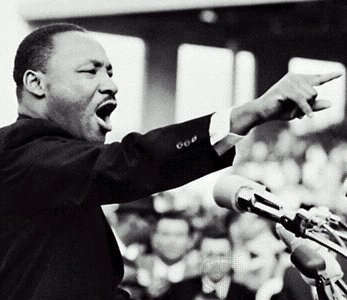 In 1995 Jeff Cohen and Norman Solomon of Fairness and Accuracy in Reporting (FAIR) wrote what I consider to be the best op-ed piece about Martin Luther King, Jr. ever written. "The Martin Luther King You Don't See On TV" demonstrates that television coverage of King ignores or minimizes the 1965-1968 period of his life, years in which he called for a radical restructuring of American society, an economic critique of American foreign policy and a call for removal of US troops from Vietnam, and "the most militant project of his life"--the Poor People's Campaign.
The toned-down, "I Have A Dream" King written about in the mainstream press and celebrated at countless events across the nation may help hypocritical representatives of established power clear their consciences, but in today's world it is the more militant King that is needed.
I teach Communication Studies (First Amendment, Classical Rhetoric, Civic Engagement, Rhetoric of Rock Music) at UW Oshkosh. Served two terms on Oshkosh City Council. Originally from Brooklyn, NY.
Sunday, January 15, 2006
Wisconsin's Road to Ruin, Part Deux
 The second of Patrick Marley's two part series on the ethics of road building in Wisconsin can be found here. Beginning with Tommy Thompson and now solidified under Jim The New Democrat Doyle and the Republican legislature, road building in Wisconsin is akin to what one might find in a banana republic. If you're a Wisconsinite, be sure to salute your new flag and be sure not to slip on the peels. Ready for a clean government candidate for governor?
I teach Communication Studies (First Amendment, Classical Rhetoric, Civic Engagement, Rhetoric of Rock Music) at UW Oshkosh. Served two terms on Oshkosh City Council. Originally from Brooklyn, NY.
The second of Patrick Marley's two part series on the ethics of road building in Wisconsin can be found here. Beginning with Tommy Thompson and now solidified under Jim The New Democrat Doyle and the Republican legislature, road building in Wisconsin is akin to what one might find in a banana republic. If you're a Wisconsinite, be sure to salute your new flag and be sure not to slip on the peels. Ready for a clean government candidate for governor?
I teach Communication Studies (First Amendment, Classical Rhetoric, Civic Engagement, Rhetoric of Rock Music) at UW Oshkosh. Served two terms on Oshkosh City Council. Originally from Brooklyn, NY.
Wisconsin's Road to Ruin
Perhaps no issue illustrates the corruption of state politics more than road building. Today Patrick Marley in the Milwaukee Journal Sentinel presents the first of two parts exposing the links between public transportation p0licy and road lobby campaign cash. Especially revealing is this graph showing how increases in state funds for road building between 1990 and 2003 outpaced the UW System and state parks. Major findings of the report include:
• Since 1994, political donations from road interests increased faster than contributions from other donors. The road builders' donations crossed party lines, usually favoring front-runners.
Probably the most shocking and disappointing comment in the Journal Sentinel is from Democratic state representative Spencer Black. He argues that increased road builder contributions are the result of how expensive campaigns have become, but then he concludes that "I don't believe there's any correlation between the contributions and the work." Spencer cannot really believe that, especially since he's been a long time clean government advocate and he must be aware of University of Michigan researcher Roland Zullo's study that showed a clear connection between size of campaign donation and awarding of state contracts from 1991-2000.


• Since 1994, political donations from road interests increased faster than contributions from other donors. The road builders' donations crossed party lines, usually favoring front-runners.
• While governors and the Legislature have funneled more money into road building, they have cut the number of employees who do engineering work, forcing the department to outsource that work to more expensive private firms. Employees of those firms often make political contributions.
• Dozens of DOT employees, including those in top positions, have left the department for jobs with those private companies. At least four former secretaries moved from the department's top post to jobs with engineering companies.
The Wisconsin Democracy Campaign has been exposing the influence peddling culture of Madison for a long time, revealing the road lobby connection to the Thompson administration long before the mainstream media had any interest in the topic. WDC's Graft Tax 2005 shows clearly the connections between cash and public policies that benefit not only road builders, but other powerful interests.Probably the most shocking and disappointing comment in the Journal Sentinel is from Democratic state representative Spencer Black. He argues that increased road builder contributions are the result of how expensive campaigns have become, but then he concludes that "I don't believe there's any correlation between the contributions and the work." Spencer cannot really believe that, especially since he's been a long time clean government advocate and he must be aware of University of Michigan researcher Roland Zullo's study that showed a clear connection between size of campaign donation and awarding of state contracts from 1991-2000.
I teach Communication Studies (First Amendment, Classical Rhetoric, Civic Engagement, Rhetoric of Rock Music) at UW Oshkosh. Served two terms on Oshkosh City Council. Originally from Brooklyn, NY.
Saturday, January 14, 2006
More On Underheim

UW Oshkosh Political Science Professor Jim Simmons makes some observatons for Gannett about why Mr. Underheim won't run for assembly in the fall. Cheryl Hentz (may need to register) says "Maybe Tony Palmeri should give it another whirl. Maybe now it's 'Time for Tony.'"
I teach Communication Studies (First Amendment, Classical Rhetoric, Civic Engagement, Rhetoric of Rock Music) at UW Oshkosh. Served two terms on Oshkosh City Council. Originally from Brooklyn, NY.
Friday, January 13, 2006
Underheim Won't Seek Re-Election
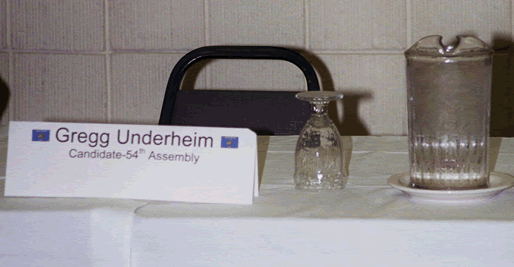
Ending months of speculation, Gregg Underheim announced today that he will not seek re-election to the 54th Assembly District in the fall. Let the politicing begin.
I teach Communication Studies (First Amendment, Classical Rhetoric, Civic Engagement, Rhetoric of Rock Music) at UW Oshkosh. Served two terms on Oshkosh City Council. Originally from Brooklyn, NY.
Paul Esslinger New Packers' Coach?

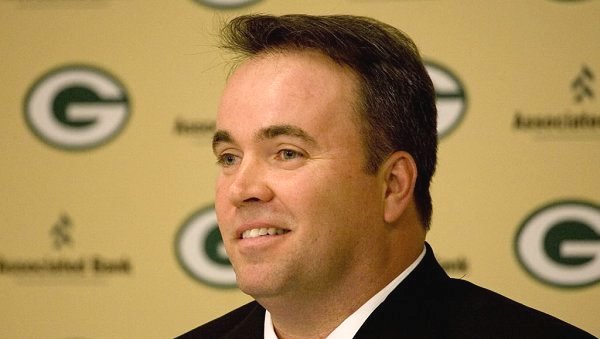

New Packers' head coach Mike McCarthy seems to bear a resemblance to Oshkosh Common Councilor Paul Esslinger. Maybe if the Packers have another losing season Paul's critics can blame him for that too.
I teach Communication Studies (First Amendment, Classical Rhetoric, Civic Engagement, Rhetoric of Rock Music) at UW Oshkosh. Served two terms on Oshkosh City Council. Originally from Brooklyn, NY.
Thursday, January 12, 2006
Steve Barney Letter To Council Candidates Re: KFC Cruelty
Below is a letter that Oshkosh citizen Steve Barney sent to each candidate for Oshkosh Common Council. In the letter, he asks the candidates to join a boycott of Kentucky Fried Chicken until the company adopts animal welfare requirements put in place by other fast food establishments like McDonald's and Burger King. The chicken served at KFC comes from the most horrific factory farm slaughterhouses imaginable, shameful conditions that are being opposed by a growing coalition of activists from different political persuasions including conservatives. For example, President Bush's former speechwriter Matthew Scully supports the KFC Boycott. I interviewed him on Radio Commentary. Take a listen here.
Mr. Barney will be holding a press demo outside the KFC on 1805 Jackson St. in Oshkosh on Martin Luther King Day (January 16th) from noon - 1 p.m. He aims to "make a strong statement to the press on the application of the ethical principle on which human equality rests, or The Golden Rule, to farmed animals - including chickens."
I think this is a perfectly legitimate issue to put before candidates for public office. If a candidate chooses to remain apathetic about an issue like this because it is "only chickens" that are suffering, or "we can't tell KFC how to run their business," such statements say much about the character of the candidate. Here is the letter:
Mr. Barney will be holding a press demo outside the KFC on 1805 Jackson St. in Oshkosh on Martin Luther King Day (January 16th) from noon - 1 p.m. He aims to "make a strong statement to the press on the application of the ethical principle on which human equality rests, or The Golden Rule, to farmed animals - including chickens."
I think this is a perfectly legitimate issue to put before candidates for public office. If a candidate chooses to remain apathetic about an issue like this because it is "only chickens" that are suffering, or "we can't tell KFC how to run their business," such statements say much about the character of the candidate. Here is the letter:
Dear Oshkosh City Council Candidates:
As a prominent community leader, please join the ethical community of
In the "McLibel Trial" of 1997, a court of law found McDonald’s to be
On the other hand, even though the KFC Corporation, as the world’s
As a frequent picketer outside the KFC restaurant in Oshkosh since
I teach Communication Studies (First Amendment, Classical Rhetoric, Civic Engagement, Rhetoric of Rock Music) at UW Oshkosh. Served two terms on Oshkosh City Council. Originally from Brooklyn, NY.
Dan Rylance on Friday Radio Commentary
 Local author/pundit Dan Rylance will be my guest on Radio Commentary this Friday at 6:15 p.m. on WRST 90.3 FM. We'll talk about the Common Council's referendum question vote, and get Dan's take on the elections coming up in April. Some of Dan's prior writings can be found here.
Shown in the photo is Dan and former Oshkosh Mayor Melanie Bloechl from March of 2002 appearing on the TV version of Commentary (co-hosted by former Oshkosh Mayor Jim Mather). Dan presented Melanie with a "Little Spender Award."
Feel free to post any questions or comments for Dan on this blog, or email me privately. (tony@tonypalmeri.com)
I teach Communication Studies (First Amendment, Classical Rhetoric, Civic Engagement, Rhetoric of Rock Music) at UW Oshkosh. Served two terms on Oshkosh City Council. Originally from Brooklyn, NY.
Wednesday, January 11, 2006
ABV Best and Worst Of 2005
Our friends over at the ABV Army Times have come up with a list of the local best and worst of 2005. Probably the funniest entry is ABV's identification of the spring elections of 2005 as the best AND worst display of local democracy. We learned last night that the most expensive Common Council in the history Oshkosh has members on it who have no problem bending rules when it comes to waiving bathroom bids, but when it comes to placing a controversial question on the April ballot (an act requiring 4 votes and no bending of rules) then rules need to be invented and interpreted in the most technical and narrow way possible. Can't wait to see the 6 councilors so upset with rule bending to call for accountability on the illegal bid waiving.
It's also hard to see how anyone could argue with ABV's selection of PMI to run the amphitheatre as the worst local decision of 2005.
Justin Mitchell is the editor of the ABV Army Times. Justin was named last year as one of Palmeri's 4 Under 40.
It's also hard to see how anyone could argue with ABV's selection of PMI to run the amphitheatre as the worst local decision of 2005.
Justin Mitchell is the editor of the ABV Army Times. Justin was named last year as one of Palmeri's 4 Under 40.
I teach Communication Studies (First Amendment, Classical Rhetoric, Civic Engagement, Rhetoric of Rock Music) at UW Oshkosh. Served two terms on Oshkosh City Council. Originally from Brooklyn, NY.
Tuesday, January 10, 2006
Narrow Technicality Wins, or, Death Goes On
Tonight the Oshkosh Common Council said "No" to placing a troop withdrawal referendum on the April ballot. I was becoming physically ill during Councilor Shirley Mattox's remarks (she was bothered by the fact that there are people who "relish the idea of three months of debate on this referendum") and so I left before the vote. I imagine it was 6-1 with only Paul Esslinger voting in favor.
Quite frankly, neither I nor anyone involved in the referendum movement were expecting anything different. Most politicians, when given the opportunity to reject something controversial on the basis of a narrow technicality, will use that basis every time. (Always backed up, of course, with grand speeches about how they are "upholding the rules." Yeah, right).
The narrow technicality here was the fact that petitioners did not receive the amount of signatures necessary to force direct legislation, even though it was pointed out repeatedly that confusion existed as to whether or not the city considered this item to be direct legislation. I know for a fact that when the city took the position that this was not direct legislation, there were people in the community who would not sign because they feared only a lawsuit would get the item on the ballot. They were hesitant to have to put the city in the position of facing a lawsuit in tough budget times.
In my remarks I pleaded with the Council that if they were going to reject the question, to reject it on grounds much stronger than a narrow technicality. We are, after all, dealing with a life and death issue here. I think that argument did resonate with a few of them, but to no one's surprise it was all to no avail.
The good news is that they seemed to all agree that if the petitioners were to try and do this again for the November ballot, a proper amount of signatures needed for direct legislation is all that is needed. The Council cannot vote it down at that point. (It was amusing to hear Councilor Bryan Bain say that if there are enough signatures to place it on the November ballot, he'd gladly vote for it then. Note to Bryan: your vote won't be needed if there are enough signatures. Your vote was needed tonight and you did not come through for narrow, technical reasons.)
Except for the brief bout with nausea I experienced during Mattox's remarks, I actually left the building feeling very good about the city of Oshkosh. When I arrived here in 1989, it was shortly before Bush #41's invastion of Panama. I remember at that time I could not find ONE PERSON in the community (though there were a few on the UW Oshkosh campus) interested in protesting the war. During Desert Storm of 1991, I had to take students down to Milwaukee and Madison because there was nothing going on up here.
It was difficult to imagine in the early 1990s that Oshkosh would become a safe place for peace rallies, social justice activism, and a debate about a troop withdrawal referendum in the City Council.
Long after politicians looking for narrow technicalities are gone and forgotten, the spirit of these citizens will live on. The narrowly technical politicians tonight simply delayed the inevitable.
When I left the building I found myself saying "Life goes on." But then as I walked home in the cold I thought that, given the horrors of war that our soldiers face while the politicians wait for a proper amount of signatures, it's more accurate to say Death Goes On.
Quite frankly, neither I nor anyone involved in the referendum movement were expecting anything different. Most politicians, when given the opportunity to reject something controversial on the basis of a narrow technicality, will use that basis every time. (Always backed up, of course, with grand speeches about how they are "upholding the rules." Yeah, right).
The narrow technicality here was the fact that petitioners did not receive the amount of signatures necessary to force direct legislation, even though it was pointed out repeatedly that confusion existed as to whether or not the city considered this item to be direct legislation. I know for a fact that when the city took the position that this was not direct legislation, there were people in the community who would not sign because they feared only a lawsuit would get the item on the ballot. They were hesitant to have to put the city in the position of facing a lawsuit in tough budget times.
In my remarks I pleaded with the Council that if they were going to reject the question, to reject it on grounds much stronger than a narrow technicality. We are, after all, dealing with a life and death issue here. I think that argument did resonate with a few of them, but to no one's surprise it was all to no avail.
The good news is that they seemed to all agree that if the petitioners were to try and do this again for the November ballot, a proper amount of signatures needed for direct legislation is all that is needed. The Council cannot vote it down at that point. (It was amusing to hear Councilor Bryan Bain say that if there are enough signatures to place it on the November ballot, he'd gladly vote for it then. Note to Bryan: your vote won't be needed if there are enough signatures. Your vote was needed tonight and you did not come through for narrow, technical reasons.)
Except for the brief bout with nausea I experienced during Mattox's remarks, I actually left the building feeling very good about the city of Oshkosh. When I arrived here in 1989, it was shortly before Bush #41's invastion of Panama. I remember at that time I could not find ONE PERSON in the community (though there were a few on the UW Oshkosh campus) interested in protesting the war. During Desert Storm of 1991, I had to take students down to Milwaukee and Madison because there was nothing going on up here.
It was difficult to imagine in the early 1990s that Oshkosh would become a safe place for peace rallies, social justice activism, and a debate about a troop withdrawal referendum in the City Council.
Long after politicians looking for narrow technicalities are gone and forgotten, the spirit of these citizens will live on. The narrowly technical politicians tonight simply delayed the inevitable.
When I left the building I found myself saying "Life goes on." But then as I walked home in the cold I thought that, given the horrors of war that our soldiers face while the politicians wait for a proper amount of signatures, it's more accurate to say Death Goes On.
I teach Communication Studies (First Amendment, Classical Rhetoric, Civic Engagement, Rhetoric of Rock Music) at UW Oshkosh. Served two terms on Oshkosh City Council. Originally from Brooklyn, NY.
Monday, January 09, 2006
Pray For Jill Carroll's Release
Jill Carroll, one of the finest freelance journalists working in Iraq, was recently kidnapped in Baghdad. Her interpreter was found murdered. The Committee To Protect Journalists is appealing for her release. The Christian Science Monitor, for which Carroll has been writing regularly since February of last year, provides more details on the abuction.
Much of Carroll's reporting in Iraq dealt with the deteriorating security situation of which she is now sadly a victim. In March of last year she wrote: "Two years after U.S. forces rolled into Iraq to depose Saddam Hussein . . . an aggressive insurgency has stymied crucial tasks of rebuilding and providing security, disillusioning ordinary Iraqis who thought the U.S. presence would bring rapid change."
In an April essay it is clear that she was aware of the dangers faced by Westerners in Iraq: "Another measure of the strength of the insurgency is how safe is it to be a Westerner on the street. Foreign women try to disguise themselves in Muslim head scarves, and foreign men grow beards. Walking the street isn't safe unless one blends in completely and foreigners cannot travel outside of Baghdad."
In her written tribute to Marla Ruzicka, the humanitarian slain in Iraq, Jill Carroll revealed her sympathy for the Iraqis in saying of Ruzicka that: "She would point out, this happens to Iraqis every day and no one notices or even cares. There are no newspaper articles or investigations into what happens to them."
Much of Carroll's reporting in Iraq dealt with the deteriorating security situation of which she is now sadly a victim. In March of last year she wrote: "Two years after U.S. forces rolled into Iraq to depose Saddam Hussein . . . an aggressive insurgency has stymied crucial tasks of rebuilding and providing security, disillusioning ordinary Iraqis who thought the U.S. presence would bring rapid change."
In an April essay it is clear that she was aware of the dangers faced by Westerners in Iraq: "Another measure of the strength of the insurgency is how safe is it to be a Westerner on the street. Foreign women try to disguise themselves in Muslim head scarves, and foreign men grow beards. Walking the street isn't safe unless one blends in completely and foreigners cannot travel outside of Baghdad."
In her written tribute to Marla Ruzicka, the humanitarian slain in Iraq, Jill Carroll revealed her sympathy for the Iraqis in saying of Ruzicka that: "She would point out, this happens to Iraqis every day and no one notices or even cares. There are no newspaper articles or investigations into what happens to them."
I teach Communication Studies (First Amendment, Classical Rhetoric, Civic Engagement, Rhetoric of Rock Music) at UW Oshkosh. Served two terms on Oshkosh City Council. Originally from Brooklyn, NY.
Paul Esslinger Radio Commentary Interview
You can find my Radio Commentary interview with Oshkosh Common Councilor Paul Esslinger here. We spent most of the approximately 35 minute interview talking about the Iraq Troop Withdrawal referendum.
I teach Communication Studies (First Amendment, Classical Rhetoric, Civic Engagement, Rhetoric of Rock Music) at UW Oshkosh. Served two terms on Oshkosh City Council. Originally from Brooklyn, NY.
Sunday, January 08, 2006
Stew's Reponse
Below is Stew Rieckman's response to my morning post. When getting past the vitriol and angst, the fact remains that Jepson's reporting on Carr is not credited in Hummel's front page story, nor is there any rationale provided as to why the online reporting on Carr can all be summarily dismissed as "sniping." If the Northwestern is really interested in "authenticating" blogosphere reports, failure to credit a key source and a dismissive attitude to boot cannot be considered acceptable. There is nothing for me to retract. Readers can judge for themselves who is the egomaniac here.--Tony
Dear Tony,
Dear Tony,
Post this or don't post this. I don't really care.
I am generally able to laugh off your rants as a product of your blind hatred of the Oshkosh Northwestern. But your well documented hatred has obviously affected your ability to be a useful, unbiased media critic. Further, it calls your academic credibility into question.
I have learned to accept you will never give the Northwestern credit for excellent journalism. You never commented on our trip to Thailand to cover the Hmong refugee crisis, or our report on the prison budget impact on the UW system, or a trip to Louisiana to cover local National Guard relief efforts, or an examination of the location of registered sex offenders in Oshkosh or the detailed reported on the impact of reassessment on the community or the report on charter schools in Wisconsin. Or any of the other enterprise and investigative stories our staff produces. None of that counts because of your hatred of the Northwestern.
Your recent accusations regarding the Northwestern's coverage of Father Carr are unfounded. First, my blog on Friday provided a direct link to Gary Jepson's blog and sites it as being the origins of the recent criticisms of Father Carr. My print column directs readers to my blog for more on the background of the Carr story. That absolutely contradicts your assertion.
Our print report on Carr advanced the story with an interview with Carr, (we like to tell both sides of story unlike yourself, Miles, Gary, et. al.) an interview with Byron Malsin of the Oshkosh Collaboration group, an interview with Kim Luke, case manager of the emergency shelter of the Fox Valley in Appleton, an interview with Eileen Connolly Keesler the head of the Oshkosh Area Community Foundation and an interview with Donna Lou Hertz, public
trust specialist for HUD.
The interview with Carr produced a previously unpublished list of "rules" he uses to operate his shelter.
If you would spend as much energy on research as you devote to your hatred of the Northwestern, you would have read the links to our archive of coverage of Father Carr before your vitriolic post today. It shows a balance of features and hard edge investigative reporting on Father Carr.
Had you taken the time to research your assertions, you would have found that Jeff Bollier covered the vacancy issue 12 months ago, before the League of Women Voters report. You would have found that Jim Collar reported in detail Father Carr's finances in a story in August 2003. It is the exact same report Miles cited on his post. The fact that we reported both first apparently has no standing in your criticism.
Reporting in 1997 by the Northwestern specifically detailed Carr's real estate dealings and financing, the community's concern about his operation and reference to his rules.
We even provided the links to the stories to make your research easier. I suspect you chose not to read the archives because it would have contradicted your hate inspired criticism of the Northwestern.
Do you have the courage to admit you overstated your criticism and retract it? I don't think you do. Your ego cannot stand an objective assessment of your intellectual honesty or an admission of being wrong. Hate the Northwestern if you must, but tell the truth even if you don't like what the truth shows. I thought university professors believed in that. I doubt
today's screed would pass peer review.
Regards,
Stewart Rieckman
Executive Editor
Oshkosh Northwestern
I teach Communication Studies (First Amendment, Classical Rhetoric, Civic Engagement, Rhetoric of Rock Music) at UW Oshkosh. Served two terms on Oshkosh City Council. Originally from Brooklyn, NY.
"Cyber Sniping" vs. Citation Etiquette
Stew Rieckman today derides as "cyber sniping" the web reporting on Father Martin Carr's Place 2B Shelter. Most of that reporting was done by Gary at This Week in Oshkosh, and includes this piece, as well as "No Room at the Inn," and "Wisconsin's Largest Homeless Shelter? Empty?"
While it may be true that some of the anonymous comments in response to Gary's reports crossed over into sniping range, the reports themselves tell the Carr story accurately and with the passion of some of the best muckraking journalism.
Meanwhile, Alex Hummel's report in today's Northwestern makes no mention of Gary's This Week in Oshkosh reports, nor any other web activity on this topic, such as the fact that I initially reported the League of Women Voters study (scroll down to Oshkosh topics) Hummel refers to and that Miles Maguire released Carr's tax returns.
I think I understand the game being played here. Rieckman has been using the term "authenticating" to describe the mainstream media's relationship to blogs and other web sources. But it seems like what is really going on is more complex and troublesome. The "authenticating" turns out to be an attempt to undermine the cyber sources by labeling them as "snipers" to readers who might never see them, and then to literally steal the reporting from those sources without proper attribution.
To authenticate a story means to cite it properly and then provide the information that supports and/or does not support the story. That is not what the Northwestern story on Carr does; instead it talks about nameless "critics." Then it proceeds to list those criticisms as if they reflect some kind of original reporting by the Northwestern. In fact there is very little original information provided in the Northwestern story save for the interview with Carr. Not being a journalism professor, I don't know if the story could be called plagiarism. Perhaps Miles Maguire might know.
Professor Maguire last year complained of the Northwestern's lack of journalistic "etiquette" in stealing web information without giving proper credit. I think it is time to revisit that complaint, and time for those us in the blogosphere to be more vigilant in learning what are our rights in these areas. Blogging cannot and must not become a way for the Gannett Corporation to get reporting and research done for free. That would be a travesty.
While it may be true that some of the anonymous comments in response to Gary's reports crossed over into sniping range, the reports themselves tell the Carr story accurately and with the passion of some of the best muckraking journalism.
Meanwhile, Alex Hummel's report in today's Northwestern makes no mention of Gary's This Week in Oshkosh reports, nor any other web activity on this topic, such as the fact that I initially reported the League of Women Voters study (scroll down to Oshkosh topics) Hummel refers to and that Miles Maguire released Carr's tax returns.
I think I understand the game being played here. Rieckman has been using the term "authenticating" to describe the mainstream media's relationship to blogs and other web sources. But it seems like what is really going on is more complex and troublesome. The "authenticating" turns out to be an attempt to undermine the cyber sources by labeling them as "snipers" to readers who might never see them, and then to literally steal the reporting from those sources without proper attribution.
To authenticate a story means to cite it properly and then provide the information that supports and/or does not support the story. That is not what the Northwestern story on Carr does; instead it talks about nameless "critics." Then it proceeds to list those criticisms as if they reflect some kind of original reporting by the Northwestern. In fact there is very little original information provided in the Northwestern story save for the interview with Carr. Not being a journalism professor, I don't know if the story could be called plagiarism. Perhaps Miles Maguire might know.
Professor Maguire last year complained of the Northwestern's lack of journalistic "etiquette" in stealing web information without giving proper credit. I think it is time to revisit that complaint, and time for those us in the blogosphere to be more vigilant in learning what are our rights in these areas. Blogging cannot and must not become a way for the Gannett Corporation to get reporting and research done for free. That would be a travesty.
I teach Communication Studies (First Amendment, Classical Rhetoric, Civic Engagement, Rhetoric of Rock Music) at UW Oshkosh. Served two terms on Oshkosh City Council. Originally from Brooklyn, NY.
Saturday, January 07, 2006
Kunstler's Eyesore of the Month
 James Howard Kunstler, whom I interviewed recently on Radio Commentary, sees in Las Vegas a metaphor for what he claims Americans have become: "a nation of slobs, clowns, patsies, and cravens."
At least Vegas provided Elvis with a catchy tune.
I teach Communication Studies (First Amendment, Classical Rhetoric, Civic Engagement, Rhetoric of Rock Music) at UW Oshkosh. Served two terms on Oshkosh City Council. Originally from Brooklyn, NY.
Friday, January 06, 2006
Palmeri v. Petak
My "Week in Review" discussion with former State Senator George Petak can be found here. It was a mostly polite discussion, with some very intelligent calls. The only tense banter (and it was quite mild, really), was when Petak advocated more nuclear power as a solution to our energy needs and I asked him if he would be willing to have the nuclear waste put in his neighborhood. He argued that was not a good reason for rejecting nuke power, but on the other hand he never quite came out and said that nuclear waste in his back yard would be okay. On the other hand, at least he doesn't pronounce it as "nuke-you-ler". (I realize that the last "on the other hand" makes three hands in this paragraph--probably a subconscious reflection of my fear that an enhanced nuke powered Wisconsin could lead to the births of the three handed bloggers).
I spent the majority of the program trying to argue that there currently is not a clean government candidate in the governor's race, and that the public will support such a candidate should he or she get into the race.
I am still leaning heavily against running for governor, but I have to say that the business as usual triumvirate of Doyle, Green, and Walker is making it very difficult to rule out a run.
I spent the majority of the program trying to argue that there currently is not a clean government candidate in the governor's race, and that the public will support such a candidate should he or she get into the race.
I am still leaning heavily against running for governor, but I have to say that the business as usual triumvirate of Doyle, Green, and Walker is making it very difficult to rule out a run.
I teach Communication Studies (First Amendment, Classical Rhetoric, Civic Engagement, Rhetoric of Rock Music) at UW Oshkosh. Served two terms on Oshkosh City Council. Originally from Brooklyn, NY.
Thursday, January 05, 2006
Ellis: no one is more to blame for the death of campaign finance reform in Wisconsin than Governor Jim Doyle
Feeling the heat from federal, Dane County, and attorney general investigations slowly but surely uncovering the sleazy nature of the guv's fundraising efforts, Jim the New Democrat Doyle today got behind campaign reform efforts he claimed to be “the most comprehensive ethics reform package to be introduced in Wisconsin in more than three decades." Senator Mike Ellis immediately debunked Doyle's campaign season smokescreen, saying accurately that “The only reason Governor Doyle is now coming out in support of even this tepid reform package is so that he can cover his butt now that he’s under the microscope for alleged ethical lapses. ”
Ellis went further:
"Suddenly, in an election year, when he is being investigated by the U.S. Attorney’s Office, the Federal Bureau of Investigation and the state Justice Department, the governor gets religion and starts to pose for holy pictures. Give me a break.”
Sounds like Mike Ellis might be ready to give Ed Thompson a call.
Ellis went further:
"Suddenly, in an election year, when he is being investigated by the U.S. Attorney’s Office, the Federal Bureau of Investigation and the state Justice Department, the governor gets religion and starts to pose for holy pictures. Give me a break.”
Sounds like Mike Ellis might be ready to give Ed Thompson a call.
I teach Communication Studies (First Amendment, Classical Rhetoric, Civic Engagement, Rhetoric of Rock Music) at UW Oshkosh. Served two terms on Oshkosh City Council. Originally from Brooklyn, NY.
Listen to Friday WPR "Week in Review"
I'm going to be the "liberal" on tomorrow's Wisconsin Public Radio "Week in Review" from 8 a.m. to 9 a.m. The "conservative" will be George Petak, former Wisconsin State Senator most known for being the deciding vote in favor of the Miller Park corporate welfare scam and getting himself recalled as a result.
I think at least some of the discussion will be about corruption in Washington and Madison. If you have thoughts about those topics that you would like to share, please pass 'em on! --Tony
I think at least some of the discussion will be about corruption in Washington and Madison. If you have thoughts about those topics that you would like to share, please pass 'em on! --Tony
I teach Communication Studies (First Amendment, Classical Rhetoric, Civic Engagement, Rhetoric of Rock Music) at UW Oshkosh. Served two terms on Oshkosh City Council. Originally from Brooklyn, NY.
Wednesday, January 04, 2006
Don't Gotcha Journalism
Yesterday, Stew Rieckman told Michelle Monte that the Oshkosh Northwestern is not interested in "Gotcha" journalism (scroll down). Ron Heilmann, Jane Van De Hey, Joe Maehl, and LuAnn Bird will be happy to know that.
Today readers of the print version of the Oshkosh Northwestern saw a new kind of journalism on page one above the fold: DON'T GOTCHA JOURNALISM. The page featured pictures of 7 of the 9 candidates for Oshkosh Common Council. Missing were the two female candidates, Michelle Bodgen and Mary Meyst.
No doubt if Meyst or Bogden were to inquire why the absence of their faces from the page, they would be told that "we don't gotcha pictures on file."
Now I'm sure we all agree that it is a candidate's responsibility to provide the press with photos, and Bogden and Meyst should know that they are going to have to be twice as good just to be treated equally in this race by an old boy MSM establishment. But in this electronic age, when Meyst and Bogden could have emailed a jpeg file to the editors almost immediately, would it have been too much trouble for the paper to request photos from them? Or let them know, when they took out papers indicating an intention to run, that front page pictures would be running?
For all I know the paper requested pictures and the candidates refused to provide them, or the paper invited them to have their pictures taken at the Northwestern and they refused. But it sure looks like a case of Don't Gotcha journalism.
Today readers of the print version of the Oshkosh Northwestern saw a new kind of journalism on page one above the fold: DON'T GOTCHA JOURNALISM. The page featured pictures of 7 of the 9 candidates for Oshkosh Common Council. Missing were the two female candidates, Michelle Bodgen and Mary Meyst.
No doubt if Meyst or Bogden were to inquire why the absence of their faces from the page, they would be told that "we don't gotcha pictures on file."
Now I'm sure we all agree that it is a candidate's responsibility to provide the press with photos, and Bogden and Meyst should know that they are going to have to be twice as good just to be treated equally in this race by an old boy MSM establishment. But in this electronic age, when Meyst and Bogden could have emailed a jpeg file to the editors almost immediately, would it have been too much trouble for the paper to request photos from them? Or let them know, when they took out papers indicating an intention to run, that front page pictures would be running?
For all I know the paper requested pictures and the candidates refused to provide them, or the paper invited them to have their pictures taken at the Northwestern and they refused. But it sure looks like a case of Don't Gotcha journalism.
I teach Communication Studies (First Amendment, Classical Rhetoric, Civic Engagement, Rhetoric of Rock Music) at UW Oshkosh. Served two terms on Oshkosh City Council. Originally from Brooklyn, NY.
Nearly 250 Tax Deadbeats From Fox Valley
Nearly 250 tax deadbeats are from the Fox Valley, including two elected officials, according to the Post-Crescent.
I teach Communication Studies (First Amendment, Classical Rhetoric, Civic Engagement, Rhetoric of Rock Music) at UW Oshkosh. Served two terms on Oshkosh City Council. Originally from Brooklyn, NY.
Tuesday, January 03, 2006
Tax Deadbeats Online
The Wisconsin Department of Revenue is now posting on its website the names of all delinquent taxpayers who owe more than $25,000. The full list is here.
Among the top 100 tax deadbeats, I only found one name from Oshkosh. He is Eugene Dadas, who owes $515, 435. (enough for a couple of floating docks). --Tony
Among the top 100 tax deadbeats, I only found one name from Oshkosh. He is Eugene Dadas, who owes $515, 435. (enough for a couple of floating docks). --Tony
I teach Communication Studies (First Amendment, Classical Rhetoric, Civic Engagement, Rhetoric of Rock Music) at UW Oshkosh. Served two terms on Oshkosh City Council. Originally from Brooklyn, NY.
Green Party Release on Tainted Guv Candidates
Ruth Weill, Co-chair, Wisconsin Green Party, 414-562-6097 or 414-350-2107, spokespersons@wisconsingreenparty.org
Bob Poeschl, Co-chair, Wisconsin Green Party, 920 312-0529, spokespersons@wisconsingreenparty.org
Jim Doyle, Scott Walker, Mark Green too Tainted to Lead to Clean Government, say
Governor rejects special session on campaign finance reform
Jim Doyle, who has been charged with being influenced by contributions from Indian tribes, Adelman Travel executives, and those who urged the Public Service Commission's approval of the sale of the Kewaunee nuclear power plant, recently decided against calling a special legislative session on campaign finance reform.
“People want clean government,” said Ruth Weill, Co-chair of the Wisconsin Green Party. “Although our
The Wisconsin Green Party advocates for public financing of campaigns, and public airtime for candidates. Wisconsin Green Party candidates do not accept money from PAC’s.
“It is clear that money is corrupting our system. Therefore, we need to reform our election system to eliminate corrupting influences,” said Weill.
A recent nationwide Associated Press/IPSOS poll showed that 88% of those polled felt that political corruption is a very or somewhat serious problem. A poll conducted by the St. Norbert College Survey Center for Wisconsin Public Radio stated that political corruption is one of the most common answers people gave when asked to identify the most important problem facing the state of
“It must be hard for someone like Mark Green, who rose up through the Wisconsin legislative ranks at the same time as the caucus scandals got their start, to show leadership in bringing clean government to our state,” said Bob Poeschl, Co-chair of the Wisconsin Green Party.
Mark Green has taken money with connections to Tom DeLay, who was indicted for corruption. The three Republican and Democratic candidates for governor, Scott Walker, Mark Green, and Jim Doyle, have accepted nearly $23,000 since 2003 from Illinois contributors who have been convicted or indicted of extortion, fraud, bribery or other crimes, or who are connected to state and federal criminal investigations, the Wisconsin Democracy Campaign has found. Milwaukee County Executive Scott Walker, a Republican candidate for governor, recently returned $325 in campaign contributions to executives of a company that won a $250,000 no-bid county contract.
“We need a candidate for the 2006 governor’s race that stands for clean government,” said Tony Palmeri, a Wisconsin Green who ran for Assembly in 2004. “So far, the field is empty.”
The Wisconsin Green Party is affiliated with the Green Party of the
I teach Communication Studies (First Amendment, Classical Rhetoric, Civic Engagement, Rhetoric of Rock Music) at UW Oshkosh. Served two terms on Oshkosh City Council. Originally from Brooklyn, NY.
Monday, January 02, 2006
How About An Ed Thompson-Mike Ellis "Co-Governorship?"
Looks like swashbuckling Republican Senator Mike Ellis, once an establishment type of guy who's garnered a reputation as a reformer largely on the basis of his campaign finance and elections/ethics board reform bills, believes that he could beat Jim The New Democrat Doyle in a general election, but won't have the necessary funds to get past Scooter Walker and Mark DeLay Green in a Republican Primary.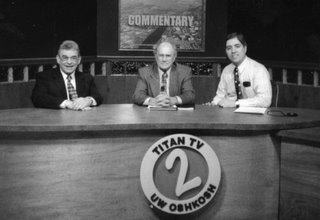
Libertarian Ed Thompson, Tommy's bro, earned 10% of the vote in 2002 and probably would have beat Scott McCallum in a Republican primary had he decided to go that route. Ed had an outstanding running mate in 2002, former Democratic state representative Marty Reynolds (probably the only real maverick in the state legislature in the late 1990s and early part of this decade). But few people outside of Ladysmith and Madison really knew Marty, and given that Lt. Governor candidates are typically ignored by the mainstream press, his impact on the ticket was negligible.

Mike Ellis is much more well-known than Marty Reynolds, and Ed Thompson is still somewhat of a celebrity around the state. What if the two of them ran as a team, on an independent ticket, with one of them formally taking the governor title but running on a kind of "co-governorship" platform? Thompson and Ellis together would have a great appeal to voters of all political persuasions, and especially the growing majority who think what's most needed are some mavericks to clean up the corruption.
Anyone old enough to remember the Republican presidential convention of 1980 will recall that there was some talk of Ronald Reagan selecting Gerald Ford as his running mate. Ford said he would do it but only if it was a kind of "co-presidency" deal. The idea died and ultimately Reagan won in a landslide with George H.W. Bush on the ticket.
I think Wisconsin voters are in the mood for something new to shake up the cronyism, inertia, and corruption represented by the establishment parties. A Thompson-Ellis co-candidacy would really shake up the election season.

Libertarian Ed Thompson, Tommy's bro, earned 10% of the vote in 2002 and probably would have beat Scott McCallum in a Republican primary had he decided to go that route. Ed had an outstanding running mate in 2002, former Democratic state representative Marty Reynolds (probably the only real maverick in the state legislature in the late 1990s and early part of this decade). But few people outside of Ladysmith and Madison really knew Marty, and given that Lt. Governor candidates are typically ignored by the mainstream press, his impact on the ticket was negligible.

Mike Ellis is much more well-known than Marty Reynolds, and Ed Thompson is still somewhat of a celebrity around the state. What if the two of them ran as a team, on an independent ticket, with one of them formally taking the governor title but running on a kind of "co-governorship" platform? Thompson and Ellis together would have a great appeal to voters of all political persuasions, and especially the growing majority who think what's most needed are some mavericks to clean up the corruption.
Anyone old enough to remember the Republican presidential convention of 1980 will recall that there was some talk of Ronald Reagan selecting Gerald Ford as his running mate. Ford said he would do it but only if it was a kind of "co-presidency" deal. The idea died and ultimately Reagan won in a landslide with George H.W. Bush on the ticket.
I think Wisconsin voters are in the mood for something new to shake up the cronyism, inertia, and corruption represented by the establishment parties. A Thompson-Ellis co-candidacy would really shake up the election season.
I teach Communication Studies (First Amendment, Classical Rhetoric, Civic Engagement, Rhetoric of Rock Music) at UW Oshkosh. Served two terms on Oshkosh City Council. Originally from Brooklyn, NY.
Sunday, January 01, 2006
How Many More?
Below is a list of the Wisconsinites killed in Iraq as of January 1, 2006.
On January 10 the Oshkosh Common Council will have the opportunity to let the citizens have a say as to whether it is time to bring the troops home. The city attorney, who earlier claimed that the referendum question was not a matter of direct legislation and only 4 council votes could place it on the ballot regardless of how many petitions were gathered, now claims that had the petitioners collected enough signatures the question would have automatically been placed on the ballot. (The petitioners collected almost 2,000 signatures, not enough for direct legislation but a huge amount regardless; additionally, Oshkosh citizen Doug Boone collected close to 3,000 signatures in opposition to the war over the summer before the beginning of the referendum drive).
Thus the city attorney has provided the Common Council with a narrow technicality on which to reject the referendum question. I think each member of the council should ask him or herself, before voting on January 10th, whether the best way to honor the fallen fifty is to resort to narrow technicalities.
On January 10 the Oshkosh Common Council will have the opportunity to let the citizens have a say as to whether it is time to bring the troops home. The city attorney, who earlier claimed that the referendum question was not a matter of direct legislation and only 4 council votes could place it on the ballot regardless of how many petitions were gathered, now claims that had the petitioners collected enough signatures the question would have automatically been placed on the ballot. (The petitioners collected almost 2,000 signatures, not enough for direct legislation but a huge amount regardless; additionally, Oshkosh citizen Doug Boone collected close to 3,000 signatures in opposition to the war over the summer before the beginning of the referendum drive).
Thus the city attorney has provided the Common Council with a narrow technicality on which to reject the referendum question. I think each member of the council should ask him or herself, before voting on January 10th, whether the best way to honor the fallen fifty is to resort to narrow technicalities.
- Amherst: Uhl III, Eugene A. Specialist 15-Nov-2003
- Beaver Dam: Straseskie, Kirk Allen Sergeant 19-May-2003
- Beaver Dam: Cantafio, Ryan J. Private 1st Class 25-Nov-2004
- Black Creek: Eacho, Donald W. Sergeant 1st Class 04-Mar-2005
- Brookfield: Schram, Matthew E. Major 26-May-2003
- Calendonia: Wyatt, Daniel R. Lance Corporal 12-Oct-2004
- Casco: Thiry, Jesse L. Corporal 05-Apr-2004
- Cleveland: Kiser, Charles A. Staff Sergeant 24-Jun-2004
- Clintonville: Hansen, Warren S. Sergeant 15-Nov-2003
- Columbus: Kurth, John F. "Hans" Captain 13-Mar-2004
- DeForest: O'Donnell, Shane K. Lance Corporal 08-Nov-2004
- Ellsworth: Hoyer, Bert Edward Private 1st Class 10-Mar-2004
- Fairchild: Kaufman, Charles A. Specialist 26-Jun-2005
- Fond du Lac: Tollefson, John O. Specialist 27-Jul-2005
- Fountain City: Bossert, Andrew L. Sergeant 07-Mar-2005
- Grant: Halverson, Andrew Private 1st Class 09-Oct-2004
- Green Bay: Edinger, Benjamin C. Sergeant 23-Nov-2004
- Hudson: Smith, Benjamin A. Specialist 02-Nov-2005
- Janesville: Schneider, Sean M. Private 1st Class 29-Mar-2004
- Lena: Frye, Nichole M. Private 1st Class 16-Feb-2004
- Loyal: Olson, Todd D. Staff Sergeant 27-Dec-2004
- Madison: Maida, Mark A. Sergeant 27-May-2005
- Madison: Kading, Matthew R. Sergeant 1st Class 31-Oct-2005
- Mayville: Wendling, Michael J. Specialist 26-Sep-2005
- Menomonie: Wolfe, Jeremy L. 2nd Lieutenant 15-Nov-2003
- Milwaukee: McGlothin, Michael A. Specialist 17-Apr-2004
- Milwaukee: Soltau, Adrian V. Corporal 13-Sep-2004
- Monona/Madison: Simon, Chad J. Staff Sergeant 04-Aug-2005
- New Berlin: Witmer, Michelle M. Specialist 09-Apr-2004
- Oneida: Jerabek, Ryan M. Private 1st Class 06-Apr-2004
- Oshkosh: Vroman, Brent T. Private 1st Class 13-Dec-2004
- Oshkosh: Jansky, Benjamin D. Captain 27-Jul-2005
- Oshkosh: Wallace, Andrew P. Sergeant 26-Sep-2005
- Platteville: Splinter, Christopher J. Major 24-Dec-2003
- Plum City: Diesing, Trevor J. Sergeant 1st Class 25-Aug-2005
- Racine: Poelman, Eric J. Specialist 05-Jun-2005
- Rice Lake: Sturino, Paul J. Specialist 22-Sep-2003
- Sheboygan: Prening, Brian P. Corporal 12-Nov-2004
- Sparta: Gaunky, Anthony Alexander "Alex" Private 1st Class 18-Nov-2005
- Spooner: Gabrielson, Dan H. Sergeant 1st Class 09-Jul-2003
- Stevens Point: Mattek Jr., John J. Lance Corporal 13-Jun-2005
- Suamico (Green Bay): Hunt, Isaiah R. Private 1st Class 15-Nov-2004
- Sun Prairie: Scott, Joshua Michael Chief Warrant Officer (CW2) 27-May-2005
- Tomah: Stevens, Andy A. Sergeant 01-Dec-2005
- Waukesha: Warner, Richard D. Lance Corporal 13-Dec-2004
- Waukesha: Warns II, Robert P. Corporal 08-Nov-2004
- Waupun: Bosveld, Rachel K. Private 1st Class 26-Oct-2003
- Wausau/Rhinelander: Martin, Stephen G. Staff Sergeant 02-Jul-2004
- West Bend: Cornell, Todd R. Staff Sergeant 09-Nov-2004
- West Bend: Wichlacz, Travis M. Lance Corporal 05-Feb-2005
I teach Communication Studies (First Amendment, Classical Rhetoric, Civic Engagement, Rhetoric of Rock Music) at UW Oshkosh. Served two terms on Oshkosh City Council. Originally from Brooklyn, NY.
Subscribe to:
Posts (Atom)