Sunday, February 03, 2013

Censored in 2012

Censored in 2012 

Media Rants 

by Tony Palmeri 
from the February 2012 issue of The SCENE 

Since 1976 Project Censored has examined news stories "underreported, ignored, misrepresented, or censored in the United States.” Walter Cronkite once said that “Project Censored is one of the organizations that we should listen to, to be assured that our newspapers and our broadcasting outlets are practicing thorough and ethical journalism.” 

Censored2013 (Seven Stories Press) identifies signs of an emerging police state, oceans in peril, Fukishima nuclear disaster worse than expected, FBI agents responsible for majority of terrorist plots in the US, and First Federal Reserve audit reveals trillions loaned to major banks as the five most censored stories of 2012. We do have to give the national press credit keeping us all up to date on celebrity pregnancies, beating the fiscal cliff to death, and making “Gangnam Style” part of the international vocabulary (while minimizing the song’s subversive message).
 
Closer to home, establishment media now pretend a “local” approach to reporting and commentary that they say features rigorous investigative journalism. Paradoxically, establishment media consumers seem to know less about their local communities than ever before. The reason is that the “local” angle is often mindless cheerleading for pet commercial projects, feel good human interest stories, and shallow coverage of municipal and county government. We know even less about what’s going on statewide and nationally since the lite localism crowds out most everything else.

Given the above, if we take Project Censored’s approach to the news then just about every story worth caring about is censored around here. Below are a few of what were worthy of more and/or much better coverage in 2012.

Censoring Third Parties. Legitimate alternatives to Barack Obama and Mitt Romney could not get a fair hearing in the establishment press. Despite the media shutout, Gary Johnson received more votes than any prior Libertarian Party candidate. The Green Party’s Jill Stein received more votes than any female general election presidential candidate in history. Imagine what Johnson and Stein could have accomplished  with a more ethical media in place?


What“We” Pay. Gannett Wisconsin Media’s “hard hitting” investigative journalism includes publishing public employee salary data, some of which (e.g. UW System employees) is already available. No doubt wide release of such data is appropriate and necessary. But obtaining and releasing the data is the easy part; what’s difficult is ascertaining what the data mean. As UW Oshkosh Professor Paul Van Auken noted in a letter to the Oshkosh Northwestern, at least as regards UW salaries it’s problematic to talk about what “we” pay when taxpayers fund less than 20 percent of the budget. In other words the real stories, the censored stories, are (1) the excessive burdens now placed on students and their families to pay for higher education, and (2) the fact that the UW is almost at the point of no longer being able to call itself a “public” institution. 

Wisconsin’s Inequality Gap. The nonpartisan Center on Wisconsin Strategy’s “Wisconsin Budget Project”is exactly the kind of methodical, insightful analysis of budget data that the establishment media are now unwilling or not able to do. COWS analyzed Department of Revenue numbers revealing that between 1996 and 2010, the bottom 40 percent of income earners in the state saw their income drop by $2,407 while the richest 1 percent actually had their income rise by $168,773. How is that not a story worth telling over and over again until policy makers do something about it?

So Much From So Few. According to the Wisconsin DemocracyCampaign, just over 2% of our adult population makes campaign contributions in state elections. The fact that the number is 1% in many other states is no silver lining. As usual, WDC Executive Director Mike McCabe hit the nail on the head: “For many years, our nation's motto was E Pluribus Unum. Out of many, one. Now it's more like E Pauci Nimis. Out of a few, too much.”  On a side note, please go to this website today to find out how you can help WDC.
The Trial of Bradley Manning. I was raised during the Cold War, a time when American leaders in the political and press establishments repeatedly told us that the Soviet Union had to be defeated in part because of their intolerance toward dissenters and whistleblowers. Dissidents end up in the Gulag camps, we were told.  
The American media’s failure to give prominence to the principles at stake in the trial of Army private Bradley Manning, the soldier accused of releasing classified documents to the whistleblowing website WikiLeaks, is Soviet like in its cave in to state power. Indeed, the New York Times own public editor Margaret Sullivan found it bizarre that the “paper of record” did not even send a reporter to cover the first eight days of Manning’s pretrial hearing. Sullivan argues that the Times had an obligation to be there not just because the testimony exposed the terrible mistreatment of Manning in prison, but also because the documents released to WikiLeaks have provided the Times (and numerous other media sources) with tons of stories.

For readers wishing to keep track of stories marginalized and/or mangled by the mainstream media, I recommend: The International Consortium of Investigative Journalists (www.publicintegrity.org), Wisconsin Center For Investigative Journalism (www.wisconsinwatch.org), ProPublica (www.propublica.org), and World Public Opinion (www.worldpublicopinion.org), and DemocracyNow! (www.democracynow.org)

Wednesday, January 02, 2013

Media Rants: The 2012 Tony Awards

The 2012 Tony Awards

From the January 2013 edition of The SCENE

It’s time for Media Rants’ annual Tony (Palmeri) awards for excellence in Fox Valley media. This year’s awards column is dedicated to the late Robert Jungwirth, former Oshkosh mayor who passed away in early December. A champion of the working class, Jungwirth’s presence as mayor in 1992 so offended the Oshkosh old boy “progressive” establishment that they maneuvered successfully to have him removed from the position. The Oshkosh Northwestern editorially lambasted the “Joe Lunchbuckets” like Jungwirth who got in the way of the establishment’s definition of “progress.” After losing subscribers the paper was forced to apologize.

I had the opportunity to interview Bob Jungwirth on television and speak with him on occasion. His standing up for the little guy, staring down the stale establishment, and sticking to his principles will be sorely missed.

And now the 2012 Tony Awards. Drum roll please.

Excellence in Print Journalism: Ben Jones of the Appleton Post Crescent. Mr. Jones earned a Tony last year for his excellent reporting on the capitol protests against Scott Walker. In an era when the corporate press cuts corners and dumbs down important issues at almost every turn, it’s rare to find a journalist like Jones who writes readable stories rigorously promoting openness and transparency in government. Two of his most noteworthy pieces in 2012 were Transparency on Wisconsin spending still lacking after six years” (March 10) and “$100 million inbusiness tax credits, but at what cost?” (Dec. 1).

Outstanding Sports Broadcasts: Bob Burnell. In 2012 the UW Oshkosh football team came within one game of making it to the Division III championship round. During the Titans’ thrilling playoff run, I found myself eagerly looking forward to listening to the games on WOSH 1490 AM. Bob Burnell’s broadcasting was truly outstanding. Alone in the booth, he called play by play and offered commentary in ways every bit as professional and enthusiastic as the best of Division I and NFL announcing.

Best New Newsletter: Wisconsin Veterans For Peace. In November I was honored to moderate a panel that included Zach LaPorte and David Heller, two courageous Iraq War veterans now active members of the organization Iraq Veterans Against the War (IVAW). The organization had its first ever statewide meeting in Neillsville last fall, and one result was the creation of a grassroots newsletter. (not yet online). The first issue identifies five IVAW action areas: (1) Raising awareness of drones in WI, (2) Engaging in coordinated Truth in Recruiting events, (3) Pressuring politicians who vote for and support war spending, (4)  Focus on offering human services to veterans in all Wisconsin localities, (5) Push “Bring Our War Dollars Home” resolutions in city and town councils. For more information, contact IVAW Communications Coordinator Matt Howard at mattwhoward@ivaw.org

Outstanding Election Night Coverage: WRST FMOn election night in northeast Wisconsin, anyone who didn’t feel like watching the likes of Karl Rove and Bill O’Reilly make utter fools of themselves on Fox News with their hysterical reactions to Barack Obama’s victory had a wonderful local alternative. UW Oshkosh student radio station WRST FM provided an evening of rational, calm, focused, insightful analysis of all the major state and national races. Student hosts conducted a series of wide ranging interviews with a variety of expert guests, politicians and pundits. Kudos to WRST Director of Radio Services Randall Davidson for his efforts aimed at working with students to make WRST a place for civic engagement.

Up and Coming Media Star: Tanya Krueger. A disability rights activist, author, and motivational speaker, Tanya Krueger has spent much of her life rising above adversity. Her website (http://www.tanyakrueger.com) includes some awesome blog posts and podcasts. Tanya took a few classes with me at UW Oshkosh a few years ago, and at that time I had the sense that she was on a mission to use media in ways that could empower herself and others. In 2012 she showed every sign of becoming a media force to be reckoned with. Do yourself a favor and see Tanya speak at the Appleton Public Library on January 14th from 4 to 5 pm on the topic of “Disabled Bodies, Able Minds.” You won’t be disappointed.

Promising New Publication: The Oshkosh SCENE. The SCENE for years has been a breath of fresh air in regions of Wisconsin saturated with mostly mediocre corporate media. Over the last ten years I’ve had the privilege of working with two great editors, Tom Breuer and Jim Lundstrom, both of whom encourage irreverence and outside the box thinking (two things that are the essence of independent media).
In 2012 the SCENE expanded into Oshkosh, and the results have been promising. Editor Justin Mitchell goes out of his way to make the publication a community asset and provide writers with guidance. Featuring primarily local writers, well written cover stories, lots of event announcements, and excellent graphics, the SCENE is indeed a community asset in its first year. Go to Facebook and Like the Oshkosh SCENE today!
Like all new publications the Oshkosh SCENE is still in the process of “finding its voice.” Does it want to be an Oshkosh cheerleader? A complement to the establishment media or a challenger of it? A forum for irreverence and outside the box thinking? Something else? We’ll see.

Congratulations to all Tony Award winners!

Tuesday, December 18, 2012

Politics and Guns

Wisconsin's 2010 US Senate race between then incumbent Democrat Russ Feingold and eventual winner Republican Ron Johnson provided a good example of why little progress on gun safety is likely to happen in the current political environment.

In June of 2010, then candidate Johnson was asked by a Tea Party group what kind of gun restrictions he might support. As we might expect from any decent human being with common sense, Johnson gave a perfectly reasonable response: "You know, like we license cars and stuff, I don't have a real, I don't have a real problem in minimal licensing and stuff. I mean I don't."

New to politics, Johnson had not a clue as to the extent to which the gun lobby controls (this is the real "gun control") the modern Republican Party. He was forced to retract the comments, said he used the "wrong word," and by July of 2012 he was framing ownership of high capacity clips and magazines as a constitutional right.  In other words, by July of 2012 Johnson on the issue of gun safety had become just one more hack Republican: no resolve to do anything about the problem, no courage to stand up to extreme elements of the gun lobby; talk of licensing now a distant memory.

But I don't think anyone, including Republicans, ever expected much more than party hackery from RoJo on most issues. What was more disturbing, rather, was Feingold's response at the time of Johnson's 2010 pro-licensing comment. The campaign put out a radio ad attacking Johnson, with Feingold saying "I approve this message because you shouldn't have to wait in line at the DMV to get a license for your constitutional rights and freedoms." That was the Democrat.

After Johnson flip-flopped and groveled at the feet of the NRA, the Feingold campaign said, "Russ Feingold has never needed a do-over when it comes to opposing gun registration." That was the Democrat.

In essence, Feingold was attempting to run to the right of Johnson on gun control. This was not unique to Feingold; since guns became a wedge issue in the 1980s, the typical Democratic response has been to "position" themselves in ways that might maintain the party base while not alienating independents.

The result? The so-called gun debate in the United States, when it does happen (usually after horrific tragedies like Columbine, Virgina Tech, Aurora, and Newtown), is skewed way to the right. Policy items like licensing and registration, which would be prerequisites for any serious attempt to do something legislatively about guns, are off the table from the start.

As long as Republicans are easily intimidated and bullied by the gun lobby, and as long as Democrats choose positioning over principle, we are not likely to see any meaningful changes in gun policy coming out of Washington or the state capitols.

Saturday, December 01, 2012

Fox Valley Media in 2022: Hopes and Expectations

Fox Valley Media in 2022: Hopes and Expectations

Media Rants 


from the December 2012 edition of The Oshkosh Scene 

If in 2002 I’d been asked to prognosticate about the state of Fox Valley media in 2012 I would have been optimistic. In 2002 I started the “Media Rants” column, produced and hosted a local access television program, published an Internet newsletter, and even did some radio. I sensed a real disgust with big corporate media, and thought it realistic to expect that developments in new media technologies would minimally create more competition for the corporates and consequently improve the overall quality of journalism and editorializing across the board.

Sadly Fox Valley media in 2012 turned out to be worse than what existed 10 years ago. Corporate television and radio continue to be advertiser driven nightmares, with news programming on the major issues of the day doggedly biased in favor of the political and commercial establishment. The Gannett press turned out to be, well, the Gannett press; commitment to market domination not matched by a commitment to nurturing a marketplace of ideas.

The SCENE, some blogs and social media, and other alternatives attempted heroically to open up space for dialogue and dissent, but lack of resources and lack of unity made it difficult to sustain the kind of independent media MOVEMENT necessary to progress beyond the stale status quo. In 2002 I reckoned independent media producers might link up and create some kind of visible alliance beyond linking to each other’s webpages. Never happened.

As we look forward to 2022, we can hope and hopefully struggle for the best, but must also have some realistic expectations about where we are headed.

We can hope that corporate media will take advantage of the opportunities presented by new technologies to minimize the profit motive in favor of a rejuvenated public service ethic. There's an Italian Newspaper called Il Fatto Quotidiano (The Daily Facts) currently doing well without excessive advertising. Online content is free and not blocked by paywalls. The paper makes profits from subscribers and newsstand sales. Why are they succeeding? Because readers perceive them as independent and not as flacks for the government or corporate interests.
We can hope that by 2022 independent Valley bloggers, social media activists, cable access producers, and others will unite. They have nothing to lose but their current marginalization and irrelevance. They have a more vibrant public sphere to gain.

We can hope that the institutions of higher learning in our region, especially the UW, revive a “Wisconsin Idea” spirit. That means placing an emphasis on helping citizens to tell their stories and encouraging students to see community civic engagement not as occasional volunteer activities, but as the essence of being an educated person. In the 21st century civically engaged people almost by definition must be media activists.

We can hope that the trillion hours per year citizens today collectively spend on digital media creation can be focused more on civic engagement. In the Fox Valley, greater digital activism could do wonders for producing the kind of grassroots political culture needed to challenge the old boy network that has ruled the roost in these parts for way too long.

We can realistically expect that the corporate media will continue to suffer from addiction to maximal profit business models that will further lower the quality of journalism in our region. I’m not sure we can realistically expect that the majority of citizens will take the step necessary to change this: stop supporting financially any media that allows pursuit of the almighty dollar to trump its responsibility to serve the cause of democracy.

We can realistically expect that independent media producers will proliferate. Productions will of course be of mixed quality, but I expect that advances in new media technologies will make it easier for people sincerely interested in bettering our communities to get their messages out clearly and unfiltered by corporate gatekeepers.

We can realistically expect our institutions of higher learning to engage in more community outreach than is currently the case. I expect Departments of Communication, Journalism, and others to become more visibly partnered with Valley communities, hopefully helping citizens to communicate their needs clearly and assertively.  

We can realistically expect that social media will become, much more than today, a key tool in the effort to rebuild our neighborhoods. In small neighborhoods like Middle Village (where I live in Oshkosh), residents are slowly but surely using Facebook and YouTube to keep citizens informed and promote neighborhood identity. We have a long way to go in using social media productively in this fashion, but given the inability of the corporate press to serve a meaningful civic role, we may have no choice.

Moving forward my major fear is that an abundance of new media technologies could just as easily alienate us from each other as opposed to the unifying possibilities I’ve outlined. Folk singer Tracy Chapman eloquently framed this fear: “We have more media than ever and more technology in our lives. It's supposed to help us communicate, but it has the opposite effect of isolating us.”

We all can cite an ample number of examples to support Tracy’s point. By 2022 we can be better, but only if we act. As the late management guru Peter Drucker once said, “The best way to predict the future is to create it.” 

Thursday, October 11, 2012

Ivan Boesky Broadcasters

Ivan Boesky Broadcasters

Media Rants 
By Tony Palmeri 
from the October 2012 edition of The SCENE
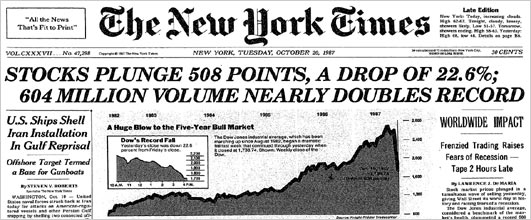
October 2012 represents the 25th anniversary of one of the worst stock market crashes in global history. On “BlackMonday” October 19, 1987 the Dow Jones Industrial Average experienced the worst ever one day percentage drop. Then as now, corporate mass media revealed an unwillingness to delve meaningfully into the root causes of monetary meltdowns, ensuring only the business as usual continuance of a fucked up financial system. Then as now, great writers with a grasp of Wall Street’s rigged casino culture, like Rolling Stone’s MattTaibbi and ProPublica’s JesseEisinger, expose the rot from the margins while the mainstream press mostly enables the status quo. 
Reflecting back, I remember seeing the Wall St. crash as nothing more than an inevitable consequence of the culture of trickle down economics and greed sanctioned by the Reagan Administration. After Reagan assumed power in 1981, media fascination with millionaires reached points not seen since the 1920s. Oliver Stone’s 1987 film Wall St. perfectly captured the ideology of the period.

Stone’s infamous character Gordon Gekko was supposedly based on a composite of several Wall St. crooks including IvanBoesky. Boesky’s a rare example of a Wall St. criminal actually prosecuted; he served 3.5 years at Lompoc Federal Prison (at the time the ultimate “Club Fed” country club facility) and paid a $100 million dollar fine for insider trading.

About Boesky, NewYork Magazine argues that “the biggest surprise about his crime is that he managed to get away with it for so long. It wasn’t any secret that he was taking massive positions in stocks in companies that, in a matter of weeks, became takeover targets of the corporate raiders of the day, earning the financier huge profits. Boesky sold himself as a genius. . . In the popular press, the wizard act was pretty convincing. . .” Boesky’s “wizard act” was so blatantly over the top that press treatment of him before his arrest can only be described as a kind of journalistic negligence. Broadcasters that should have been Boesky badgerers became, at least for a bit, Boesky boosters.

Indeed, before federal prosecutors reined him in, Boesky in public provided ample signs that he was up to no good. Stone’s Gordon Gekko in Wall St. famously says in part that “greed, for lack of a better word, is good. Greed is right, greed works.” In real life in May of 1986 Boesky delivered the commencement address at the Berkeley School of Business Administration and said "Greed is all right, by the way. I want you to know that. I think greed is healthy. You can be greedy and still feel good about yourself."

Corporate mass media hardly ever spark a sense of urgency about going after Wall St. crooks because, in a real sense, CORPORATE MEDIA ARE BOESKY. Consider the major tenets of Boeskyism: greed, insider fetishism, and a reduction of all moral questions to the “bottom line.” What institution then and/or now operate according to those tenets more than corporate mass media? 
Boesky broadcasting is always awful, but probably at its worst during presidential election years. Let’s apply the tenets of Boeskyism to corporate media coverage of this year’s race. 

Greed: As of the middle of September the Obama campaign had raised about $755 million while the Romney team reported about $710 million. It’s no secret that the insane level of money raised for today’s campaigns is due in large part to the cost of media advertising, especially television buys. Given that the air waves belong to the public, it’s absurd that private corporations make windfall profits off of campaign year advertising.   

While most democratic countries allow some form of free advertising for ballot qualified candidates, the United States has a “pay to play” system. The result?  Narrow choices for voters (third parties can’t afford pay to play) and enhancing the power of the Super Pacs and big donors to the Democrats and Republicans. In the past polls showed huge support among the public for free air time, but status quo politicians won’t move legislation forward and the Boesky broadcasters are in no hurry to put the brakes on the gravy train. 

Insider Fetishism:  A group of high profile political reporters recently told Politico that they “loathe” covering the 2012 campaign. They are apparently tired of being spun and manipulated by campaign flaks, fed daily sound bites instead of substantive policy statements, and roped into covering silly controversies. So locked into the Boesky mindset these reporters cannot even imagine doing things that would whip the Dems and GOP into shape. Give serious coverage to the platforms of Green Jill Stein, Libertarian Gary Johnson, and Constitutionalist VirgilGoode and you’ll force the Republicrats to grow up. But the third party candidates aren’t insider approved candidates, making each persona non grata for Boesky broadcasters.

Bottom Line Morality: On September 11th NBC broadcast an interview with Kris Jenner (the Kardashian matriarch) about her breast implants rather than observe a moment of silence for 9/11 victims. From a Boeskyian perspective NBC’s choice makes total sense: mama Kardashian played up the “boob tube” side of television, which is good for the bottom line. The inane coverage of campaign ’12 is very much like that interview. Such is the consequence of the Boesky broadcaster’s bottom line morality. 

Monday, September 03, 2012

Media Rants: On Elections--The Media's Ottinger Effect

On Elections: The Media’s Ottinger Effect


From the September 2012 issue of The SCENE 

Though not old enough to vote at the time, the first political campaign I followed closely was Jimmy “I've looked on a lot of women with lust” Carter v. Gerald “There is no Soviet domination of Eastern Europe” Ford in 1976. Subsequently I became a bona fide political communication junkie, almost obsessively keeping tabs on local, state, and national elections.

Like most voters I rely on mainstream mass media for information about issues and candidates. I peruse newspapers, magazines, television, radio, and a variety of electronic media sources. The experience is never pleasant, is often maddening, and requires sifting through tons of bull crap to get to anything beneficial. 

What’s frustrating is that before each election cycle, mainstream media always promise to feature reporting and punditry that will be high quality or at least better than the last time. Before the election season commences, the media create an image of themselves that they never quite live up to: the image of the crusading fourth estate debunking candidates’ false claims, forcing serious and wide ranging discussion of vital issues, and being responsive to the real concerns of the electorate.

In failing to live up to an image, mainstream media are much like some politicians. In TheCongress Dictionary, Paul Dickson and Paul Clancy refer to “the phenomenon of not living up to an image” as the “Ottinger effect.”

Representative Richard Ottinger was a liberal New York Democrat who ran for the US Senate in 1970. The Republican in the race, Charles Goodell, was appointed to complete Bobby Kennedy’s term. Soon after being seated, Goodell irked Republicans by speaking and acting much like Kennedy, especially in opposition to the Vietnam War. The New York Conservative Party nominated James Buckley, and with Goodell and Ottinger splitting the liberal vote Buckley won the seat. Ottinger could and should have won the election even with another liberal in the race, but in debates and other public appearances he could not live up to the statesmanlike image promised by his slick TV ads. Texas Governor Rick Perry’s dismal primary campaign for president this year is a good example of the Ottinger effect on the conservative side. 
(below: Watch Rick Perry's campaign ad on "Proven Leadership." Then watch his "Oops" moment at a Republican debate. A classic example of the Ottinger Effect.). 


Like Ottinger and Perry, mass media promise something edgy and different but when it comes time to deliver the goods they are essentially empty suits.  Below are three examples of the mass media election season Ottinger effect.

First, the failure to effectively debunk false claims. False claims are a fact of like in politics; a rigorous watchdog media is really the only way to hold liars accountable. Unfortunately, the mainstream media’s addiction to a mistaken understanding of “balance” creates a “they all do it” mentality that makes the fact check process almost pointless.Factcheck.org and Politifact.com once held great promise as guides to exposing BS in politics, but both sites are now like a  football referee who calls nothing but offsetting penalties justified via convoluted, rambling explanations. 

Second, the lack of wide ranging discussion. We’re in a presidential election year where the major parties and candidates disturbingly agree on a wide range of issues, from austerity to national security. Yet the mass media will not insist on the presence of third party candidates at debates, nor even question the legitimacy of the “Commission” that blocks third party participation. The Green Party’s Jill Stein, the Libertarian Party’s Gary Johnson, and the Constitution Party’s Virgil Goode, in spite of mainstream media’s only token mention of their names, will all be on the ballot in enough states to technically be able to get enough electoral votes to win the presidency. Additionally, the three of them are the only candidates saying anything substantive about issues. Yet the overwhelming majority of voters will hear nothing about them. More than anything else, mainstream media censorship of ballot qualified third party candidates exposes the incestuous relationship between the major parties and the press.

Third, the failure to be responsive to the real concerns of the electorate. National election coverage especially is now indistinguishable from Entertainment Tonight. In Time Magazine JamesPoniewozik calls 2012 the “Year of the Nontroversy.” He argues that “political news has become full of these trumped up, social media and cable news fanned brouhahas over quotes, anecdotes and associations. We're coming off a decade of war and financial ruin, yet our politics have gone from Israeli settlements to Irish setters, from 9/11 to 7 Eleven.” I’d have given Poniewozik’s column an “A” if he’d pointed out that Time itself long ago established the standard for shallow coverage of campaigns.

Media failure to respond to the real concerns of the electorate is not just a national phenomenon. Talk to anyone who’s ever run for city council or town board and they’ll tell you that voters consistently tell them they are concerned about cracked streets, crime, garbage pick up, removing bird droppings from the parks, snow and ice removal, and other less than sexy issues. But in order for the local media to call someone a “progressive” candidate, he or she has to sign on to some big ticket Chamber of Commerce demand like tax incremental financing or other questionable tax shifting schemes. 

Want to be better informed about elections? You took a great first step by reading this month’s SCENE!

Wednesday, August 01, 2012

Media Rants: Resist Predatory Paywalls

Resist Predatory Paywalls

Media Rants by Tony Palmeri 

Question: What do American newspapers, colleges and universities, and religious establishments have in common?
Answer: They are all 19th century institutions addicted to flawed 20th century corporate business models that undermine their ability to survive meaningfully in the digital 21st century.

That question and answer occurred to me recently when the Oshkosh Northwestern, the Appleton Post Crescent and most other Gannett Empire print products announced that online readers would have to pay for accessing news content online. The imposition by newspaper corporations of “digital paywalls” is not new; the WallStreet Journal pioneered the payola scheme in 1997. Declining ad and subscriber revenues pushed other papers to play with paywalls, most notably the New York Times. The only surprise about Gannett is that it took them so long to join the paywall ring.

Gannett’s is a “soft” paywall because nonpaying customers get unlimited access to some content as well as a certain number of “free” articles each month before the paywall kicks in. If you’re not a paid digital subscriber, each time you click on illuminating stories like “UFO Over Grand Chute” or “Burger King Betting on Bacon Sundae” (that story was quite  the whopper) you’re  reminded how many articles you have left before being coerced into paying the Gannet Empire Download Duty.
Paywalls are a 20th century solution to a 21st century problem. It’s like religious institutions responding to declining church membership by squeezing more money out of the remaining loyal flock. Or colleges and universities responding to dwindling external funding by raising tuition to levels that force some out and others into decades of debt.
How did these cultural institutions, all of which should play primary roles in making America a more just society, get to this crisis point? The answer deals with the flawed manner in which each institution defines its relationship to The Public. I only have enough space to deal with newspapers, but a similar dynamic exists across institutions.

In the 19th century, American newspapers in the new nation saw The Public as something to “shape.” Newspapers were “propaganda” organs preaching values consistent with the revolutionary ideals of the Founding Fathers. Van Wyck Brooks once wrote that the “American mind” is not shaped by books, but by “newspapers and the Bible.”

The legendary New York World publisher Joseph Pulitzer epitomized the shaping function when he lent the weight of the World to raising money for construction of the Statue of Liberty pedestal. Pulitzer of course saw his actions as a way to promote the paper, but his fixation on getting Americans to support “liberty” made it difficult to think of profit as his major motivator.

Eventually Pulitzer did become primarily business centered. He and the New York Journal’s William Randolph Hearst were dueling innovators skilled at exploiting scandal and sensationalism to grow circulation and enhance advertising revenue. By the early 20th century, the commercial newspaper business sees The Public not as something to shape but to “seduce.” Advertising rates increase as publishers deliver more readers; the more seductive the content, the more eyes on the page. As media scholar Dallas Smythe argued, 20th century mass media secured windfall profits by selling audiences to advertisers. To get audiences to play such a subordinate role requires sophisticated seduction.

Digital paywalls are an extension of the 20th century seduction model. Audiences are made to feel that they are somehow “freeloaders” if they click links without subscribing. By paying up, the audience member is somehow “supporting journalism” even though journalism worthy of the name was sacrificed long ago in the interest of the corporate bottom line. By signing up for a digital subscription to a Gannett paper (or any paper), all you are really doing is improving the media corporation’s chances of raising digital advertising rates.

I’ve heard responses to Gannett’s paywall announcement similar to what blogger Matt Yglesias wrote about the Wall Street Journal paywall: “I read the WSJ sometimes. But it’s going to be a cold day in hell before I voluntarily surrender money to firms controlled by Rupert Murdoch when there are alternatives.”

Ben Bagdikian’s classic The Media Monopoly describes Gannett as “an outstanding contemporary performer of the ancient rite of self serving myths, of committing acts of greed and exploitation but describing them through its own machinery as heroic epics.” If you need to read a Gannett paper, maybe the paywall is the excuse you’ve been waiting for to take that daily walk to the public library. There you can read the paper for FREE.  

Paywalls improve the corporate bottom line in the short term. For newspapers to survive in the long term, a new relationship to The Public is necessary. The new relationship must be one of “service.”  Josiah W. Gitt, late editor of the York, PA Gazette & Daily many years ago articulated a vision for newspapers that transcended shaping and seduction: “A newspaper is a public servant and to be permanently successful must be faithful to the interests of the public it serves. It dare not be selfish. It dare not be mercenary.”

Media corporations are by definition selfish and mercenary. The new relationship can be developed only by independent newspapers not fixated on the bottom line. Want to save journalism? Resist predatory paywalls and contribute instead to independent publications.