Monday, April 01, 2019

On Vertical Triangulation

In representative democracies across the globe, candidates for public office spend much time trying to figure out how to "position" themselves vis-a-vis their opponents and the voters. In mainstream American politics, the positioning historically occurred on a left-right axis. For example, in the most stark form, the "left" candidate was allegedly pro-union and  the "right" candidate allegedly pro-management. Or the left candidate favored higher taxes on the rich to support social programs while the right candidate wanted low taxes on the rich so that their wealth would "trickle down" to the rest of us. Etc. Etc. 

Today the ground has shifted: thanks in large part to the way in which Occupy Wall St. and other populist movements provoked a reframing of our political language, the horizontal left-right axis no longer sheds any light on civic life. Occupy shifted the language from horizontal to vertical: in the 2010s left-right has slowly but surely given way to bottom-top as the framework that makes the most sense as we try to understand the policies and positioning of the major players impacting our political life. 


In the old days, mainstream political players were never really comfortable positioning themselves as purely left or purely right. "Transcending" the left-right axis became known as "triangulation." Today there's a similar discomfort with being labeled purely bottom or purely top, and what we're seeing in response is a kind of vertical triangulation. 


In the remainder of this post I want to briefly summarize key moments in the history of left-right horizontal triangulation, then refer to the gaggle of Democrats seeking to gain the 2020 nomination to face Donald Trump to identify what is fast becoming a case study in 21st century vertical triangulation. 


On Horizontal Triangulation


Some of the most consequential parts of US history can be framed as the triumph of a restrained middle over more a more radical left and/or right :


*In 1787 those calling for the creation of a Constitutional Republic saw it as a middle ground between the pro-slavery fiefdoms represented by the then existing Articles of Confederation and the armed supporters of Shays' Rebellion who thought the values of the 1776-1783 revolution had been betrayed. 


*Abe Lincoln running on a platform of "non-extension of slavery" in 1860 was a middle ground between the northern abolitionists and the southern slave-holding aristocracy that wanted to extend the evil from coast-to-coast. 

*While the Republicans from the time Franklin Roosevelt took the oath of office in 1933 called his New Deal recovery program "Socialist," the New Deal was in fact a middle ground between the GOP's inaction in the face of mass economic depression and actual revolutionary socialism on the left. 


Post World War II, positioning in the middle became a more strategic, public relations industry style of re-branding a politician so that he seemed to "rise above" the left and right. This is what the political "professionals" mean by triangulation,  and it's probably best exemplified by the presidential campaigns of Richard Nixon in 1968 and Bill Clinton in 1992 and 1996. 


The Nixon campaign of 1968 emerged in a context in which President Johnson's "Great Society" programs opened up Democrats to being branded as the party of "big government" and "Washington solutions" to local problems. To his right, Nixon was challenged by segregationist George Wallace, the Alabama governor whose third-party campaign represented a complete rejection of the civil rights movement. 


The Democrats in 1968 fielded Vice-President Humphrey as their candidate--an old school liberal fully on board with the Great Society. Nixon cleverly situated himself in the middle of Humphrey and Wallace, running on a platform of respect for "states rights" and for greater "law and order" as a response to urban and campus uprisings of the time. The Nixon campaign even ran some ads explicitly targeting African-American voters in an effort to show a middle-ground between the Dems' espousal of government programs to assist historically oppressed groups and Wallace's nostalgia for the pre-civil rights era America. 

In 1968 Republican presidential candidate Richard Nixon ran ads explicitly targeting African-American voters. The ad is an example of political triangulation that's been used in many campaigns since. 
It's not an exaggeration to say that the Nixon 1968 campaign forever changed the Republican Party; from that moment on they could run against any government action at all as being part of some kind of left conspiracy, while sounding out dog whistles to those fearful of progress on the right. 

In a real sense, the Trump 2016 campaign was the natural outcome of many decades of triangulating. Finally, the most extreme elements of the Republican base found a candidate they could rally around, a man who channeled George Wallace with his overt racial appeals and call for the wall to keep "them" out of the country. In the Republican primaries, the more traditional triangulating of Marco Rubio, Ted Cruz, Jeb Bush, John Kasich and others was no match for Trump.  


Probably the most extreme form of political triangulation occurred in Bill Clinton's runs for the presidency in 1992 and 1996. Clinton represented the "New Democrat," an ideology of "centrism" that attempted to rebrand the Dems as pro-business, competent technocrats. In Mr. Clinton's speech accepting the Democratic nomination in July of 1992 we can find triangulation in its most pristine form: 


We meet at a special moment in history, you and I. The cold war is over; Soviet Communism has collapsed, and our values -- freedom, democracy, individual rights, free enterprise -- they have triumphed all around the world. 


The Republicans have campaigned against big government for a generation. But have you noticed? They've run this big government for a generation, and they haven't changed a thing. They don't want to fix government, they still want to campaign against it, and that's all.


But, my fellow Democrats, it's time for us to realize that we've got some changing to do, too. There is not a program in government for every problem. And if we really want to use government to help people, we have got to make it work again.


Now, I don't have all the answers. But I do know the old ways don't work. Trickle down economics has sure failed. And big bureaucracies, both public and private, they've failed too.


That's why we need a new approach to government. A government that offers more empowerment and less entitlement, more choices for young people in the schools they attend, in the public schools they attend. And more choices for the elderly and for people with disabilities in long-term care they receive. A government that is leaner, not meaner, a government that expands opportunity, not bureaucracy, a government that understands that jobs must come from growth in a vibrant and vital system of free enterprise. I call this approach a New Covenant, a solemn agreement between the people and their government, based not simply on what each of us can take, but what all of us must give to our nation.


An America where we end welfare as we know it. We will say to those on welfare: "You will have, and you deserve, the opportunity, through training and education, through child care and medical coverage, to liberate yourself.


But then, when you can, you must work, because welfare should be a second chance, not a way of life. That's what the New Covenant is all about.

Somehow "New Covenant" does not have the same ring as "New Deal" or "New Frontier," but that's really the point. Why? Because the language of triangulation is designed not to get a nation to conceive of ways to get a handle on urgent crises, but to get politicians through election cycles. "New Covenant" for Clinton, like "Law and Order" for Nixon, was about meeting the personal political needs of the moment. "New Covenant" allowed Clinton to say "I'm not like those big government liberals or those mean conservatives." "Law and Order" allowed Nixon to act out socially acceptable "toughness" as opposed to the permissiveness of the liberals and neo-fascism of the Wallace segregationists. 

Left-right triangulation has an addictive quality to it, and even though the ideological ground has shifted we find partisans doggedly reaching for the traditional middle ground. The best (or worst, depending on your point of view) examples are the "Never Trump" Republicans still in denial about how grassroots level frustration with their triangulated nonsense created Trump in the first place, and the dickhead plutocrats like Howard Schultz and Michael Bloomberg who imagine some middle ground that might make them look like something other than brazen billionaire opportunists. 

On Vertical Triangulation

We've come to a point in the United States where it is slowly but surely coming to full acceptance that we are not divided by Left and Right but by Bottom and Top. That we have a government--in Washington and most state capitols--of, by, and for the one-percent is no longer in any kind of serious dispute. Donald Trump's pledge to "drain the swamp" was a recognition of the problem. That he never really had any intention of draining said swamp, and that he has been, continues to be, and will always be the ultimate swamp dweller himself is something lost on his core supporters. Sad. 


Given that the swamp does in fact rule Washington, we have no shortage of candidates literally in debt to the one-percent. But as the rest of us (the ninety-nine percent) become more aware that our division into left and right camps has been a sham orchestrated by one-percent interests, we begin to find populist ideas and candidates attractive. This presents a quandary for the one-percent candidates: how do they continue to serve their wealthy masters while simultaneously positioning themselves as great friends of the rest of us? 


The answer is a new kind of triangulation. Just like Nixon and Clinton looked for ways to transcend the left-right axis, today we've got candidates trying to find a middle ground between the one-percent and the ninety-nine percent. Today, the best place to find vertical, top-down triangulation is in the Democratic Party contest for president. Bernie Sanders' surprising performance in 2016, helped along by the fact that he tends to be in a rhetorical war with the one-percent, looks poised to repeat itself in 2020. Many other Democrats, especially Joe Biden,  Beto O'Rourke, and Kamala Harris, appear to be setting themselves up as the "anti-Bernie." 


Anti-Bernieism is vertical triangulation; it's a way of saying "sure our system is designed to benefit the uber-rich, but if we just tinker around the edges we can fix it! We don't need democratic socialism!" 


Vertical triangulation can best be illustrated in the way Democrats talk about health care reform. Sanders' Medicare For All plan, a true single-payer plan that would cover all Americans and eliminate the private health insurance industry, has a high amount of support from Democratic base voters and even large numbers of Republicans. It is of course bitterly opposed by the insurance and pharmaceutical industries, both of which benefit immensely from the status quo. Because those industries wield huge influence in the political system, it is difficult for candidates to break free from them. So what the candidates do is triangulate: look for some kind of middle position that can somehow solve the health care woes of the ninety-nine percent while simultaneously pacifying the very interests that are creating the woes in the first place. 


Liberal New York Times columnist Paul Krugman is already writing talking points for Democratic triangulators on health care, arguing that there should not be a "purity test" in the primaries and that a "Medicare For America" plan that preserves private insurance might be just as good as a real national health care plan. As the campaigns go on we are going to see more and more attempts to protect one-percent interests under the guise of actually helping the population at large. Expect to hear many of the candidates find ways to defend trade, tax, health care, jobs, environment, and other policies in ways that offer platitudes to the population-at-large while not offering any serious threat to the donor class. 

Within Democratic Party circles, Bernie Sanders most offends those who see the one-percent as fitting under the Party's "big tent." That is, he offends the top-down triangulators. I don't think offending those folks will hurt him with at-large voters. 


I'm not sure if Bernie Sanders is the best candidate to face Donald Trump. But I firmly believe that if the Dems nominate a vertical triangulator they will fall into the same trap that caught them in 2016: being perceived as the "business as usual" party and once again allow a swamp dweller like Mr. Trump to frame himself as the true reformer. A race that should be a landslide for the Democrats will once again become winnable for Trump in the antiquated Electoral College system. 


So if not Bernie, then at least someone who stands clearly on the side of the ninety-nine percent in word and deed. Left-Right triangulation was a disaster for Democrats that led to huge losses in governorships, state legislatures, and the Congress. Left unchecked, top-down triangulation will be a similar disaster. 


Friday, March 01, 2019

Sineading at the Summit

On October 3, 1992 Irish rock/pop singer Sinead O'Connor almost wrecked her career during a live performance on NBC's Saturday Night Live. Instead of the typical SNL musical performance--instrumental energy coupled with obtuse and/or bland lyrics--O'Connor belted out an impassioned a cappella version of Bob Marley's "War" reworked to draw attention to child abuse:

Until the ignoble and unhappy regime
Which holds all of us through
Child abuse, yeah, child abuse yeah
Sub human bondage has been toppled
Utterly destroyed 
Everywhere is war . . . . 

Children, children 
Fight! 

We find it necessary. 
We know we will win. 
We have confidence in the victory of 
Of good over evil. 

Fight the real enemy! 
If she had just stopped there, the performance probably would have been pored over by pundits wondering who or what O'Connor was blaming for child abuse and who was the "real" enemy. Instead she left no doubt: in one of the most spectacular moments ever to enliven live TV, she tore apart a picture of Pope John Paul II. In just a few years she went from covering Prince to (symbolically) cutting the Pope. 

To understand how truly radical this act of papal picture mutilation really was, you have to remember a few things about America in 1992: (1) the issue of child abuse in the Catholic Church had barely registered a blip on the mainstream media radar; (2) Pope John Paul II possessed icon status in the United States at the time (not so much for his representation of Christ on Earth as for his enmity toward Communism); (3) in that pre #metoo era outspoken women were much more likely to face condemnation when demonstrating that they did not "know their place." The fact that actor Joe Pesci, hosting SNL the next week, received loud applause when he showed up with a taped up picture of the Pope and announced he would have given O'Connor a "smack" says about all we need to know about the state of the country circa '92. Sinead's act of icon defiance sparked what could be called the first social media shit storm--a few decades before anyone even knew what social media was. 
There's a rhetorical trope called "anthimeria" in which one part of speech is used to substitute for another. For example, if I say "they were sad and needed a good cry" I am using the verb "cry" as a noun. When Clint Eastwood famously addressed an empty chair at the 2012 Republican National Convention, it became known as "Eastwooding" (in anthimeria terms, it is a noun being used as a verb). 

What O'Connor did on the SNL stage is what I call "Sineading": the calling out of child abuse, child abusers, and child abuse enablers on the global stage.  

Under increasing pressure to make clear that abuse in the Church is seen by the Vatican hierarchy as an issue of social justice as opposed to a mere public relations crisis, Pope Francis recently hosted a historic summit on the "Protection of Minors in the Church." The event was held many decades too late and--from the perspective of every major survivor advocate organization--woefully inadequate in terms of righting past wrongs, rooting out current ones, and guaranteeing an abuse-free future. Yet the summit was not merely an exercise in papal propaganda, in large part because victims were allowed to speak and the summit attendees witnessed two courageous acts of Sineading: speeches by Nigerian Sister Veronica Openibo and Mexican TV journalist Valentina Alezraki. 

On the third day of the summit, Sister Veronica  Sineaded the patriarchs in the audience: 

"We must acknowledge that our mediocrity, hypocrisy, and complacency have brought us to this disgraceful and scandalous place we find ourselves as a Church. We pause to pray, Lord have mercy on us!"


She called out the Vatican hierarchy for not acting on a range of abuses due to obsession with public relations: 

"Why have other issues around sexuality not been addressed sufficiently. e.g. misuse of power, money, clericalism, gender discrimination, the role of women and the laity in general? Is it that the hierarchical structures and long protocols that negatively affected swift actions focused more on media reactions?" 

She closed with a clarion call for change moving forward: 

"I hope and pray that at the end of this conference we will choose deliberately to break any culture of silence and secrecy among us, to allow more light into our church. Let us acknowledge our vulnerability; be proactive not reactive in combating the challenges facing the world of the young and the vulnerable, and look fearlessly into other issues of abuse in the church and society." 

Valentina Alezraki's speech is one that ought to be required reading in all journalism schools. Her remarks can be read as a rallying cry for a journalism of integrity that puts the profession squarely on the side of truth and justice. Speaking directly to the Pope, Bishops, and other Vatican bureaucrats, she sent out this warning: 

"If you do not decide in a radical way to be on the side of the children, mothers, families, civil society, you are right to be afraid of us, because we journalists, who seek the common good, will be your worst enemies . . ."
 
"We journalists know that abuse is not limited to the Catholic Church, but you must understand that we have to be more rigorous with you than with others, by virtue of your moral role. Stealing, for example, is wrong, but if the one stealing is a police officer it seems more serious to us, because it is the opposite of what he or she should do, which is to protect the community from thieves. If doctors or nurses poison their patients rather than take care of them, the act draws even more of our attention because it goes against their ethics, their professional code."

The idea of a journalism that on principle holds power accountable and sides with decency in the manner argued by Alazraki is so far removed from what is typically practiced in the mainstream United States press as to be depressing. One could imagine an American journalist speaking at the papal summit and saying something like this to the assembled pope-arazzi: "as portrayed in the movie 'Spotlight,' the Boston Globe did some great work exposing child abuse in the Church. But I want to assure you that we do not set out to look for abuse, and while we sympathize with victims we never, ever take sides. As long as you provide us with your side of the story in a timely manner, we will never be your worst enemies.That's not our role." One can imagine those remarks getting a standing ovation from the 'razzi.

Will the stirring testimony of victims and the speeches of Sister Veronica Openibo and Valentina Alezraki, along with other acts of Sineading, be enough to provoke real change in the Church? The true test will be how long it takes the hierarchy to adopt the five very reasonable reform policies advocated by the Survivors Network of Those Abused by Priests (SNAP): 

  1. Fire any and all bishops or cardinals who have had a hand in clergy sex abuse cover-ups,
  2. Impose “dramatic and punitive consequences” to deter any future cover-ups,
  3. Eliminate any directive for church staff to report abuse to bishops and instead direct all church staff and officials to make reports to law enforcement, and
  4. Compel bishops around the world to turn their files over to law enforcement for independent investigations into their handling of clergy sex abuse cases, and
  5. Order bishops and other hierarchs to cease lobbying efforts against legislative reform that would benefit survivors.
If the Church is seriously interested in justice for victims and a just future, one would think these reform policies would be "no brainers." The fact that the Vatican hierarchy, after now decades of proven abuses and coverups, is still taking baby steps is not a good sign. Watch Judy Woodruff's PBS News Hour interview with SNAP's Becky Ianni for more insight as to why the summit was mostly disheartening. 

After her daring act in 1992, Sinead O'Connor said "I knew my action would cause trouble, but I wanted to force a conversation where there was a need for one." How tragic that after so many years and acts of Sineading the issue of child abuse in the Catholic Church and other institutions of power still does not carry the sense of urgency necessary to end it. Shame on all people with public platforms who spend more time shucking responsibility than Sineading.  

Friday, February 01, 2019

Censored in 2018: The Enemy of a Pathetic Granfalloon

Censored in 2018: Julian Assange as the Enemy of a Pathetic Granfalloon

Following the lead of Project Censored, I like to do an annual column on what was (in my view) the most censored story of the previous  year. Censored 2019 (Seven Stories Press) names the "Global Decline in Rule of Law as Basic Human Rights Diminish" as the top censored story of 2018. 

In a variety of ways and at different levels of severity, millions of people around the world suffer from persecution at the hands of governments that respect neither international law nor, in many cases, the laws of their own countries. In large part due to the mind numbing propaganda spewed by establishment media that enables global power arrangements, the persecuted are often themselves thought to be oppressors, or thought to have somehow brought their misfortune on themselves. For example, many Americans today celebrate Dr. Martin Luther King Jr., but they forget (or never knew) that government agents worked actively to discredit him from the mid-1950s until the day he died. While convincing evidence of a government directed conspiracy to kill King has never emerged, one need not be a conspiracy wacko to acknowledge that government forces and some in the establishment media created the hostile climate that made his assassination inevitable. And as the great writer George Bernard Shaw once wrote, "Assassination in the extreme form of censorship." 

He has not been assassinated--yet--but today Wikileaks founder Julian Assange serves as a representative anecdote of how governments and establishment media can censor anyone who dares expose their crimes and mendacity. In 2018 Assange, who since 2012 has been trapped in the Ecuadorian embassy in London out of legitimate concern that he would be extradited to the United States should he leave (to stand "trial" for "crimes" that are not exactly clear), literally had his Internet access cut off. But his situation is much more dire; Pultizer-Prize winning journalist Chris Hedges likens the treatment of Assange to a modern day crucifixion: 
Wikileaks founder Julian Assange has been unable to leave the Ecuadorian embassy in London for years out of concern that leaving would result in extradition to face government persecution in the United States. 
"Julian Assange’s sanctuary in the Ecuadorian Embassy in London has been transformed into a little shop of horrors. He has been largely cut off from communicating with the outside world for the last seven months. His Ecuadorian citizenship, granted to him as an asylum seeker, is in the process of being revoked. His health is failing. He is being denied medical care. His efforts for legal redress have been crippled by the gag rules, including Ecuadorian orders that he cannot make public his conditions inside the embassy in fighting revocation of his Ecuadorian citizenship." 

Hedges cites an appeal made by Assange's mother Christine on her son's behalf: 

“Despite Julian being a multi-award-winning journalist, much loved and respected for courageously exposing serious, high-level crimes and corruption in the public interest, he is right now alone, sick, in pain—silenced in solitary confinement, cut off from all contact and being tortured in the heart of London. The modern-day cage of political prisoners is no longer the Tower of London. It’s the Ecuadorian Embassy . . . Julian has been detained nearly eight years without charge. That’s right. Without charge. For the past six years, the U.K. government has refused his request for access to basic health needs, fresh air, exercise, sunshine for vitamin D and access to proper dental and medical care. As a result, his health has seriously deteriorated. His examining doctors warned his detention conditions are life-threatening. A slow and cruel assassination is taking place before our very eyes in the embassy in London.”

And she said this: "My son is in critical danger, because of a brutal political persecution by the bullies in power whose crimes and corruption he has courageously exposed when he was editor-in-chief of Wikileaks." 
Assange and Wikileaks receive little support from establishment media, even though Wikileaks releases have been used repeatedly by said media in thousands of stories. 
In 2016 a United Nations' Working Group on Arbitrary Detention found Assange's detention to be in violation of international law, but the group's report was not even acknowledged by the global powers that be. 

Thanks in large part to establishment media's willingness to carry water for oppressive global governments, Assange's situation is either ignored or--worse--he is not at all viewed as a sympathetic figure among politically active elites whose voices could be of assistance not just in securing his release, but of all political prisoners around the globe. My guess is that even many people reading this blog post, if they know of the Assange situation at all, respond to his name with deep suspicion; among hyperpartisan Democrats Assange supposedly conspired with Putin and Trump to undermine Hillary Clinton's campaign. Among hyperpartisan Republicans he is, in the words of Secretary of State Mike Pompeo, a "fraud, a coward hiding behind a screen." 


That so many establishment Democrats and Republicans, and their respective propaganda arms MSNBC and Fox News, can unite in mutual enmity against Julian Assange ought to give us pause. The situation is quite pathetic, perhaps in a way that only the late Kurt Vonnegut, Jr. could help us understand. 

Julian Assange as the enemy of a pathetic granfalloon

The late Kurt Vonnegut, Jr.'s voice is much missed today. His comic yet starkly insightful works of fiction and political prose were the epitome of bullshit-detector in action. One of my favorite Vonnegut concepts is from his classic Cat's Cradle: the "granfalloon";. i.e. the "proud and meaningless association of human beings." Members of a granfalloon typically feel some kind of superiority for being members of the "in" group. 
Kurt Vonnegut Jr.'s  concept of "granfalloon" is a perfect way to describe the union of establishment liberals, neocons, and Republican opportunists that want to see Assange prosecuted. 
The website Changing Minds had a good summary of the basic characteristics of a granfalloon, including this aspect that's most relevant to our discussion of the censorship and persecution of Mr. Assange: "Real or imagined enemies, such as government agents or anyone who criticizes the group."


In the Trump years, the so-called "Resistance" has become a most pathetic granfalloon. MSNBC watchers are treated daily to the remarkable spectacle of former intelligence agency heads (e.g. John Brennan, James Clapper, James Comey), neoconservatives (e.g. Bill Kristol, David Frum), and "never Trump" Republicans (e.g. Charlie Sykes, Steve Schmidt) in union with the "liberal" hosts as they endlessly dissect any and all Trump/Russia connection no matter how tenuous. The Intercept's Glenn Greenwald came up with a useful list of the top-ten most embarrassing media failures that this so-called resistance has had to apologize for. 

Just to be clear: my criticism of MSNBC for giving a forum to dubious characters whose commitment to the cause of democracy and freedom is at best questionable is not meant to suggest that Fox or other so-called "conservative" media are doing anything better. Indeed, Fox and their offspring continue to represent the absolute worst of what American media has to offer and have pretty much destroyed genuine political conservatism as a serious force in American politics. The problem is that the "Resistance" media, in giving safe haven to Russiaphobes and right wing opportunists, has actually managed to make Fox and others look only slightly more unhinged by comparison. 

How does this so-called Resistance impact political prisoners like Assange? Consider this Orwellian October, 2018 letter sent to Ecuadorian President Lenin Moreno by two members of the House Committee on Foreign Affairs: the "liberal" Democrat Eliot Engel and the "conservative" Republican Ileana Ros-Lehtinen. The letter is a textbook example of mindless granfalloon rhetoric: 

"We are very concerned with Julian Assange's continued presence at your embassy in London and his receipt of Ecuadorian citizenship last year. Most recently, we were particularly disturbed to learn that your government restored Mr. Assange's access to the Internet. On numerous occasions, Mr. Assange has compromised the national security of the United States . . . It is clear that Mr. Assange remains a dangerous criminal and a threat to global security, and he should be brought to justice." 

Mr. Moreno gave in to threats from the UK and US, and so Assange once again lost Internet access and faces the real possibility of losing his asylum status. 

As for Assange being a "dangerous criminal," he has now served what any fair and sane observer would call an eight year prison sentence, yet he's never actually been charged with a crime outside of "failure to surrender" to the British authorities when he entered the Ecuadorian embassy in 2012. Sexual assault charges against Assange in Sweden, which produced mountains of sensational headlines and unsubstantiated claims, were dropped in 2017. In 2013 the Obama Administration concluded that to charge Assange would mean having to charge other media publishers, because leaking classified documents is something that they all either have done and/or consider to be protected journalistic activity under the First Amendment. 

Perhaps the low point in the Resistance granfalloon's jihad against Assange was this recent exchange between NBC's Chuck Todd and Republican Senator Marco Rubio: 

Chuck Todd:  "Should it be a crime working with Wikileaks?"

Rubio: "I think certainly if you're wittingly doing it, it should be considered as such."

I think the appropriate follow-up question should have been, "should it be a crime working with NBC news?" Seriously, is Chuck Todd saying that if NBC had in its possession a classified document that proved Trump/Russia collusion, they would not publish it? Does Todd think that the Washington Post and New York Times should have faced criminal penalties for publishing the Pentagon Papers? 

Julian Assange is the enemy of the Resistance, a motley crew of establishment liberals, neoconservative hawks, Republican opportunists, and a wide range of academics and journalists who gleefully write about leaked documents but then lack the courage or integrity to defend the person(s) who put their lives at risk to make such documents available. In Vonnegutian terms, that motley crew is a truly pathetic granfalloon. 

Because Julian Assange is in a real sense a representative anecdote of what happens when someone doesn't just talk about speaking truth to power but actually does it, his story should be told accurately and persistently by all establishment media claiming to be defending journalistic values in the age of Trump. In 2019 Assange's story in establishment circles was told neither accurately nor persistently, making it my choice as the most censored story of 2018. 

Tuesday, January 01, 2019

The 2018 Tony Awards

Welcome to another edition of the Tony Awards! Annually since 2002 I've dedicated one column to naming what was, for me, some of the most outstanding journalism and/or commentary of the year. I operate from no automatic set of criteria when deciding what media to honor, but in general I am drawn to:

*insightful works that shed light on some important public issue.
*creative works that deserve a wider audience.
*informative works that provide eye-opening education on a difficult topic.
*courageous works that speak truth to power.
*humorous works that skillfully provoke laughter and thought at the same time.
*local works that promote community and civic engagement.


Over the years I've received much private feedback on the Tony Awards column. It tends to be most popular with independent thinkers who appreciate being alerted to media creations they might have missed and/or reminded of media creations they too thought were worthwhile. The column tends to be least popular with those who have little use for anything that does not reinforce their point of view and/or lend itself to being shared for partisan purposes. For them my advice is simple: make and share your own list! 

And now the 2018 Tony Award recipients. Drum roll please. 

*Best Local Journalist: Mile Maguire. For the second consecutive year, Miles Maguire earns the Tony for  best local journalist. Oshkosh is served (?) by full-time journalists working for the Gannett press and corporate television, yet when critical issues face the city few citizens trust that those outfits can be counted on to cover them completely or accurately. Instead, I constantly hear people say things like, "has Miles written about this yet?" In 2018 he debuted a space for local reporting called the Oshkosh Examiner. He also continues to edit the Oshkosh Independent Magazine, which you should subscribe to today if you have not already done so. 
Miles Maguire
For the second year in a row, Miles Maguire receives the Tony for best local journalist. Few local writers can match Miles' ability to cover important issues with depth and intelligence.
*Best New Local Media: The Oshkosh Herald. In the 21st century we've become accustomed to hearing about hard copy newspapers forced to scale back production or fold altogether. We almost never hear about successful attempts to start new ones. In 2018 Oshkosh was fortunate to welcome The Oshkosh Herald, an informative newspaper delivered weekly to 28,500 Oshkosh households.
Karen Schneider
Oshkosh Herald  Publisher Karen Schneider  says that the paper wants to "contribute to becoming a more well informed community." 
The Oshkosh Herald
Publisher Karen Schneider and the entire Herald team are working hard to prove that a quality hard copy paper can survive in this digital age. Here's hoping that in 2019 the Herald not only survives, but expands its reach. 

*Most Compelling Local Media Creation. Fit Oshkosh Color-Brave Photo Project: Black and Brown Faces, A New Narrative


Lots of people talk about making Oshkosh into a place that welcomes, treasures, honors, and recognizes its strength in diversity. Fit Oshkosh and its Executive Director Tracey Robertson walk the talk. In 2018 Fit Oshkosh worked with local photographer Colleen Bies to create a remarkable traveling exhibit of magnificent portraits highlighting personal narratives of some extraordinary people of color living in Oshkosh. The project is brilliant on many levels, from its aesthetic beauty to the way it proudly and honestly asserts the lived realities of people of color in Oshkosh. Kudos to The Wisconsin Humanities Council, Candeo Creative, The Oshkosh Area Community Foundation, The Paine Arts Center and Gardens, University of Wisconsin-Oshkosh, First Congregational Church, The Draw, Ebony Vision, Inc., Marion University, and Esther of the Fox Valley for their sponsorship and support of the project. 
Tracey Robertson
Fit Oshkosh Executive Director Tracey Robertson is a tireless advocate for racial justice in the Fox Valley and  beyond. 
*Best #MeToo Inspired Media: 
-Ella Dawson, "To Read In Case I am Ever Murdered By A Man
-Kerry Howley, "How Did Larry Nassar Deceive So Many For So Long?"
-Maggie Astor, "For Female Candidates, Harassment and Threats Come Every Day
-New York Times Obituaries of Unjustly Forgotten Women, "Overlooked" 


The #metoo movement is rightly recognized for removing douchebags like Harvey Weinstein from positions of power and sparking necessary conversations about the connection between gender and power in the workplace, politics, relationships, and other areas. But the movement has also produced some of the most eye-opening, dazzling writing of the decade, much of which provokes "why the hell are we only learning about this NOW" reactions. 

Writer Ella Dawson's "To Read In Case I am Ever Murdered By a Man" should be must-reading in a society that is still largely in denial about the reality of men's violence against women. She writes in part:
 
Writer Ella Dawson in 2018 wrote a powerful piece on how we should think about men's violence against women. 
How many lives would we save if we listened to women’s fears? How many lives would we save if we taught people how to recognize the red flags of abuse and misogyny before they can escalate to domestic violence? How many lives would we save if we treated domestic violence as a warning sign for murder and mass shootings?

Kerry Howley's piece on how Larry Nassar deceived so many for so long paints a disturbing picture of how the disgraced former Olympic gymnastics team doctor got away with abusing hundreds of athletes for decades. In painful detail, Howley shows how Michigan State University and USA Gymnastics bureaucrats simply refused to take women's complaints seriously. She also reveals that had a police officer not found child pornography in the external hard drive Nassar had thrown to the curb, there's a strong possibility that he would still be a doctor in good graces with the bureaucrats and still abusing girls and women. 
Kerry Howley
Kerry Howley uncovered the bureaucratic nightmare that enabled Larry Nassar for decades as he abused hundreds of gymnasts. 
We all know that female candidates for public office get judged by standards much harsher than what their male counterparts experience. Maggie Astor's "For Female Candidates, Harassment and Threats Come Every Day" demonstrates the sheer extent to which this is true, for candidates on all sides of the political spectrum. 

The New York Times in 2018 unveiled "Overlooked," a feature that should have a positive impact in history, political science, communication studies, and a variety of additional curricula in K-12, colleges, and universities. Introducing the feature earlier this year, the Times wrote: "since 1851, obituaries in the New York Times have been dominated by white men. Now, we're adding the stories of other remarkable people." Every week the Times adds a new entry, each one featuring in-depth looks at female abolitionists, scientists, political leaders and many others who've never received the proper amount of recognition from establishment media sources. 

*Editorial of the Year: "America Needs A Bigger House," New York Times. I'm actually shocked at how many New  York Times pieces are receiving Tonys this year, as the paper disappoints more often than not. But truthfully, the paper derisively called "failing" by the POTUS really produced some remarkable pieces this year. (Note to POTUS: The "failing" New York Times now has 1,500 journalists employed compared to 1,100 in 2014. That doesn't sound like failure.). 

"America Needs A Bigger House" is an important editorial because it dares to challenge one of the most destructive beliefs in the modern USA: the belief that our government is too large. As the editorial shows persuasively and with ample evidence, our government is TOO SMALL: 

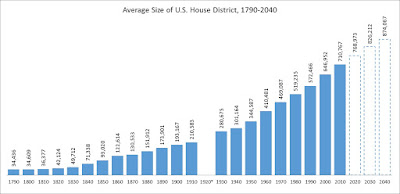
The House’s current size — 435 representatives — was set in 1911, when there were fewer than one-third as many people living in the United States as there are now. At the time, each member of Congress represented an average of about 200,000 people. In 2018, that number is almost 750,000 . . . how does a single lawmaker stay in touch with the concerns of three-quarters of a million people? The answer is she doesn’t.


Size of US House of Representatives Districts
In 1910 each member of the US House of Representatives on average represented just under 211,000 people. In 2011 the Congress fixed the number of Representatives at 435, and so today each member represents around 750,000--making a mockery of the idea of the US truly being a representative democracy. In 2018 the New York Times provided a valuable public service in trying to get some discussion going about the urgent need to increase the size of the legislature. 
Applying the "cube root law" of apportionment that's followed by most of the world's democracies and used to be followed here until the Congress fixed the amount of representatives at 435, the Times writers conclude that we should be adding 158 new members to the House of Representatives. I don't anticipate that this will happen in the next 10 years, but it will eventually and when it does the Times will be recognized for giving the matter prominent attention when few other mainstream sources would. 

*Rock-and-Roll Activist of the Year: Roger Waters. This is a new Tony Awards category, and is inspired by the great work of Roger Waters, the legendary co-founder of Pink Floyd. At the age of 75, Waters travels the globe in a never ending quest to "tear down the walls." In 2018 he was a leading voice in opposition to the rise of global fascism, putting his own life at risk to campaign against the fascist Bolsonaro in Brazil. In a great interview with TeleSur he challenges the Western obsession with wealth accumulation and says, "What makes you happy is communicating with other human beings, helping them if you can, and letting them help you." 

*Twitter Thread of the Year: Derek Johnson Bursts Our Precious Bubble. Twitter is of course a mostly horrible social medium over saturated by bots, trolls, hyperpartisan assclowns, self-serving hucksters, and assorted other forms of shitheadism. But every now and then something really important hits the screen. In 2018 my favorite tweet thread was from Derek Johnson, the Executive Director of Global Zero, an organization that advocates for the elimination of all nuclear weapons from the face of the Earth. After Secretary of Defense Jim Mattis, the alleged "adult in the room," announced his resignation from the Trump Administration, Johnson put forth this 16-part thread that should be a wake-up call for anyone interested in the survival of humanity: 

1/ With Mattis and Kelly heading for the door and the myth of “adults in the room” evaporating, now feels like a good time to remind everyone that, yes, We The People really did hand a flailing, impulsive ignoramus the unadulterated power to end life on Earth as we know it.

2/ On a daily basis folks insist to me this isn’t how it works. They need to believe that someone — Sec Def, the Joint Chiefs, or a general, somewhere, surely — has to agree. Because the alternative sounds too insane to be real life. Allow me to burst your precious bubble.


3/ Everywhere Trump goes, the nuclear briefcase follows. Inside it are levers to weapons made to wipe cities off the map. At any moment he can open it up, flip through its black book of targets, pick up the phone, and tell the Pentagon which armageddon on the menu he likes best.

4/ The officer in charge of the National Military Commander Center (the “War Room”), who may not be any more senior than a colonel, will be on the other end of the line. A small group of senior advisors/commanders may or may not be patched in depending on their availability.


5/ This is where folks assume top brass has to agree. Nope! This is a "consultation" only to the extend POTUS wants to have a conversation. He can end discussion immediately. Sure, people can refuse/resign, but a disobedient officer in the War Room will be immediately replaced.

6/ Once given the order must be verified. It's the only “check” in the process. The War Room officer reads a challenge code and POTUS reads the matching response on a little card he carries w/ him always. Then, like magic, the order is imbued w/ full power of the presidency.

7/ A verified order has presumption of legality and the pressure to obey will be massive. Executing officers in the chain of command have no legal/procedural grounds to defy it no matter how inappropriate it seems. If POTUS's identity is confirmed, the order is considered legit.


8/ From there the order speeds through the system, encrypted in a message half the length of a tweet. This happens FAST. By the time it reaches its final destination — launch officers in underground silos — only a few minutes will have passed since POTUS opened the briefcase.

9/ Five launch crews w/ 2 officers each, spread miles apart underground and overseeing 50-missile squadrons, receive these orders. The 20-something-year-old officers open their safes and make sure the War Room's codes match. If they do, they unlock the missiles and target them.

10/ Each pair of officers then inserts their twin launch keys and turns them together. (The “2-man rule” is at the bottom of the chain, not the top.) Each crew turning their keys generates a “vote” to launch. 5 crews means 5 votes. It only takes 2 votes to launch the missiles.


11/ To block the launch, 4 of the 5 crews would have refuse to obey what seems like a legitimate order from the commander-in-chief, without the benefit of any outside info. If that mutiny is where you pin your hopes for all of human civilization, good fucking luck with that.

12/ When those keys turn the nuclear weapons will launch instantly. The whole process, from POTUS cracking open the briefcase to city-killing missiles climbing into the air, takes less than 5 minutes. There are no take-backs. There's no way to stop or cancel a launched missile.


13/ Bear in mind these weapons are 10-20x more powerful than the bombs dropped on Japan, and travel at 22x the speed of sound. They'll obliterate target cities in 30 mins or less. Hundreds of millions of people will be dead faster than POTUS can get a big mac sent into the Oval.


14/ I don’t blame you for refusing to believe. I’m not sure I’d believe it myself, had I not heard directly from nuclear command and control experts, veteran launch officers, and the 4-star general who commanded all US nuclear forces. But this is real. This is how it works.

15/ Trump may be the most unfit person to ever hold the office, but this is the vast, terrible power we bestow on every American president. At the heart of our democracy is an undemocratic nuclear monarchy that holds the whole world hostage to one man's decision-making.


16/ The system is bonkers — but it doesn't have to be. There's a bill in Congress *right now* that would make it impossible for any president, Republican or Democrat, to start a nuclear war on their own. can fix this. Hard to imagine anything more urgent or obvious.


*Investigative Journalism of the Year: David Barstow, Susanne Craig and Russ Buettner, "Trump Engaged in Suspect Tax Schemes as He Reaped Riches From His Father." This meticulously researched New York Times investigation required the authors to dig through more than 100,000 documents related to the Trump family financial empire. The authors note: 

What emerges from this body of evidence is a financial biography of the 45th president fundamentally at odds with the story Mr. Trump has sold in his books, his TV shows and his political life. In Mr. Trump’s version of how he got rich, he was the master dealmaker who broke free of his father’s “tiny” outer-borough operation and parlayed a single $1 million loan from his father (“I had to pay him back with interest!”) into a $10 billion empire that would slap the Trump name on hotels, high-rises, casinos, airlines and golf courses the world over. In Mr. Trump’s version, it was always his guts and gumption that overcame setbacks. Fred Trump was simply a cheerleader . . . The reporting makes clear that in every era of Mr. Trump’s life, his finances were deeply intertwined with, and dependent on, his father’s wealth . . . 

By age 3, Mr. Trump was earning $200,000 a year in today’s dollars from his father’s empire. He was a millionaire by age 8. By the time he was 17, his father had given him part ownership of a 52-unit apartment building. Soon after Mr. Trump graduated from college, he was receiving the equivalent of $1 million a year from his father. The money increased with the years, to more than $5 million annually in his 40s and 50s.

If Mr. Trump's fraudulent telling of his own personal narrative had been revealed before the election, would he still have won? We will never know. But from this point forward, any media (including sources friendly to the POTUS like Fox) that allows him to continue spinning the false personal narrative deserves condemnation and advertiser boycotts. 

*Speech of the Year: Michelle Wolf's Address at the White House Correspondent's Association (WHCA) Dinner. Thanks to Ms. Wolf, The WHCA will no longer have a comedian perform at their annual event. Donald Trump, the most thin-skinned POTUS in the history of the universe (or as Wolf put it in her speech, Trump is "the one pussy you're not allowed to grab"), now says he might attend. What did Wolf say that got establishment types so upset? Publicly they claim Wolf went over the line in her jibes at Sarah Sanders and others--but those jokes were hardly any more pointed or cruel than what many other comics have presented at the event since Stephen Colbert's take down of Bush #43 in 2006. I think it had more to do with Wolf's insightful exposure of the pathetic nature of the mainstream press in the Trump years:


There’s a ton of news right now, a lot is going on, and we have all these 24-hour news networks, and we could be covering everything. Instead, we’re covering three topics. Every hour is Trump, Russia, Hillary, and a panel full of people that remind you why you don’t go home for Thanksgiving. Milk comes from nuts now all because of the gays.
You guys are obsessed with Trump. Did you used to date him? Because you pretend like you hate him, but I think you love him. I think what no one in this room wants to admit is that Trump has helped all of you. He couldn’t sell steaks or vodka or water or college or ties or Eric, but he has helped you. He’s helped you sell your papers and your books and your TV. You helped create this monster, and now you’re profiting off of him. If you’re going to profit off of Trump, you should at least give him some money, because he doesn’t have any . . . 
And her brilliant closing line: Flint still doesn’t have clean water.
When the WHCA announced the comedian ban, Wolf tweeted more truth: “The @whca are cowards. The media is complicit. And I couldn't be prouder.”
*Best Bo Diddley Beat: Richard Thompson's "The Storm Won't Come." As someone who teaches a course on rock music, I am in perpetual search for new and creative uses of the Bo Diddley beat. In 2018 the legendary Richard Thompson (co-founder of pioneering folk-rock group Fairport Convention) released an outstanding collection of new songs called "13 Rivers." The opening track, "The Storm Won't Come," includes a raw sounding Bo Diddley beat and a searing guitar solo from Thompson. In 2019 Thompson will turn 70 and he shows no signs of slowing down. But because contemporary FM music radio sucks beyond belief, most Americans will never get a chance to hear this music. That's sad. 

*Rallying Cry of the Year: Emma Gonzalez' "We Call B.S." The young survivors of the Marjory Stoneman Douglas High School massacre in Parkland, FL are owed our gratitude for a number of reasons. In 2018 not only did they provoke a meaningful national conversation about gun violence that led to new laws passed in a number of states, but they also helped increase youth voter turnout, shamed advertisers into abandoning toxic media, organized a huge and successful march on Washington, and defied every single millennial generation stereotype. If these young people represent the majority of people in their age group--and I think that they do--then we do have reason to be optimistic about the future of the country. 
Emma Gonzalez' "We Call B.S." is already an iconic statement of defiance aimed not just at the elected cowards who shrink in the face of the slightest pressure from the National Rifle Association, but to all people in positions of authority who pollute our public discourse with lame, self-serving talking points designed to pacify their masters instead of address in an honest way the critical issues of our time. 

There you have the 2018 Tony Awards. For 2019, let us all resolve to create, use, and consume media in responsible ways that elevate public discourse, provoke critical reflection and positive change, and/or hold the powerful to account. In very different ways, all of the 2018 Tony recipients did some or all of those things.