Thursday, June 01, 2017

Roger Ailes and the Eristic Revival

In this media rant I wish to make three points:
  1. Fox News, guided by the values of founder Roger Ailes, did not originate but did magnify the worst tendencies of post-World War II news media in the United States.
  2. The real significance of Ailes and Fox is his/its revival of the ancient “eristic,” an intoxicating mode of argument rooted not in the civil exchange of ideas for the purpose of arriving at sound public policy, but rooted instead in the desire to defeat and humiliate opponents.
  3. The end and tragic result of Fox’s magnification of the news media’s worst tendencies and revival of the eristic has been the death of political conservatism as a force for generating new ideas or reformulating old ones.
Fox and the Three Worst Features of American News Media      

Roger Ailes, the founder of Fox News, died recently. The response by his critics was, paradoxically but predictably, Fox News-like in its vitriol. Media Studies Professor Marc Lamont Hill tweeted, “Roger Ailes has died. Wow. Sending deep and heartfelt condolences to everyone who was abused, harassed, exploited, and unjustly fired by him.” Rolling Stone’s Matt Taibbi chimed in withThe extent to which we hate and fear each other now – that's not any one person's fault. But no one person was more at fault than Roger Ailes. He never had a soul to sell, so he sold ours. It may take 50 years or a century for us to recover. Even dictators rarely have that kind of impact. Enjoy the next life, you monster.” Media critic Neal Gabler posits that Ailes created a monstrous news channel:


You could say that Fox News gave voice to those who felt voiceless, though it might be more accurate to say that he gave voice to those who were so filled with enmity that they seemed on the borderline of sanity. With his hosts and guests howling at elites without surcease, he created not just an alternative media or even an alternative set of facts, but an alternative universe that has overtaken the real one — a bizarre universe bubbling with resentments and conspiracies and fabrications in which liberals aren’t a political opposition; they are the source of all evil. Basically, he poisoned America.

Think Gabler is exaggerating? Consider the recent case of Princeton University assistant professor of African-American Studies Keeanga-YamahttaTaylor. Professor Taylor delivered the commencement address at Hampshire College in Amherst, Mass. In the speech she called President Trump a “racist, sexist megalomaniac.” After Fox News covered her speech, she was subjected to bitter, angry, threatening, racist trolling that forced her to cancel public lectures in Seattle and San Diego. She put out a statement which said in part:

My speech at Hampshire was applauded but Fox News did not like it. Last week, the network ran a story on my speech, describing it as an “anti-POTUS tirade.” Fox ran an online story about my speech and created a separate video of excerpts of my speech, which included my warning to graduates about the world they were graduating into. I argued that Donald Trump, the most powerful politician in the world, is “a racist and sexist megalomaniac,” who poses a threat to their future. Shortly after the Fox story and video were published, my work email was inundated with vile and violent statements. I have been repeatedly called “nigger,” “bitch,” “cunt,” “dyke,” “she-male,” and “coon” — a clear reminder that racial violence is closely aligned with gender and sexual violence. I have been threatened with lynching and having the bullet from a .44 Magnum put in my head. I am not a newsworthy person. Fox did not run this story because it was “news,” but to incite and unleash the mob-like mentality of its fringe audience, anticipating that they would respond with a deluge of hate-filled emails — or worse. The threat of violence, whether it is implied or acted on, is intended to intimidate and to silence . . . The cancelation of my speaking events is a concession to the violent intimidation that was, in my opinion, provoked by Fox News. But I am releasing this statement to say that I will not be silent. Their side uses the threat of violence and intimidation because they cannot compete in the field of politics, ideas, and organizing.

The most credible accounts of Roger Ailes’ tenure at Fox suggest that he created a toxic, ratings driven corporate culture, while his predatory behavior toward women is now well documented. (Appropriately, Ailes’ biggest defender is Bill O’Reilly, himself finally forced out at Fox in April of this year after his show’s corporate sponsors could no longer stand by the sexual harassment behaviors that Ailes enabled for many years). Maybe what’s most shocking is that the TV liberal Rachel Maddow openly admits to considering Ailes a “friend.”


As regards his journalistic legacy, most of Ailes’ critics seem convinced that he represented something uniquely awful in the history of American and/or global news media. My own view, for what it’s worth, is that historians of the future will find Ailes and Fox News noteworthy for how they magnified the three worst features of post-World War II American news media:

Worst Feature #1: The news media as an arm of the State. Some Vietnam War reporting and Watergate-era journalism created an inaccurate perception of American news media as adversarial towards the interests of the State. In fact the establishment media have always had a cozy relationship with the powers that be, exemplified most distressingly by the annual White House Correspondents Dinner. And probably the best example of the reigning in of what little media/State tension did exist during the Vietnam era was CNN’s 1998 termination of April Oliver and Jack Smith, producers of a feature report showing that the US military used sarin gas during the Vietnam’s “Operation Tailwind.” Oliver and Smith were fired after significant pushback to the story from the Pentagon. (Oliver and Smith ended up writing a 77-page rebuttal to the CNN internal report that was used a justification  to fire them. It is a worthwhile read for anyone interested in the real world challenges to journalists who dare to be more than stenographers for the powerful.).

Worst Feature #2: The News as Entertainment. Fox has taken this feature to lamentable heights, but it did not begin with them. Reuven Frank, who served as President of NBC news from 1968-1974 and again from 1982-1984 reportedly said that every news story should "display the attributes of fiction, of drama. It should have structure and conflict, problem and denouement, rising action and falling action, a beginning, a middle and an end." Attorney Floyd Abrams claims that Frank told him “sunshine is a weather report. A flood is news.”

Worst Feature #3: The News as Alternative Reality. In 2012 Thomas Mann and Norm Ornstein published It's Even Worse Than It Looks: How the American Constitutional System Collided with the New Politics of Extremism. The authors published an op-ed that same year in the Washington Post that summarized one of the key points of the book: “The Republican Party has become an insurgent outlier in American politics — ideologically extreme; contemptuous of the inherited social and economic policy regime; scornful of compromise; unmoved by conventional understanding of facts, evidence and science; and dismissive of the legitimacy of its political opposition.”  That is, the modern day GOP inhabits an alternative reality.

No doubt Fox News aided and abetted the Republicans march toward an alternative universe. But as with the news as entertainment, this is not unique to Fox. Put on your local television news or read your local corporate newspaper. What you will see and read bears only marginal relation to the real lives of the majority of people inhabiting the geographical region. Most mainstream media subscribe to what Roger Ailes called the Orchestra Pit Theory: “If you have two guys on a stage and one guy says, ‘I have a solution to the Middle East problem,’ and the other guy falls in the orchestra pit, who do you think is going to be on the evening news?”  News media, from Fox on up, give us a view of reality as nonstop orchestra pit malfunctions, consequently making “reality” (especially for heavy TV news viewers) seem more chaotic, evil, and beyond repair than it actually is.

Roger Ailes, Fox News, and the Revival of the Ancient Greek Eristic

More than 2000 years ago, ancient Greek philosophers developed a fascination with what we today call “mass communication.” They called it Rhetoric, and they had spirited debates about the ethics of such communication. Most people today receive little education about that time period or those debates, which is unfortunate because if they did maybe it would be easier to understand the rise of Roger Ailes and Fox News.

In the 5th century BCE, as Greece dabbled in experiments with democracy, attention was given to the importance and power of communication in civic life. Today when people hear the word “rhetoric” they think of “spin” or “bullshit,” but to the ancient Greeks the study of rhetoric was equal to the study of citizenship; rhetoric was vital as an aid in making policy decisions, resolving disputes, and mediating the discussion of public issues to citizens.

Early teachers of rhetoric were known as “Sophists.” Many of them were brilliant philosophers and educators teaching the skills necessary to be successful as a public advocate, but others were kind of like early versions of Dale Carnegie; “winning friends and influencing people” took priority over sound argument and the search for truth. Socrates, his student Plato, and Plato’s student Aristotle developed a sense of rhetoric as “philosophy in action.” Aristotle’s Rhetoric, the most well developed exploration of the “art of rhetoric” from that time period, conceives of a rhetorician as someone who presents a well-argued case, develops an emotional connection with an audience, and is perceived by them to be a person of goodwill.


Plato was quite hostile to the sophists. In his writings, most of which feature his teacher Socrates, Plato has Socrates accuse the Sophists of engaging in “eristic” argument. Eristic argument was a kind of verbal duel; the purpose was not to enlighten or arrive at truth but only to win an argument. Plato’s Socrates differentiates eristic from dialectic. According to professor James Benjamin, “A defining characteristic of proper dialectic is that the participants must seriously pursue the subject under discussion. Disputes become eristical when one of the participants violates the serious purpose of the dispute. Just as a card game deteriorates into chaos when one player intends to play bridge while another player intends to play hearts, so too does dialectic deteriorate into eristic if one participant holds a serious intention while another participant holds a less serious intention . . . Eristic is fallacious dialectic that corresponds to fallacious argumentation in rhetoric and is motivated by a disregard for the rules of serious argumentative pursuits.” (quote appears in Benjamin, J. "Eristic, Dialectic, and Rhetoric." Communication Quarterly, Vol. 31, No. 1, Winter 1983, pp. 21-26).  Eristic argument, given that it is like a sport, has high entertainment value and literally draws crowds. 

Seen from this perspective, Roger Ailes and Fox News since 1996 have provided us with a powerful model of modern eristic. The bluster and bloviation of blowhards like Bill O’Reilly and Sean Hannity—maddening to their opponents—is rooted in a communication model that ancient philosophers and rhetoricians warned us about many years ago. In a corporate media world that lives and dies by the advertising dollar, it is not surprising that the success of Ailes’ eristic has spawned a wide range of imitators all over the political spectrum, from the alt.right to the so-called left over at MSNBC. The mainstream media's obsession with Vladimir Putin, cleverly coined "Putinology" by Keith Gessen, comes straight from the Fox playbook in use of the most vulgar guilt-by-association tactics. 

Ailes, Fox, and the Death of Political Conservatism

Perhaps the most disastrous consequence of Ailes’ eristic has been Fox’s impact on political conservativism. Conservativism used to be about, and should be about, figuring out how to adapt precedent and traditional principles to modern problems. Conceived of that way, conservativism at its best is a rigorous and spirited testing of ideas. Ailes and Fox, because of their addiction to the eristic mode of argument, literally destroyed any of that sense of conservatism. They replaced it with a sham conservativism that seeks not to advance new ideas or provide fresh takes on old ones, but rather is content to demolish “liberal elites.”

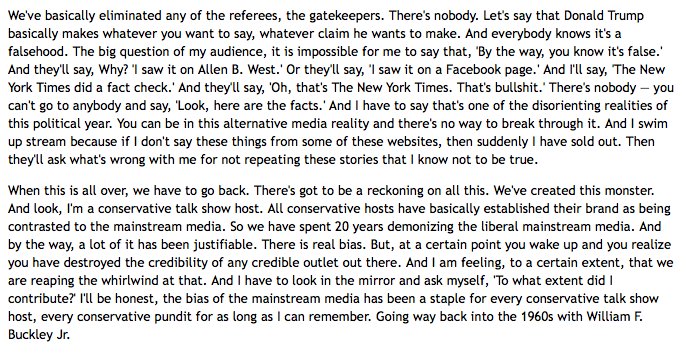
Charlie Sykes, the conservative talk-radio host who appears to have finally “had it” with the excesses of the movement that he himself had a prominent role in creating, penned an important op-ed recently for the New York Times that gets at the heart of what the eristic style has done to conservatism. He writes:

Not surprisingly, the vast majority of airtime on conservative media is not taken up by issues or explanations of conservative approaches to markets or need to balance liberty with order. Why bother with such stuff, when there were personalities to be mocked and left-wing moonbats to be ridiculed?

What may have begun as a policy or a tactic in opposition has long since become a reflex. But there is an obvious price to be paid for essentially becoming a party devoted to trolling. In the long run, it’s hard to see how a party dedicated to liberal tears can remain a movement based on ideas or centered on principles.

Conservatives will care less about governing and more about scoring “wins” — and inflicting losses on the left — no matter how hollow the victories or flawed the policies. Ultimately, though, this will end badly because it is a moral and intellectual dead end, and very likely a political one as well.

If you want to test Sykes’ argument, just go to Facebook and monitor the posts of your self-identified “conservative” friends. You won’t see much original argument or insight, but you will see a boat load of memes mocking liberals. (There are of course exceptions, but the exceptions always seem to prove the rule.). Is this entirely because of Roger Ailes and Fox? No, but Fox has for over 20 years produced an almost intoxicating brand of eristic that has normalized mockery, name-calling, and knocking down straw (wo)men as legitimate forms of conservative argument. If liberalism died because its advocates lack guts, maybe conservatism died because, as Stephen Colbert famously noted in his roast of George W. Bush, it argues “from the gut.”

So addictive is the eristic that if you point out the strategy to the addicts, a typical response is “whataboutism;” “Whatabout when liberals attack conservatives? Whatabout that professor’s commencement speech? Didn’t she call Trump names?”  Etc. etc. A great sign of a philosophy going bankrupt is when its adherents are reduced to answering all major criticisms by pointing out the hypocrisy of the critics.


Eristic argument will always be with us. The answer is not to censor it or whine about it, but to teach citizens how to recognize it. Once citizens recognizes the eristic at work, they can seek out more ethical discourse interested in the pursuit of truth as opposed to the pursuit of power and ratings points. Even better, they can become a more active contributor to the media; we need more blogs, newspaper columns, social media posts, podcasts, and other forms of media that reject trolling (i.e. the eristic) and seek understanding and insight. Drown out the eristic with a healthy dose of ethical citizenship. 

Monday, May 01, 2017

Still Bombing After All These Years

Last month we were bombarded (pun intended) with  news that the US had dropped the "mother of all bombs" on Afghanistan. According to the New York Times, "The bomb explodes a few feet above the ground, and is designed to send a devastating wave of fire and blast hundreds of yards to kill troops, flatten trees, knock over structures, collapse cave entrances and, in general, demoralize those far beyond the impact zone." For sheer awe and shock theatrics and destruction, only a nuke can surpass the MOAB. 

Because the MOAB was dropped on "ISIS caves," (caves probably financed and built with CIA assistance in the 1970s and 1980s) reaction from establishment Democrats was predictably muted. Rather than join former Afghan President Hamid Karzai in condemning as an "immense atrocity" the use of Afghanistan as a testing ground for the use of weapons of mass destruction to "send messages" to North Korea or other alleged enemies of the homeland, Democrats instead chastised Donald Trump for his lack of a coherent "strategy" in the region. So presumably if the Administration develops something resembling a coherent strategy, the use of weapons of mass destruction will become okay. Now there's a position that will attract rural voters in for the Dems in 2018 and beyond! (That sentence is meant to carry MUCH sarcasm.).

There was a time when even the threat of using such weapons would be met with some kind of organized, large scale outrage: marches, teach-ins, letter writing campaigns, etc. Not anymore. The logic and tactics of the "War on Terror" have apparently become so deeply internalized that even a moderate to left leaning source like vox.com can write about the MOAB strike, with no irony or sarcasm, "There’s no reason to assume this was something out of the ordinary, even though the bomb was bigger than ones typically used by the US military." 

So how did the logic and tactics of the "War on Terror" become normalized? How did nonstop bombings become "ordinary?" Are we really at the point where the US government has to drop a nuke in order to cross the line into "out of the ordinary" aggression?  


I think the simplest answer can be found in President George W. Bush's Address to a Joint Session of Congress on September 20, 2001. That speech came to be known as "Freedom and Fear are at War." As someone who has an academic background in the history of American political speeches, I can say with some degree of confidence that President Bush's 9/20/01 address is probably the most consequential presidential speech ever delivered. Every military action taken abroad--and every assault on civil liberties at home--during the Bush, Obama, and now Trump administrations, makes complete sense when evaluated in accordance with the framing of the "War on Terror" found in Bush's speech.


In the speech, Bush argued that those responsible for 9/11 were the modern day equivalent of fascists, Nazis, and totalitarians; they were part of a global terror network operating in more than 60 countries. They hate us because of our freedoms and because we stand in the way of their desire to overthrow existing governments and drive Israel out of the Middle East. 

President Bush then warned us of the never ending war that was to come: 

Now this war will not be like the war against Iraq a decade ago, with a decisive liberation of territory and a swift conclusion. It will not look like the air war above Kosovo two years ago, where no ground troops were used and not a single American was lost in combat. Our response involves far more than instant retaliation and isolated strikes. Americans should not expect one battle, but a lengthy campaign, unlike any other we have ever seen. It may include dramatic strikes, visible on TV, and covert operations, secret even in success. We will starve terrorists of funding, turn them one against another, drive them from place to place, until there is no refuge or no rest. And we will pursue nations that provide aid or safe haven to terrorism. Every nation, in every region, now has a decision to make. Either you are with us, or you are with the terrorists. From this day forward, any nation that continues to harbor or support terrorism will be regarded by the United States as a hostile regime.

As much as Barack Obama and Donald Trump condemned and critiqued the ineptitude of the Bush Administration's conduct of the wars in Iraq and Afghanistan, Obama and now Trump both left the essential features of the never ending war untouched. Bush and Obama at least pleaded with Americans to avoid scapegoating and demonizing Muslims, a plea of basic decency that is too difficult for the Tweeter in Chief, but it is just plain delusional to think that Trump is conducting the never ending war in a way that is significantly more violent than his predecessors. Trump's Pentagon is operating within a framework devised by Bush and reinforced by Obama.

Just consider the data from President Obama's last year in office. According to the Council on Foreign Relations, in 2016 the United States dropped 26,172 bombs on 7 nations. Here's the breakdown by nation: 


*Syria:............. 12,192 bombs 
*Iraq:................12,092 bombs
*Afghanistan:.....1,337 bombs
*Libya:..................496 bombs
*Yemen:..................35 bombs
*Somalia:................14 bombs
*Pakistan:.................3 bombs 

NBC news reported that the 2016 bombings equate to an average of 72 bombs per day or 3 per hour. For those who appreciate Orwellian Newspeak and/or in-your-face evidence of the global domination of the military-industrial complex, the US military affectionately refers to the bombing campaigns as "Operation Inherent Resolve." They even have a cheerful website.  


Can all of these bombings possibly be legal under US law? (Let's not even ask about if the bombings are legal under international law because we know the US government will only follow said law when it is convenient to do so.). In an intelligent piece for Slate, Joshua Keating argues persuasively that  "Questions of executive power in war are often more a question of political precedent than written law, and the way the previous administration conducted operations in countries including Pakistan, Syria, Libya, Yemen, and Somalia helped normalize the notion that limited airstrikes are not 'real' war.'" That political precedent was framed and initiated by Bush, reinforced and made normal by Obama, and now, with Trump, giving us a more hostile and vile rhetoric to match the violence on the ground. I mean, when Trump says he wants to "Bomb the shit out of ISIS" he is merely providing a more blunt description of what the prior administrations did for the previous 15 years (contrary to the right wing Republican wingnut view that Barack Obama was somehow a pacifist on foreign policy.).

Serious questions: Does anyone seriously, sincerely think that these legally dubious bombings that probably kill more innocent civilians than we are told do anything to reduce the threat of terror? Is it not more likely that each bombing raid actually increases the chance of terror in all the nations supporting the US? 

Forget for a moment the propaganda-ish claims of war and bombings somehow reducing terror. What about the actual monetary costs of the war(s) started by President Bush and a compliant Congress (not to mention a lapdog media) on September 20, 2001 and continuing today? Political Science Professor Neta Crawford of Boston University has done some of the most thorough research on this topic. In her piece US Budgetary Costs of Wars Through 2016: $4.79 Trillion and Counting,"  she provides a sobering reality check: 


As of August 2016, the US has already appropriated, spent, or taken on obligations to spend more than $3.6 trillion in current dollars on the wars in Iraq, Afghanistan, Pakistan and Syria and on Homeland Security (2001 through fiscal year  2016). To this total should be added the approximately $65 billion in dedicated war spending the Department of Defense and State Department have requested for the next fiscal year, 2017, along with an additional nearly $32 billion requested for the Department of Homeland Security in 2017, and estimated spending on veterans in future years.


And in the "insanity means doing more of the same but expecting a different result" category, the press is reporting that Trump and a bipartisan coalition of Congressional representatives will avert a government shutdown in part by giving the Pentagon a $12.5 billion increase for the fiscal year ending September 30. There's also "the possibility of an additional $2.5 billion contingent on Trump delivering a plan to Congress for defeating the Islamic State militant group." (Reuters). 

In short, in the last 16 years we've seen that the basic outlines of the "War on Terror" outlined in a general way by President Bush on 9/20/01 have remained solidly in place. The "Bush Doctrine" or preemptive strikes against those labeled as terrorists--or against those who "harbor" them, has been the dominant foreign policy strategy through three consecutive administrations, with wide bipartisan support in Congress.


What would be an alternative to the Bush Doctrine? When Barack Obama campaigned in 2008 on the platform that he would seek to negotiate with Iran, many of us thought he was signaling an intention to reinvent American foreign policy in a way that would minimize the "good v. evil" structures in our political rhetoric that almost always lead to pointless war and bombing. But alas, it never happened. Save for the Iran nuclear deal, Obama for the most part left the Bush Doctrine intact.

In a 2014 op-ed, political science professor Christopher Hobson describes the kind of changed thinking that needs to happen in Washington if we are ever to have a chance at a future not plagued by an ill-defined, never ending war. He wrote:


When looking at Iraq and Syria it should be apparent that there are simply no good solutions immediately available. The horrific acts of Islamic State should be denounced and the international community must consider how it can limit the suffering of affected people. But acknowledging this messy and brutal reality also means coming to terms with Islamic State as a political actor, which is motivated by grievances and goals.


The longer we dismiss Islamic State as an “apocalyptic death cult” or medieval savages, the longer it will be before we can devise a more effective response to dealing with the terrifying challenge they represent.

 
Given the heightened emotions, confusion, and panic generated on September 11, 2001, President Bush can perhaps be forgiven for not immediately responding to the crisis by seeking to come to terms with America's adversaries as political actors motivated by grievances and goals. But we've now had a decade-and-a-half worth of nonstop war and bombing rooted in the vision set out by Bush on 9/20/01. At what point do we as a People start to demand a rethinking of the assumptions and language that put us in this position?

If you would like to keep track of the bombings, go to airwars.org.

Monday, April 03, 2017

Comedy in Crisis

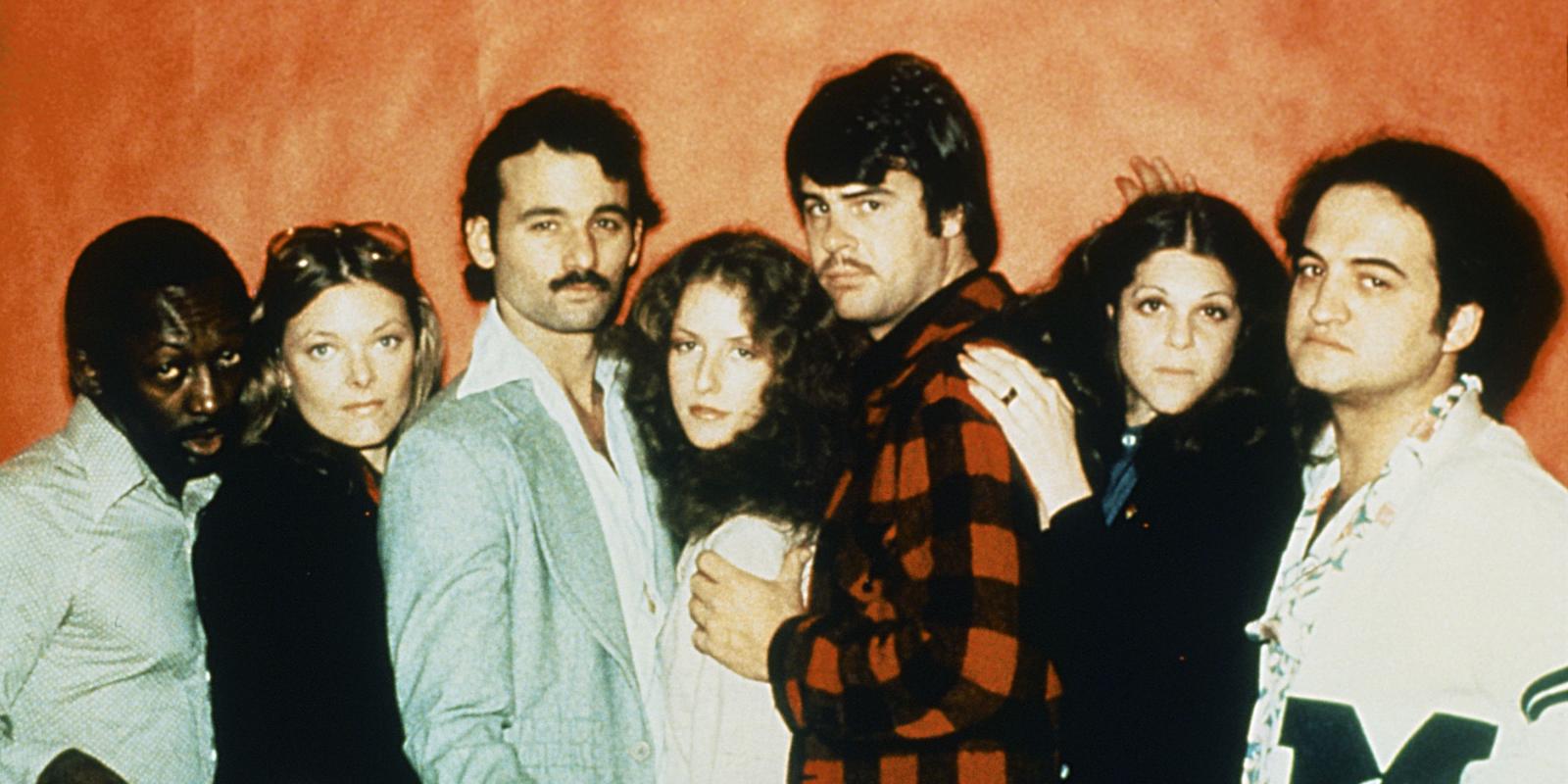
When NBC's Saturday Night Live debuted in October of 1975, I was a freshman at Archbishop Molloy, at that time an all boys high school in Queens, NY. SNL's original "Not Ready For Prime Time Players" (especially Chevy Chase, Gilda Radner, Jane Curtin, Garrett Morris, John Belushi, Dan Aykroyd, and Laraine Newman) had an authentic irreverent and anti-authority vibe to them that deeply impressed a kid experiencing the weirdness of being in a gender-segregated Catholic school at the height of the Second Wave feminist movement of the 20th century. Thanks in no small part to [what I perceived to be] the rebel comedy promoted by SNL, I learned to laugh at some of the absurdities of my school and life in general rather than get depressed or angry. I suspect millions of Americans had a similar experience. (Today we would probably all be put on adderall, ritalin, and/or anti-depressants).


Archbishop Molloy enforced very high academic standards; Molloy Boys learned American history and were forced to read classic literature. Thus my viewing of SNL from the beginning was filtered through a historical/critical lens. I could see how the SNL writers in their penchant for satire and social commentary were somewhat like a modern day Jonathan Swift--though less profound than the Swiftians called Monty Python's Flying Circus across the pond in the United Kingdom. I could even recognize some Mark Twain and George Bernard Shaw in the early skits, but the more immediate influences seemed to be edgy comics of the 1960s like George Carlin, Lenny Bruce, the Smothers Brothers, Richard Pryor, and Rowan and Martin's Laugh-In.

Thanks to Donald Trump, the 2017 version of SNL is more political than usual, and politics combined with a ratings surge has critics and viewers comparing today's show to the 1970s version. The comparison doesn't really hold up because the earlier show and today's appear in radically different contexts. When the 1975 SNL entered the scene, America had just been through an extremely turbulent period featuring assassinations (two Kennedys, Malcolm X, King), campus strife, a variety of movements pushing for social change, the Watergate scandal, and ultimately President Nixon's 1974 resignation. The fact that not only did Nixon resign, but 18-year-olds got the right to vote and protests helped bring the Vietnam War to an end were widely perceived as signs that--however imperfectly--civic engagement and America's democratic institutions did work the way they were supposed to. In that context, the 1975 SNL was a kind of "comic relief" not needed to end an ill-advised war or topple a corrupt president because those crises had already passed. I don't think it's a coincidence that disco music arrived on the scene at the same time: after more than a decade of social and political chaos, millions of people felt they had earned the right to just laugh and just dance.

Unfortunately, SNL never quite got out of the "comic relief" mode. The show never was a serious threat to the political or news media establishment, and by the 1980s had pretty much become part of that establishment. SNL introduced many brilliant comics over the years (Eddie Murphy, Bill Murray, Tina Fey, Dana Carvey, Kristen Wiig, etc. etc.), but no one ever looked to SNL as an ally in the struggle against Reaganomics in the 1980s, "free trade" deals and deregulation in the 1990s, or the War on Terror in the 2000s and beyond. If anything, the power brokers that have given us Reaganomicsfreetradederegulationwaronterror (yes, I made up a word) over the last 30  years have looked forward to their portrayals on SNL, sometimes even yukking it up with the performers at various galas and occasionally even on the show. In fairness, SNL from the beginning did not pretend to be anything more than comic relief.

But today we've got comedy in crisis. I mean that in a couple of different ways: (1) comedy exists IN the crisis of the Trump years, but (2) COMEDY itself is in crisis. If we truly are in a national political crisis unlike anything we've seen in our lifetimes, then "comic relief" just won't cut it.

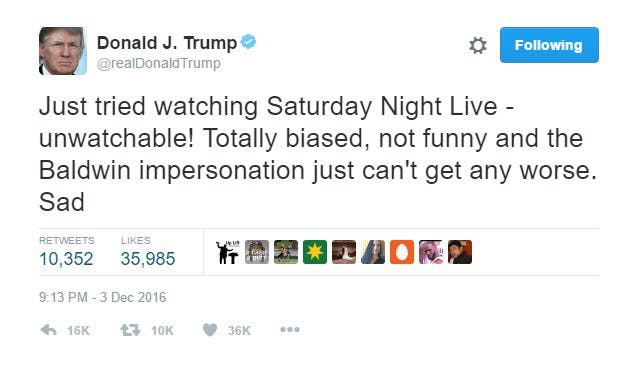
So what could we say about SNL in these early days of the Trump years? We know that the Tweeter-in-Chief watches the program, as evidenced by his tweeted dislike of Alec Baldwin's portrayal of him. For me, Baldwin's Trump doesn't go much beyond comic relief. Sure, he capture's the president's narcissism, inability to take responsibility, vulgarity, and intellectual limitations. But in so doing, Baldwin and the writers merely display the obvious. Great caricature, like great satire generally, succeeds most when it shows us what is NOT obvious. Baldwin himself told the UK Press Association recently that Trump is "satire resistant" and that he might not repeat the role for next season's SNL because “If everything stays the same in this country as it is now I don’t think people are going to be in the mood to laugh about it come September.”


If I were calling the shots at SNL I'd hand the Trump role over on a permanent basis to the African-American comedienne Leslie Jones. Her portrayal puts on display the president's greatest fear: that people of color and women can reduce him to a laughing stock, primarily by doing their job with more skill and competence than he can do his. She's also been a victim of racist Twitter trolling, an experience that will come in handy as she awaits the 140-character wrath of Trump

Gender-switching has actually been one of the more intriguing aspects of this year's SNL. Melissa McCarthy's send-up of White House press secretary Sean Spicer became iconic almost instantly. When watching the real Sean Spicer perform, one gets the feeling that--as with all press secretaries for all presidents--he is bending over backwards to satisfy his boss. Yet rarely has anyone in that position seemed so willing as Spicer to sacrifice all personal integrity so as to be a point man for the president's alternative universe. McCarthy's Spicer is an arrogant, belligerent dumb ass so obsessed with maintaining the "tough" image of the Trump White House that he feels compelled to defend the indefensible at every turn.

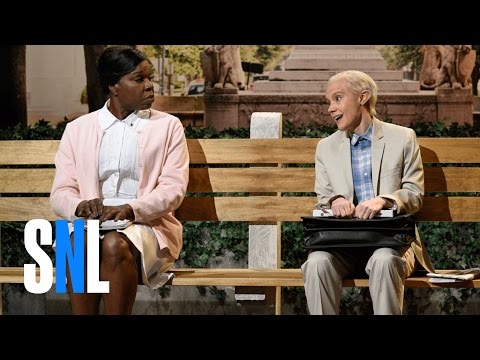
Kate McKinnon's SNL portrayal of Attorney General Jeff Sessions has not received the attention of Baldwin's Trump or McCarthy's Spicer, but in my view it's a more important performance. McKinnon's Sessions hides an attitude of intolerance and a willingness to lie for personal gain and to protect cronies under a thin "aw shucks" veneer that eerily channels the real Jeff Sessions. I've been following and been bothered by Jeff Sessions for his entire career in the United States Senate, but it really wasn't until McKinnon's caricature that I finally figured out what it is about him that has irked me all these years. It's not the intolerance and the lying; we expect those things from politicians. Rather, it's what I'll call a "banality of evil lite;" Sessions can exude a charm and surface-level civility at the same time communicating deep hostility toward political opponents or anyone defined as "the other." He's a "nicer"--but more dangerous because he's smarter--version of Trump, something that is not immediately obvious but shines through in McKinnon's portrayal.


The performances of Baldwin, McCarthy, and McKinnon show that SNL in the Trump era is interested in going beyond mere "comic relief" in response to the times. Those of us who believe that the nation really, truly is in an existential crisis should appreciate what SNL is doing at the same time recognizing that comedy produced by profit-driven corporations can only go so far. SNL is not and will never be Charlie Hebdo (neither is any other popular comedy found on the networks or cable stations).

For what it's worth, here's my advice for SNL going forward. For the remainder of the Trump presidency, make every "Weekend Update" segment into a serious news broadcast. Invite people who are being directly harmed by Trump's policies to participate in that segment, either live or by taped interview. Introduce the revamped Weekend Update section with a statement like this:

Saturday Night Live has always been and will continue to be a source of comic relief during tough times. We've always believed that comedy and laughter were the best medicine for whatever's been ailing our nation. We still believe that, which is why SNL will continue to feature the most cutting edge comedy we can produce. But like millions of Americans, we're deeply disturbed by what we see as the current administration in Washington's willful and persistent attacks on democratic institutions, the media, and really anyone that disagrees with them. We've tried to make fun of the abuses that we see, but there comes a time when even professional comics have to admit that some things just aren't funny. Therefore, for the remainder of the Trump presidency the Weekend Update segment will be a serious newscast designed to (1) explain clearly what kinds of abusive policies are being hatched and put in place in Washington and (2) introduce our viewers to some of the real victims of those policies.

We know that in reformulating the Weekend Update we are inviting harsh attacks from political partisans and hacks. We expect a windfall of hostile tweets from the Commander-in-Chief. We expect to lose advertising revenue. We expect to be mocked by other comedy  shows. We expect to lose some of our most loyal fans who will sincerely disagree with our decision to place serious news and commentary in a comedy show. 

SNL is produced by writers and performers who are citizens just like you. It's important to us, as citizens, to know that we are doing everything within our power to protect this great country from threats to its core democratic freedoms. We believe that the revamped Weekend Update is a small but potentially powerful way to do that. Please watch it with an open mind and let us know what you think. 

Tuesday, February 28, 2017

Know Your Enemies

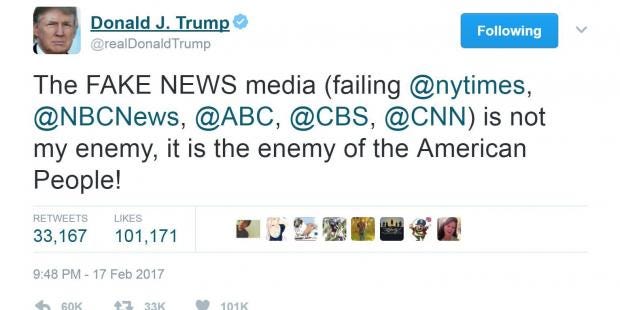
Donald Trump, who received approximately five billion dollars in free media advertising during his presidential campaign/reality show, is rightly being condemned from all sides for his self-serving claim that mainstream media sources are "enemies of the American people." The phrase has an ugly history, as noted by journalist Veronika Bondarenko: "Over the course of the last century, it has been used repeatedly by dictators and autocrats to delegitimize foreign governments, opposition parties, and dissenters." 

Freedom loving people of course need to stand up to the Trump/Bannon attacks on the First Amendment and other constitutional freedoms. On the other hand, let's be wary of attempts by the mainstream press to exaggerate the extent to which they do in fact serve the interests of The People. Just because an institution is not the "enemy" of the people does not mean that same institution is a "friend" to them. In a free market media system, the people are "units" sold to advertisers. Fox News or CNN, for example, says to a pharmaceutical company, "we can deliver 8.2 million units to see your product ad in prime time on the evening of the State of the Union Speech." The more units that can be delivered, the higher the ad rate. That some great journalism is produced under those conditions is remarkable. That lots of crappy journalism is produced under those conditions is to be expected. That a con man like Donald Trump figured out how to play this system all the way to the White House would be funny were it not for the fact that he now commands the most powerful military in the history of the world. 

A common response by the mainstream media to Trump's accusations of their enemy status has been to call on establishment figures as character witnesses. The most pathetic example was NBC's recent decision to trot out former President George W. Bush to make a statement about the need for an independent media to hold the powerful to account. 

While it is nice to hear the former President express a coherent thought about the need for a free press, the fact of the matter is that during his time in office he was rarely held to account. The mainstream media's performance in the lead up to the Iraq War and its immediate aftermath remains as arguably the lowest point in the history of American journalism. As the war dragged on only comic Stephen Colbert and an occasional journalism student seemed interested in pressing for real accountability. 


If Matt Lauer and NBC wanted to provide viewers with a sense of how a compromised media can undermine democracy and destroy lives, they should interview more Gold Star Families who daily live with the consequences of a media that failed to hold leaders to account. 

Don't hold your breath waiting for those interviews. The best media criticism of the last 50 years--think George Seldes ("The Real Fascists of America are never named in the commercial press."), Noam Chomsky, Amy Goodman, Bob McChesney, Chris Hedges--has shown how American corporate media more often than not finds ways to marginalize, ignore, misrepresent, or undermine peoples' movements for peace, justice and a variety of additional causes. This does not make corporate media the "enemy" of the people, but it does force passionate citizen activists to dedicate valuable time and resources to finding ways to attract media attention and struggle to get stories framed in ways that might actually motivate citizen action. Few citizens have the kind of training necessary to engage the media in this fashion, which is one of the major reasons why so many critical local, state, national, and international stories remain unknown or under reported. 

Clearly, the Trump/Bannon strategy is to exploit the existing disgust with the mainstream media to facilitate the rise of Breitbart.com and other Alt-Right vehicles as legitimate alternatives. How does the mainstream media defend itself in such an environment? Here's a thought: develop trusting relationships with listeners, readers, and viewers. Since it seems that subscriptions to mainstream media sources are actually increasing under Trump, these sources should treat the new subscribers to a new business model. Instead of responding to Trump, respond to the subscribers--develop a citizen based news agenda. Or as Jon Stewart put it recently, it's time to get your groove back. 


Mainstream media are not and must not be the enemies of the American people. But if they do their job ethically, they can help us all to discover what and/or who are the real enemies of the American people. 


Tuesday, January 31, 2017

Media Rants: Censored in 2016

Censored in 2016

When the late Sonoma State University Professor Carl Jensen founded Project Censored in 1976, he probably could not have imagined that 41 years later we would be living in a “post-truth” era featuring absurdities like presidential flacks citing “alternative facts” in a debate about the crowd size at an inauguration. The fact that we even have a national leader who obsesses over crowd size I am quite sure would have disturbed Jensen—as it should disturb any thinking person. The point is that given the troubling character of the times we are living in—and the deeply troubled characters leading the United States—fretting over corporate media censorship almost seems quaint and beside the point. Maybe it’s time for every patriotic citizen to find ways to connect meaningfully with the resistance movement started at the January 21 Women’s March on Washington, a march which I am sure the “size matters duo” of Trump/Bannon were horrified to learn may have been the largest demonstration in US history.
On the other hand, those grassroots activists sparking resistance to the Trump/Bannon regime cannot be successful as long as the body politic continues to distrust the establishment press as much as it distrusts establishment politicians. By pointing fingers at critical issues not be covered adequately—or covered at all—by the establishment media, Project Censored instructs said media on the easiest way to gain public trust: COVER THOSE STORIES! Even better, when covering the stories do not fall into the typical corporate media habit of filling the story with special interest “experts,” partisan hacks,, mainstream politicians, and others detached from the reality of the story being presented.


Annually Project Censored compiles a volume of news stories "underreported, ignored, misrepresented, or censored in the United States. New York University media professor Mark Crispin Miller writes of the Project that “Most journalists in the United States believe the press here is free. That grand illusion only helps obscure the fact that, by and large, the US corporate press does not report what’s really going on, while tuning out, or laughing off, all those who try to do just that. Americans–now more than ever–need those outlets that do labor to report some truth. Project Censored is not just among the bravest, smartest, and most rigorous of those outlets, but the only one that’s wholly focused on those stories that the corporate press ignores, downplays, and/or distorts.” The legendary Walter Cronkite said that “Project Censored is one of the organizations that we should listen to, to be assured that our newspapers and our broadcasting outlets are practicing thorough and ethical journalism.”  Bestselling author and activist Naomi Wolf asserts that, “Project Censored is a lifeline to the world’s most urgent and significant stories.” 

Project Censored is famous its nontraditional definition of censorship, referring to it as “anything that interferes with the free flow of information in a society that purports to have a free press.” They argue that censorship includes not just stories that were never published, but also “those that get such restricted distribution that few in the public are likely to know about them.” Going forward, I hope the Project includes another, more current form of censorship: those stories that are so contaminated by “alternative reality” frames that discovery of the “truth of the matter” becomes all but impossible. Unless the press finds a way uphold Journalism 101 values in this hostile Trump/Bannon atmosphere, expect many of the latter stories in the next 4 years.

Censored 2017: The Fortieth Anniversary Edition (Seven Stories Press) is dedicated to the late media scholar and critic Ben Bagdikian, who in his seminal work The Media Monopoly wrote that “Media power is political power . . . To give citizens a choice in ideas and information is to give them a choice in politics: if a nation has narrowly controlled information, it will soon have narrowly controlled politics.”  Censored 2017 continues the Project’s annual exploration of what a panel of judges determines to be the top 25 most censored stories of the year. The top five are: (5) Corporate exploitation of global refugee crisis masked as humanitarianism, (4) Search engine algorithms and electronic voting machines could swing 2016 election, (3) Rising carbon dioxide levels threaten to permanently disrupt vital ocean bacteria, (2) Crisis in evidence-based medicine, (1) US military forces deployed in 70 percent of world’s nations. Each is thoroughly summarized and explained and provides citations to the independent (and in some cases courageous) works of journalism that made knowledge of the stories possible.

My own personal choice for the most censored story of 2016 is, paradoxically, the one that received the most media coverage: the entire presidential campaign season. We expected third parties and even the Sanders campaign to be treated shoddily by the corporate press, so there was no surprise there. We also expected—and sadly got—the media obsession with horse race journalism featuring months’ worth of covering mostly polls and “insider baseball” interpretations of them. What was somewhat surprising this time was the extent to which the corporate media completely abandoned even a pretense of being concerned with issue coverage. As reported on in many sources, the respected Andrew Tyndall Report found that Since the beginning of 2016 to late October (about two weeks before the election), ABC’s World News Tonight, CBS Evening News and NBC Nightly News have devoted just 32 minutes to issues coverage.

For all his brash talk about hating the media, especially television, Donald Trump exploited it more skillfully than any other candidate in the history of the United States. He did it by recognizing that, above all else, television is an entertainment medium. Back in 1985 Neil Postman in his classic Amusing Ourselves to Death (with the crucial subtitle “Public Discourse in the Age of Show Business”) wrote that “Americans are the best entertained and quite likely the least well-informed people in the Western world.” (See Chris Teare's application of the book to Trump here.) That book was widely read in its time, and I thought it presented an ethical challenge to both the media and politicians: since Postman made it clear that the reduction of politics to entertainment always carried the risk of producing terrible public policy, politicians and media had to make the choice whether to inform or to entertain. For politicians and the media, making the choice to inform means risking less popularity and lower ratings. Making the choice to inform also carries the risk that the now informed public will put more pressure on the politicians and media to address serious issues in a meaningful way.


In 2016 Donald Trump and the majority of the establishment media made the choice to go into full-blown entertainment mode. Trump’s tweets, often incomprehensible if not just plain ignorant, were covered as if they were serious campaign documents. The networks repeatedly allowed Trump to call into programs, something that was historically rare for candidates and which was done for no discernible reason. When journalists did try to push back against Trump, he turned them into what NYU journalism professor Jay Rosen calls a “hate object,” (scroll down to the 7th paragraph) something which only increased the entertainment value of the campaign.

It didn’t have to be this way. Major media could have talked less to Trump and his surrogates and talked MORE to the voters who found the campaign attractive. After the election, MSNBC did a town hall forum with Bernie Sanders surrounded by white working class Wisconsinites who voted for Trump. The forum was a fascinating exchange, with Sanders actually persuading a few of the participants to his side by doing nothing more than stating the same views he had espoused for over a year during the campaign. The questions I was left with were, why are the media only NOW talking to these voters? Would it have not made more sense to include people like them as REGULAR features in the news cycle? Do you think the major media will be more willing to talk (and listen) to average, everyday citizens in 2020? No, I don’t think so either.

We’re now at the point where even the Koch brothers think that we are moving dangerously close to authoritarian rule. The irony of that is incredible when you consider the fact that the over the years the Koch’s have coopted andexploited legislative bodies in ways that Trump/Bannon may not have even dreamed of yet. But don’t worry, Trump/Bannon will get there. The question is, can or will the media uphold their responsibility to stop them? 

Monday, January 16, 2017

A Media Rant From 2003: King Karma

Note: Today is Martin Luther King, Jr. Day. The essay below was originally published in the March 2003 edition of the SCENE. Because recent events in our country have made King's message more urgent than ever, I'm reproducing the piece in this space. -Tony Palmeri

King Karma: Yesterday and Today

Media Rants by Tony Palmeri 

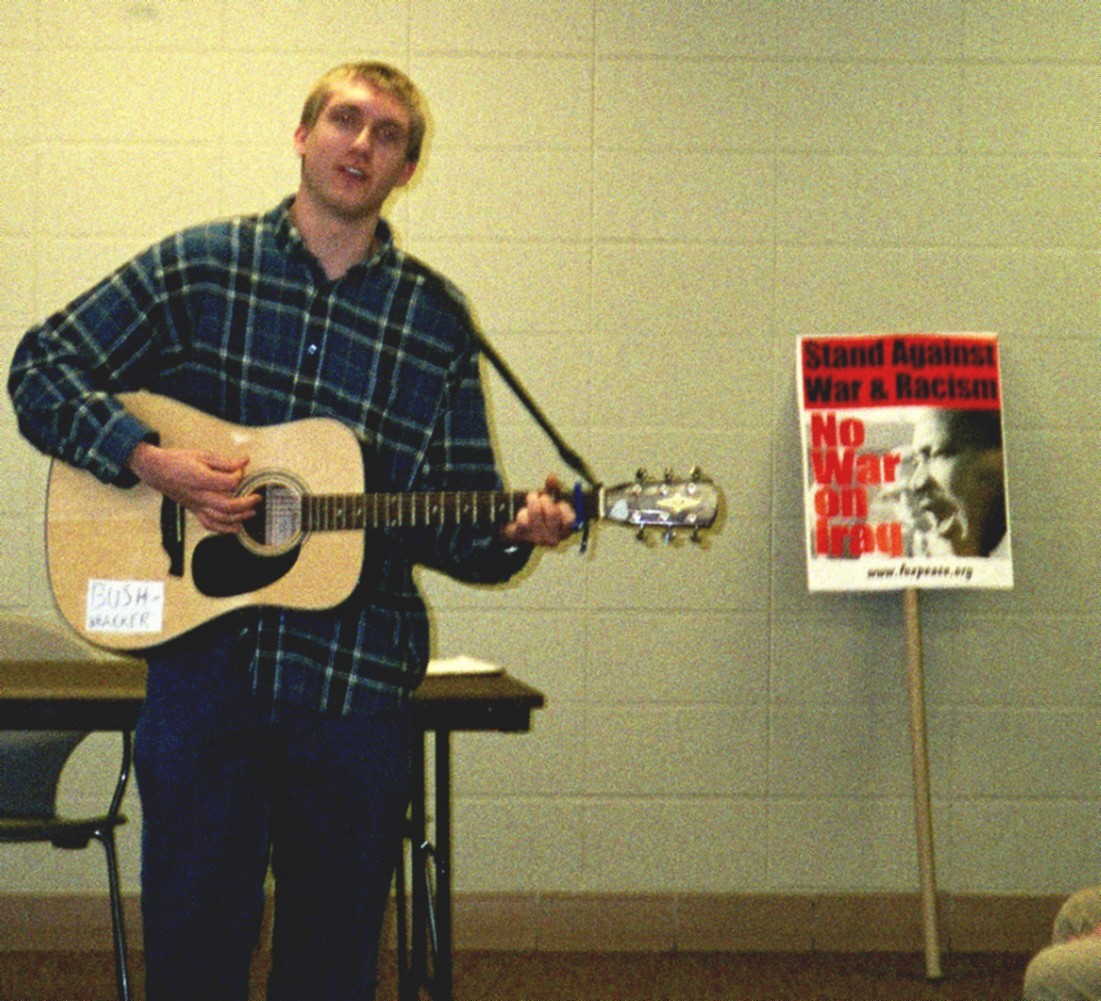
On January 20, 2003 in Oshkosh, the Fox Valley Peace Coalition sponsored a "March For the Life and Ideas of Martin Luther King, Jr." About 80 people braved blustering winds while carrying signs with sentiments such as "Unity Against Racism, Justice Through Peace" and "War Is Not The Answer." On a big banner stood this Kingism: "Wisdom born of experience should tell us that war is obsolete."

The march started at the downtown Opera House Square and ended at UW Oshkosh Reeve Union. Demonstrators listened to impromptu speeches and music by local folk singers Barry Weber and Jason Moon. My impromptu speech included another King aphorism: "Our scientific power has outrun our spiritual power. We have guided missiles and misguided men."

The feelings of goodwill made Dr. King seem eerily present. One woman called it "good karma." I said we should call it "King Karma" attributable to the fact that the slain civil rights leader visited this region in 1967. Puzzled, she said: "Martin Luther King was here?" In part because establishment media portray our region as uncomfortable with the kind of social justice Christianity preached by King, it is difficult to imagine that 36 years ago there would have been a constituency in place to invite him. Yet invited he was. In the remainder of this rant I'll describe the event specifics.

The Oshkosh Northwestern of Thursday, May 11, 1967 printed a brief announcement headlined "Broadcasts Set For King Talk." King would speak the next evening at 8:15 p.m. at the University of Wisconsin Fox Valley Center in Menasha. Radio stations WHBY in Appleton and WMKC in Oshkosh planned to broadcast the speech (entitled "The Future of Integration") live. Lawrence University's campus radio station WLFM planned to tape the speech for a Sunday broadcast. The announcement said King would speak also at the UW Marathon County Center in Wausau.

The May 12 Northwestern carried an item headlined "Large Crowd Expected For King Speech." UW Center English professor and event organizer David Price said that over 600 mostly students and faculty were expected to attend. Thirty-five Menasha police officers were assigned to the event.
Some time ago one of my undergraduate students named Heather Evert researched King's Menasha speech. She identified individuals in addition to professor Price involved with the planning. Communication professor Ken Anderson handled closed circuit television. Economics professor Val Kopitzke organized a reception. Cliff Miller, former Appleton Post-Crescent Madison Bureau chief, covered King's visit for the Twin City News Record along with his editor John Turinas. Lutheran Pastor Gerald Kissell's church held a reception for King. UW Menasha Campus Dean Jim Perry, who in 1967 was President of the UW Marathon County student government, shared the dais and introduced Dr. King at the Youth Building in Marathon Park. All were moved by the event. Dean Perry told me recently about King's influence: "I'm a firm believer that when people get to know people, be they African-American, Hmong, or Iraqi, Christian, Hindu, Islamic or Atheists, the insanity of war and political strife begins to come tumbling down. Dr. Martin Luther King started me on this path of personal conviction."

The May 13th, 1967 Northwestern carried two stories about the speech, headlined "Racial Injustice Still Negro Burden: King," and "Police 'Cover' King Speech." In an accompanying photo, two young women are carrying signs saying "There's no link between the Vietnam War and Civil Rights" and "King Let Your People Go!!" The Northwestern photo caption said, "Approximately one dozen local high school students marched outside the Fox Valley Center Friday night protesting the anti-war views of Dr. Martin Luther King Jr. They refused to reveal which school they attend. King barely touched on the subject of Vietnam in his speech." The paper reported expectations of 3 separate demonstrations, but only the one materialized.

The King Center in Atlanta does not have the Menasha speech, nor unfortunately did any of the Valley media keep copies of recordings. I spoke to Cynthia Lewis of the King Center Library and Archives who said that in 1967-68 King delivered "The Future of Integration" often. She sent me a manuscript delivered at Kansas State University in January of 1968. The Northwestern Menasha speech coverage and the Kansas speech indicate that King's main points centered on providing a history of racial injustice in America, a progress report on the accomplishments of the civil rights movement, a debunking of myths that get in the way of creating change, and calls for guaranteed employment and income. The Vietnam War he identified as not only "unjust and ill-considered," but a diversion from our domestic problems.


As I write it is February 16th, the day after millions of peace demonstrators in over 600 cities on 5 continents said a resounding NO to the George Bush, Tony Blair Iraq policy. One of the million protesters in Rome, 56-year-old Tommaso Palladini, expressed the King Karma: "You don't fight terrorism with a preventive war. You fight terrorism by creating more justice in the world."

Knowledge of King's visit enables contemporary peace and justice advocates in the region to hold one hand out to the past and reach out to the change agents of that time. The task then is to take the other hand and extend it into the future so that change agents 36 years from now can tap into the King Karma anew.

Saturday, January 07, 2017

Palmeri on WPR Week in Review

On Friday, January 6th I was a guest on Wisconsin Public Radio's Week in Review program. You can find the link here. Also a guest on the program was Marion Krumberger, Chair of the Brown County (Wisconsin) Republican Party.

Sunday, January 01, 2017

The 2016 Tony Awards

The 2016 Tony Awards

Media Rants


I’ve been a consumer and critic of American journalism since the Watergate era of the early 1970s. With some notable exceptions like Bob Woodward and Carl Bernstein’s Watergate reporting and the Boston Globe’s expose of the child rape scandal in the Catholic Church (chronicled powerfully in the great film “Spotlight”), national reporting/commentary on politics in that time has never been the CRUSADING FOURTH ESTATE we read about in Journalism 101 textbooks. But in only two years did American journalism sink to a level of badness that might with some justification be called “evil.”

The evil years of American journalism? Let’s call them 2003 and 2016.

For those who don’t remember (or choose to forget), 2003 was the year that American journalism not only failed in its basic watchdog responsibilities in the run up to the Iraq War and beyond, but even sunk to the level of pathetic cheerleaders.  The ultimate responsibility for that foreign policy fiasco rests with the Bush Administration and bipartisan majorities in Congress who went along for the death ride, but the sleazy politicians and war profiteers were aided and abetted every step of the way by a servile press that refused (and refuses to this very day) to allow arguments for peace to compete fairly with war mongering in the marketplace of ideas. As noted by journalism prof Christian Christensen: “The one-sidedness of coverage, particularly in the US, bordered on the morally criminal.”  

In 2016 Donald Trump—a narcissistic huckster, conspiracy monger, and public policy lightweight—took on the Republican establishment with a political shock and awe operation that took the typically subtle bigotry and intolerance of GOP campaigns and put it right in our collective face. The Donald’s entry into the race called for principled, courageous journalism; instead, a man who was probably the most divisive candidate in the history of the country received literally billions of dollars of free advertising. Trump’s tweets—which almost always demonstrate that he really is as delusional and dumb as you think—generated (and continue to generate) countless hours of “analysis” from the same pundits who assured us that Hillary’s “blue firewall” would rescue us from four years of orange hued oafishness.

But I digress. The purpose of this month’s column is not to condemn the year’s worst journalism, but to praise some of the best. Every year since 2002 I’ve awarded a “Tony” for journalism, commentary, and/or other media productions that, for some of us at least, went above and beyond the call of journalistic duty during the year. The winners for 2016 are:

Journalism as Creating Urgency: Rachel Maddow’s Flint Reporting. 2016 was a rough year for cable television liberals. Their acceptance of the legitimacy of the faceless, corporate controlled bureaucracy running the nation’s capital made it virtually impossible for them to come to terms with the populist insurgency represented by the Trump and Sanders movements.  Having disavowed grassroots activism as a viable political strategy, establishment liberals and their cable tv cronies were left with mocking Trump, ignoring Sanders, and monitoring Nate Silver’s 538 blog to reassure themselves that “moderation” (or at least lesser evilism) would ultimately prevail. Oops.

Like all other cable tv liberals, MSNBC’s Rachel Maddow had a rough time covering the presidential campaigns. Hopefully that will not detract from what for me was the single greatest act of journalism we’ve ever seen on cable television: I’m talking about Maddow’s shocking revelation of the racist politics that led to the poisoning of the water in Flint, Michigan. Ancient rhetoricians coined the term “kairos” to describe the act of giving urgency to an issue. Thanks to Maddow, the issue of excessive lead levels in public water supplies now has kairos in scores of cities. What made Maddow’s reporting especially powerful was the fact that she connected the dots and showed how the poisoning of Flint’s water was the DIRECT result of Michigan’s “emergency manager” legislation that robbed the city of its democracy.

The investigations sparked by Maddow’s reporting have led to criminal charges against two of the “emergency managers.” Both were thrown under the bus by Governor Rick Snyder—the mastermind of the emergency manager policy who-- if justice is to prevail in this tragedy, should at a minimum be removed from office and possibly face charges himself.

Best Trump Coverage (Tie): The New York Times’ David Barstow, Susanne Craig, Russ Buettner, and Megan Twohey on Trump’s taxes; The Washington Post’s David Fahrenthold on the Trump Foundation.  Not all mainstream media coverage of Mr. Trump was awful. When it became clear that Trump had no intention of releasing his taxes, and that he would continue to lie about the reason why (“I am under audit.” Right.), four New York Times reporters were able to get access to a portion of Trump’s 1995 tax return. Through some deft research, they discovered that Trump’s “net operating losses” from that year would have theoretically made it possible for him to avoid paying any federal taxes until 2010.

Did Trump respond to the New York Times report by pledging more transparency in his personal financial reporting? No. He claimed instead that the real story of the report was that the reporters illegally obtained the 1995 tax return.

Of all the mainstream journalists covering Trump, none is more forceful or important than the Washingon Post’s David Fahrenthold. Called “nasty” by Trump himself, Fahrenthold worked tirelessly in 2016 to try and hold Trump to account for his many claims and promises. Trump’s late December announcement that he would be closing down his Foundation was a direct result of the numerous irregularities in its operation uncovered by Fahrenthold. Not surprisingly, Trump’s alt-right minions claimed a partisan political agenda in the reporting, but as noted recently by Fahrenthold:

“The point of my stories was not to defeat Trump. The point was to tell readers the facts about this man running for president. How reliable was he at keeping promises? How much moral responsibility did he feel to help those less fortunate than he?

In 2017 we will need many MORE reporters asking such basic questions.

Best Tweetstorm: Jay Rosen’s “Winter is Coming”.  NYU Journalism Professor Jay Rosen’s writings, including his PressThink blog, have for years been invaluable resources for those seeking to figure out ways to make real world journalism live up to its promise of serving the cause of small-d democracy.

In 2016 Rosen took to Twitter to warn of the unique threats posed to press freedom by Donald Trump. The mindfulness of Rosen’s tweets run in perfect contrast to the mindlessness of Mr. Trump’s. Rosen’s 20-part tweetstorm, “Winter is Coming,” laid down what is (or should be) THE question for journalism in the Trump era: “The problem is not at the level ‘how to cover Trump,’ but how to recover conditions in which anything journalists do makes a difference.

Best Mea Culpa: Charlie Sykes on Where the Right Went Wrong. It took the specter of a Trump presidency to do it, but in August Charlie Sykes, the Dean of Right Wing Radio in Wisconsin, in an interview with journalist Oliver Darcy finally took some responsibility for the contemporary right wing’s alternate reality. Sykes followed up with a December op-ed in the New York Times in which he expanded how the situation had gotten so bad:

“One staple of every radio talk show was, of course, the bias of the mainstream media. This was, indeed, a target-rich environment. But as we learned this year, we had succeeded in persuading our audiences to ignore and discount any information from the mainstream media. Over time, we’d succeeded in delegitimizing the media altogether — all the normal guideposts were down, the referees discredited.
Sykes still insists that political con men like Paul Ryan and Scott Walker somehow represent a coherent “conservative” philosophy, and his many years of flacking for some terrible people and policies should not be easily forgiven or swept under the rug. But to have someone of his status and influence in conservative circles argue for the existence of reality is an important step in helping to reform partisan politics in this country.

Wisest Explanation of the Trump Phenomenon: Gary Younge’s “How Trump Took Middle America.”  In the 19th century the Frenchman Alexis de Tocqueville’s Democracy in America offered what was for its time an insightful interpretation of the United States from a European perspective. In 2016 it took another European, this time British journalist Gary Younge, to explain the Trump phenomenon. In a lengthy but gripping piece for the Guardian, Younge recounts his interaction with Trump supporters in the Midwest and shows just how completely out of touch were the establishment Democrats:

Trump, and his counterparts, are often described in Europe as a threat to democracy. But in truth they would be better understood as the product of a democracy already in crisis . . .

You can pin it on the Russians, WikiLeaks, the FBI, the media, third parties, and they all played a role. But sooner or later moderate liberals are going to have to own the consequences of their politics. In this period of despair and volatility, their offer of milquetoast, market-led managerialism is not a winning formula. For a political camp that boasts of its pragmatic electability, it has quite simply failed to adapt.

Carefully scripted but complacently framed, the Clinton campaign emerged from a centrist political tradition at a moment where there is no center, offering market-based solutions at a time when Clinton’s own base has begun to see the free market as part of the problem.

The Occam’s Razor Award for the Simplest and Most Cogent Statement of Why Hillary Clinton Lost: Lou Cannon’s “On the Importance of Just Being There.”  At some point establishment Democrats will get over their fixation with Putin, Comey, Jill Stein, and WikiLeaks and start to come to terms with some of the shortcomings of their 2016 campaign. They should start by reading Lou Cannon’s short but insightful essay, “On the Importance of Just Being There.” Cannon’s a long time political writer and operative who’s written five biographies of Ronald Reagan. He shows in his piece how Reagan almost lost the 1980 nomination because early in the campaign his handlers had calculated—inaccurately as it turned out—that he could run a kind of “Rose Garden strategy” and not have to do any street level campaigning. After losing the Iowa Caucuses, the Reagan people shifted gears and their candidate became more visible in key counties.

Hillary Clinton, who won the national popular vote by almost 3 million ballots, lost Wisconsin, Michigan, and Pennsylvania by less than 80,000 votes. Cannon argues that Clinton simply needed to spend more time in those states: “What we do know suggests that Hillary Clinton might now be preparing to take the oath of office if she and her team had been less confident of victory and campaigned full time in Michigan, Pennsylvania and Wisconsin, the firewall states that weren’t. Instead of blaming Putin or Comey for their discomfort, Clinton and her advisers should take a peek in the mirror.

The Guilty of Committing an Act of Journalism Award: Amy Goodman’s Dakota Access Pipeline Reporting. Democracy Now!’s Amy Goodman has been one of the MVP’s of citizen based journalism for many years. In 2016 her courageous reporting on the brutal corporate suppression of Dakota Access Pipeline protesters got her arrested. Charges were eventually dropped, and the Obama Administration did respond to the protest pressure by halting construction of the pipeline.

Without Amy Goodman’s reporting, the true nature of what was happening at Standing Rock would never have been known. She’s done that kind of reporting on numerous citizen movements, almost single-handedly challenging the narrative that the masses are apathetic or completely brainwashed by government and corporate propaganda. As noted by Rolling Stone’s Matt Taibbi: “she's as close to the ideal of what it means to be a journalist as one can get in this business.

Best New Critical Thinking Tool: Indiana University’s “Hoaxy”. One terrible consequence of the social media age is the rapidity with which completely unverified, false stories can spread. With hyperpartisans on all sides all too ready to accept the absolute worst about their opponents, the preponderance of so-called “fake” news will only get worse.

What’s needed is training in media literacy at the earliest possible age, probably middle school. Teachers involved in such training will need resources that can help them demonstrate to learners what constitutes an unverified story and how it spreads. In 2016 researchers at Indiana University launched “Hoaxy,” an online resource that allows users to visualize the spread of unverified information. According to the site’s creators: “The World Economic Forum ranks massive digital misinformation among the top future global risks, along with water supply crises, major systemic financial failures, and failure to adapt to climate change. Social news observatories such as Hoaxy have the potential to shed light on this phenomenon and help us develop effective countermeasures.”

Can Hoaxy and similar resources help reduce the spread of misinformation? Maybe, but only if we can find a way to restore trust in journalism and do what we can to spread the critical work represented by this year’s Tony Award recipients.