Monday, May 02, 2011

Media Rants: Inside Looking Out

Inside Looking Out

Media Rants

by Tony Palmeri

Shortly after moving to Oshkosh in 1989 to teach at the university, a student asked me to grade the local media’s reporting on local politics. I gave them an “F,” and explained that corporate newspaper, radio and television coverage of influential people featured shallow, incomplete and biased coverage favoring establishment interests.

Rather than bitch and whine, I followed a path punk rocker Jello Biafra later referred to as “Don’t hate the media, be the media.” Throughout the 1990s and 2000s I helped produce and host independent television and radio public affairs programs along with a blog and this column.

In 2007 the path took a detour when I was elected to the Oshkosh Common Council. For the first time I’d have the opportunity to evaluate media from an “insider” perspective. In April of this year I lost the election for the office of Oshkosh Mayor and decided not to run for another Council term, so I’m an “outsider” again.

But I want to reflect on those four insider years. Bob McChesney’s great 1999 book Rich Media, Poor Democracy argued that in a Democracy, journalism has three major roles: accounting of people in power, diversity of opinion, and fact checking. From an insider’s perspective, what grade do I give the local mainstream media on each role?

Let’s start with the worst, television. In four years on the Council, the only stories that piqued the interest of TV news producers were those featuring nasty neighborhood conflicts, like controversies over deer culling or building a Muslim mosque. Modern TV “journalists” in smaller markets like the Fox Valley are usually charming and pleasant, but seem incapable of exploring anything in depth and appear to have zero interest in critical issues affecting the health of cities (e.g. budget intricacies, bureaucratic incompetence) that do not produce great visuals for the TV screen. Just awful.TV grades:

Accounting of People in Power: F
Diversity of Opinion: F
Fact Checking: F

Radio’s only marginally better. In many cities a locally originated talk radio call in program becomes a way for public officials to feel the pulse of the people, and also helps keeps them accountable. Charlie Sykes plays that role effectively on the Right in Milwaukee, and John “Sly” Sylvester does it well on the Left in Madison. Oshkosh has no local call in for politics, while syndicated call in programs tend to be nothing more than wingnut bloviation.

Commercial radio these days dedicates limited resources to local reporting. Consequently, listeners get little insight about local government actions. Bob Burnell’s “Morning News Focus” on WOSH occasionally challenges local officials to defend a position, and at least he does provide a discussion forum. But overall, radio’s mostly a non-entity when it comes to playing a meaningful role in building a healthy Democracy. What a waste of air. Radio grades:

Accountability of People in Power: F
Diversity of Opinion: D
Fact Checking: F

In Oshkosh, print media’s dominated by Gannett’s Oshkosh Northwestern. They have very little competition (the UW Oshkosh Advance-Titan, for example, did not cover the race for Oshkosh Mayor even though both candidates were campus professors!). That’s unfortunate because profit-driven print media have minimal motivation to pursue high standards of journalistic and editorial excellence when they are the only game in town.

The Northwestern does a decent job, in reporting and editorially, on open government issues. But other than that they exist essentially as establishment cheerleaders. Almost every thinking adult in Oshkosh senses the pull of a deeply entrenched old boy network in the way the city is managed and in the underperforming patterns of economic development, yet the press is just not willing or able to crack that nut with the rigor or persistence that could win them a Pulitzer Prize.

In my four years on the Council I never refused a request to talk to Northwestern journalists, and often had lengthy conversations with them in which I offered facts and opinions that ran counter to the establishment view of the issue at hand. Most of that would not make it into the paper, of course, due to what one reporter once communicated to me as a problem of “getting my vetters to accept this.” By “vetters,” he meant the old boys protecting the old boys. Surely not unique to Oshkosh, but not any less frustrating because of that. Newspaper grades:

Accountability of People in Power: D
Diversity of Opinion: C
Fact Checking: C

What about alternative media like blogs, public access television, and social media like Facebook and Twitter? At their best, newer media challenge business as usual while providing information and viewpoints the mainstream press can’t or won’t go near. At their worst, they are little more than hyper partisan forums for misinformation and (often anonymous) cheap shots.

There are too many alternatives to grade as a group, but for me the most valuable was and is Main Street Oshkosh (mainstreetoshkosh.com). That site kept me accountable during my elected official insider days NOT by insults or questioning my integrity, but by pushing me to become better informed.

From the inside looking out, mainstream journalism turned out to be as subpar as I thought it was from the outside looking in. Inside or out, I’ll keep doing my best to raise the media bar.

Monday, April 04, 2011

Media Rants: On Legacies; Ellis, Moore, and Us

Note: The Media Rant below was submitted to the SCENE before the controversy erupted involving UW Madison Professor William Cronon and the Wisconsin Republican Party's requests for his emails. Like Cronon's New York Times op-ed, mine makes use of a Joe McCarthy/Scott Walker analogy. I agree with Professor Cronon that "Scott Walker is not Joe McCarthy," though my piece argues that Mr. Walker has divided Wisconsin in ways that McCarthy could not have even dreamed. But I am less interested in Walker and McCarthy as much as how RESPONSES to divisive politicians build a legacy for the person(s) doing the responding. Read on for more.

On Legacies: Ellis, Moore, and Us

Media Rants

By Tony Palmeri

from the April 2011 edition of THE SCENE

America ain't broke! The only thing that's broke is the moral compass of the rulers
. Michael Moore in Madison, March 5th 2011

In office for barely several months, Governor Scott Walker’s already managed to divide our state in ways the late commie hunter Joe McCarthy could not. At least Tail Gunner Joe could be excused as a bumbling alcoholic or inevitable product of anti-Communist hysteria going on at all levels of the federal government in the 1950s. And when the cameras were off McCarthy befriended his political opponents; the New York Times reported recently that he would often have lunch with Milwaukee’s Socialist Mayor Frank Zeidler.

In contrast, Walker breaks bread with supporters or sycophants. He found 20 minutes for a phone chat with a person he believed to be billionaire Republican operative David Koch, yet could not find 20 seconds for any Democrat who could have helped resolve the impasse over the “Budget Repair” bill. The Washington Post’s Dana Milbank listened to the Koch call and heard in Walker an “unprincipled rigidity” that sees politics as tribal blood sport featuring a “never-ending cycle of revenge killings.”

One good thing about politicians like McCarthy and Walker is that they force people in a position to influence current events to show their true grit. Well known politicians, pundits, business leaders, educators, and others end up intentionally or unintentionally building an entire legacy around their response to the McCarthy or the Walker.

Republican Senator Margaret Chase Smith in 1950 stood up to McCarthy as she delivered her courageous “Declaration of Conscience.” She left a legacy of integrity, arguing that the Republican Party should never ”ride to political victory on the Four Horsemen of Calumny: Fear, Ignorance, Bigotry, and Smear.” (Someone needs to get that speech to Sarah Palin or Mike Huckabee, among others.).

Edward R. Murrow became an icon of American journalism as a result of his WW II radio broadcasts, but his 1954 defense of the right to dissent and denunciation of McCarthyite excesses solidified his legacy as a champion of free speech and free association. Of McCarthy, Murrow said that, “his primary achievement has been in confusing the public mind,” a statement that sounds eerily contemporary as we listen to Mr. Walker’s mantra that the reason the state is “broke” is because of public worker wages and benefits.

The controversy over the Governor’s curtailing of collective bargaining rights and balancing the budget on the backs of the middle class and poor represents a legacy producing moment. Democratic Senators left for Illinois to filibuster the legislation, while their GOP counterparts (with the exception of Dale Schultz) rubber stamped the governor or, like West Bend’s Glenn Grothman, served as his unofficial attack dog. I predict history will judge the Fab 14 more kindly than Walker groupie Glenn.

But I want to single two public figures out for special mention: Neenah Republican Senator Mike Ellis and film maker Michael Moore. Ellis lost, and Moore left, a populist legacy in the state of Wisconsin.

Mike Ellis, who served in the Assembly from 1970 to 1980 and in the Senate since 1982, was always known as an independent Republican. His strong stands against pay to play politics and for good government gave Republican Tommy Thompson heartburn. His ideas for dealing with the state’s structural deficit never included repealing the right of public employees to have a seat at the bargaining table. He’s truly been a source of provocative and often progressive policy ideas.

Until now. When the people most needed Mike’s voice to push an extremist governor to moderation, he chose to shut up. Worse, when he did speak he often spread the stale GOP party line: “pass the governor’s bill or lose 1,500 jobs.” A formerly principled reformer with a populist edge now leaves a legacy as a political hack. Saddest. Transformation. Ever.

In contrast, film maker Michael Moore came to Madison and passionately defined the moment for thousands of rally participants. He demonstrated, in a pointed and clear way, that the current attacks on workers because “we’re broke” represent merely a continuation of the same dynamic that gave us the taxpayer funded Wall St. bailout in 2008. He challenged the mainstream media to just once state a truism:

Right now, this afternoon, just 400 Americans, 400, have more wealth than half of all Americans combined. Let me say that again. And please, someone in the mainstream media, just repeat this fact once. We’re not greedy; we’ll be happy to hear it just once. Four hundred obscenely wealthy individuals, 400 little Mubaraks, most of whom benefited in some way from the multi trillion-dollar taxpayer bailout of 2008, now have more cash, stock and property than the assets of 155 million Americans combined.

The Milwaukee Journal Sentinel’s Politifact meter rated Moore’s claim as True. Unfortunately what’s also true is that mainstream media moguls have no intention of repeating Moore’s claim with a frequency that might make it as well known as Charlie Sheen’s Twitter stats or Lady Gaga’s new look.

Moore predicts that the people will fix the broken moral compass of the rulers and “steer the ship ourselves from now on.” That would be a noble legacy for our generation to leave.

Tony Palmeri is a Professor of Communication Studies at UW Oshkosh

Saturday, March 05, 2011

Media Rants: Scott Walker and the WI Media's View From Nowhere


Scott Walker and the Wisconsin Media’s View from Nowhere

Media Rants

By

Tony Palmeri

Back in January of 1991 I traveled to Milwaukee to participate in a protest against Bush #41’s invasion of Iraq. Thousands rallied. An hour into the event, less than a dozen counter protesters showed up to back Bush. I went back to Oshkosh and eagerly anticipated news of the event.

Watching the mainstream media coverage, a few things stood out. First, the protest event itself was framed as a kind of political Olympics, an arena battle between competing teams. Second, the reporters and editorialists situated themselves as being outside the arena; just spectators watching and commenting on the action. Third, the coverage seemed lazy; i.e. simple “here’s what team ‘A’ says about the claims of team ‘B’” as opposed to a systematic and rigorous search for the truth. Fourth, after concluding that both teams were “outside the mainstream,” the media referees announced their own “moderate” views that were supposedly “objective” and ruled by reason and common sense not found in the rhetoric of the passionate Olympic teams.

Media treatment of the revolt of large numbers of working Wisconsinites against Governor Scott Walker’s plan to decimate public sector unions reminds me of that war coverage. Bill Lueders of the Madison Isthmus sees the pattern in the Wisconsin State Journal’s editorializing: “Two days after saying that moves to strip the collective bargaining rights of almost all public employees ‘aren't justified,’ it now urged that this be done, albeit just for the next two years, until June 2013. It also opined, ‘The chaos we're experiencing in Wisconsin is simply the extreme manifestation of politics as usual,’ suggesting that all sides are equally to blame for their inability to let go of excessive partisanship.”

The local Oshkosh Northwestern has been more critical of Mr. Walker’s bill, including a fine February 15 editorial exposing its draconian and unfair features. But then on February 19th the paper went back to an “objective” stance and concluded that both Republicans and Democrats were at fault for practicing a “politics that push issues to the far edges of ideology.” Thank goodness the editorial writers are always so moderate and responsible. (Sarcasm intended).

Mainstream television and radio coverage of protest events is typically much worse than newspapers, and that’s certainly been the case in Wisconsin. From TV especially it’s almost impossible to tell who is telling truth in the conflict. Instead, the “objective” newscaster tells us what each side says, with sensational pictures as a backdrop.

New York University Professor of Journalism Jay Rosen refers to the dominant style of American journalism as “the view from nowhere.” When I first became aware of Rosen’s idea in the mid 2000’s I thought he was perfectly describing the coverage of that earlier Iraq War protest and virtually all other substantive issues. As we shall see, the idea captures what’s going on in the Wisconsin media’s construction of Scott Walker’s row with unions.

Influenced by philosopher Thomas Nagel’s book of the same title, Rosen describes three elements of the “View from Nowhere”:

In pro journalism, American style, the View from Nowhere is a bid for trust that advertises the viewlessness of the news producer. Frequently it places the journalist between polarized extremes, and calls that neither-nor position “impartial.” Second, it’s a means of defense against a style of criticism that is fully anticipated: charges of bias originating in partisan politics and the two-party system. Third: it’s an attempt to secure a kind of universal legitimacy that is implicitly denied to those who stake out positions or betray a point of view. American journalists have almost a lust for the View from Nowhere because they think it has more authority than any other possible stance.

I can guarantee you that the folks who run the Wisconsin State Journal and Oshkosh Northwestern, along with every other mainstream print and electronic news source in Wisconsin, would defend their reporting and editorializing as “balanced.” They would say something like, “pro Walker readers think we are too liberal. Pro union readers think we are too conservative. We must be doing our jobs very well if we offend every side of the political spectrum.”

In contrast Rosen says “The View from Nowhere . . . encourages journalists to develop bad habits. Like: criticism from both sides is a sign that you’re doing something right, when you could be doing everything wrong.” Allowing constant repetition of false or inaccurate claims is one of the worst characteristics of a View from Nowhere news operation.

To their credit, the Milwaukee Journal Sentinel tries to hold public figures more accountable with a “PolitiFact” section. Reporters research statements of public figures and rate them on a “Truth-O-Meter:” True, Mostly True, Half True, Barely True, False and “Pants on Fire” for utterly ridiculous statements.

The Governor’s political opponents have shown some blatant distortions in Walker’s rhetoric, and even the Journal Sentinel gave him a “pants on fire” rating for the claim that the budget keeps collective bargaining “fully intact.” Media still let Walker and his fans get away with that claim or variations on it.

All news outlets need a Truth Meter to apply not only to statements of public figures, but to their own reporting and editorializing.

Sunday, January 30, 2011

Media Rants: Censored in 2010, Part 2

Censored in 2010, Part 2

Media Rants

By Tony Palmeri

Last month I identified half of the top ten censored stories of 2010. They were: (10) BobFest Shutout Again, (9) Forever Censoring Howard Zinn and Chalmers Johnson, (8) The 2010 South African World Cup. Invictus in Reverse, (7) Obamacare Unconstitutional!!! (6) What did Bernie Sanders Say? Each story was underreported, ignored, misrepresented, or censored by corporate media in 2010.

And now the top 5.

No. 5: Beck and Byron. Jared Lee Loughner’s January Tuscon massacre sparked a wave of corporate media blathering about the role of heated political rhetoric in creating a climate conducive to pushing lunatics over the edge.

Unfortunately the blather featured too little substance delivered much too late. Months earlier, in July of 2010, deranged felon Byron Williams set out to assassinate San Francisco members of the ACLU and the obscure Tides Foundation. A traffic stop leading to a shootout between Williams and the Oakland police foiled the plot.

The story disappeared from the corporate media until October, when Williams in a jail cell interview with John Hamilton of Media Matters for America described how his actions were influenced by Fox News’ self-described “progressive hunter” Glenn Beck. Describing Beck’s conspiratorial TV rants (Beck had condemned the Tides Foundation 29 times before Williams’ action), Williams said that “I look at it more like a schoolteacher on TV, you know? . . . And it was the things that he did, the things he exposed, that blew my mind.”


Why did it take the efforts of relatively small, left leaning media watchdog organizations like Media Matters and Democracy Now! to do the work necessary to link Byron to Beck? Beck’s fantasizing about the death of his political opponents is something that requires repeated exposure and denunciation from more than just the political left. Thankfully, the New York Times finally got around to reporting on how Beck’s mindless assaults on activist professor Frances Fox Piven have put her life at risk. (http://www.nytimes.com/2011/01/22/business/media/22beck.html?_r=2)

No. 4: FBI Thwarts Own Investigation. Sometimes it seems as if salon.com’s Glenn Greenwald is literally the only journalist asking serious questions about the conduct of the so-called War on Terror. In November the FBI released an affidavit alleging that 19 year old Mohamed Osman Mohamud planned to detonate a bomb at a Christmas event in Portland.

As noted by Greenwald, mainstream media reporting on the event relied exclusively and uncritically on the FBI affidavit. Greenwald grants that it might turn out that the FBI lawfully foiled a nefarious act, “But it may also just as easily be the case that the FBI, as they’ve done many times in the past, found some very young, impressionable, disaffected, hapless, aimless, inept loner; created a plot it then persuaded/manipulated/entrapped him to join, essentially turning him into a Terrorist; and then patted itself on the back once it arrested him for having thwarted a 'Terrorist plot’ which, from start to finish, was entirely the FBI's own concoction. Having stopped a plot which it itself manufactured, the FBI then publicly touts, and an uncritical media amplifies, its ‘success’ to the world, thus proving both that domestic Terrorism from Muslims is a serious threat and the Government's vast surveillance powers, current and future new ones, are necessary.”

No. 3: War Disappears from 2010 Midterms. In a November Gallup Poll 68% of Americans said they were very (31%) or somewhat (37%) worried that the costs of war will make it difficult for the U.S. to address its domestic problems. That’s one reason it was shocking that Afghanistan and Iraq virtually disappeared as issues in the 2010 midterm elections, with Tea Party candidates like Ron Johnson allowed to pacify the press with Republican Party talking points. Shameful.

No. 2: Press Backs Away From Assange. Thanks to WikiLeaks, 2010 will go down as the year the first visible dent appeared in the armor of the military industrial complex. Yet as reported by McClatchy’s Nancy Yousseff, American journalists remain hesitant to defend WikiLeaks or its founder Julian Assange even though the survival of the First Amendment is literally at stake. Watching the mainstream American journalistic establishment bullied and intimidated by the Obama Administration on this matter is nothing short of sickening. To fight back, be sure to follow WikiLeaks on Twitter (http://twitter.com/wikileaks).

No. 1: Veterans For Peace Protest Outside White House. The mainstream press’ message to the oh so slightly dented military industrial complex seems to be, “don’t worry, we’ve got your back.” Case in point: More than 130 people, mostly war veterans, protested outside the White House in mid December. The event was completely censored in the corporate press. Former New York Times Pulitzer prize winning journalist Chris Hedges, a participant in the protest and author of the recently released Death of the Liberal Class, told Democracy Now’s Amy Goodman that the shutout was par for the course:

I think we’ve seen a kind of a withering of corporate media, including my own paper, the New York Times. As advertising rates decline and as circulation drops, they become even more craven in their service of the power elite and reportage that in no way offends the structures of power. So, you know, events like that one are nonentities for mainstream news organizations.

Friday, December 31, 2010

Censored in 2010, Part 1

Censored in 2010, Part 1

Media Rants

By

Tony Palmeri

From The January 2011 edition of THE SCENE

Annually since 1976, Project Censored has identified news stories "underreported, ignored, misrepresented, or censored in the United States." Censored 2011 (Seven Stories Press) cites the efforts of global leaders with the Shanghai Cooperation Organization to begin the process of replacing the dollar as the world’s reserve currency as the top censored story of 2010. The Project argues that “If the world leaders succeed, the dollar will dramatically plummet in value; the cost of imports, including oil, will skyrocket; and interest rates will climb.”

Inspired by the Project, every year I dedicate two columns to ranking what I see as the ten stories most censored during the year. An important recent study by worldpublicopinion.org, demonstrating that the mainstream press misinform voters, shows the importance of Project Censored style work. And now the censored stories:

No. 10: Bobfest Shutout Again. By now even the organizers of Ed Garvey’s annual September Fighting BobFest at the Sauk County Fairgrounds expect the event to be censored in the mainstream press. But the censorship was especially absurd in 2010 as the corporate press couldn’t wait to cover Tea Party rallies in every part of the state. A Tea Party rally in Racine attracted half as many attendees as BobFest on the same day, yet the latter still earned little press.

No. 9: Forever Censoring Howard Zinn and Chalmers Johnson. Especially since 9/11, mainstream media have agonized over the “why do they hate us” question. Networks and cable stations trot out establishment historians and pundits to assure us that for all its flaws, America is at the end of the day a force for good in the world. That comforting mythology was challenged for years by two great thinkers who passed away in 2010. Professors Zinn and Johnson were war veterans (Zinn a WW II bombardier, Johnson served in Korea) who, in the tradition of America’s greatest patriots, dared tell the truth about their country’s behavior around the world.

Zinn’s A Peoples’ History of the United States is required reading for anyone interested in an account of our past not clouded by narrow, nationalistic ideology. Johnson’s Blowback series chronicles and exposes the effects of militarism and empire building on our safety, freedoms, and economy. That the insights of Zinn and Johnson are regarded in the mainstream press not as starting points for additional investigations but as “alternative” and marginal is a testament to the great power of the press to blind the masses.

No. 8: The 2010 South African World Cup. Invictus in Reverse. Watching USA coverage of 2010’s World Cup in South Africa, you’d have thought that the obnoxious sounding plastic horn, the vuvuzela, was THE story of the event. Another view was presented by Dave Zirin, one of the few American writers to reveal the social consequences of the tournament for South Africa:

“The present situation in South Africa could be called ‘Invictus in reverse.’ For those who haven't had the pleasure, the film Invictus is about the way Nelson Mandela used sport, particularly the near all-white sport of rugby to unite the country after the fall of apartheid. The coming World Cup has in contrast, provoked the camouflage of every conflict to present the image of a united nation to the world . . . All of these steps: displacements, crackdowns on informal trade, even accusations of state-sponsored assassinations, have an echo for people from the days of apartheid. It's provoked a fierce, and wholly predictable resistance.”

Evidence of resistance was difficult to find in the US press, unless it was about resistance to the vuvuzela.


No. 7: Obamacare Unconstitutional!!! In December district court judge Henry Hudson (appointed by George W. Bush) ruled the individual insurance mandate of Obamacare to be unconstitutional. This was a top news story on virtually every network and cable television news program, front page above the fold in lots of mainstream newspapers, and all the buzz on talk radio. Politicians like Utah Republican Orrin Hatch, who supported the mandate in the 1990s, said the opinion was a “great day for liberty.”

I personally do not like the mandate or Obamacare in general, as I believe coercing people to purchase a defective product from the corrupt private insurance industry is immoral and wrong. But from a media criticism perspective, I found it extraordinary how the feeding frenzy over one judge’s opinion minimized (and in many cases flat out ignored) the fact that eleven challenges to the insurance mandate were dismissed by courts and in two others judges ruled the mandate to be constitutional.

No. 6: What did Bernie Sanders Say? Another December story was Vermont Senator Bernie Sanders’ filibuster against the Obama/Republican deal on extending the Bush tax cuts for the rich. Ralph Nader wrote that “Sanders tore the covers off an oligarchic driven Congress and a concessionary President with eight and a half hours of nonstop presentations of facts and figures and a plea for fairness and justice.” Absent in most coverage was any emphasis on what Sanders actually said in 9 hours; e.g. ExxonMobil paid no federal income taxes last year, made $19 billion in profits and somehow even managed to get a $156 million refund from Uncle Sam.

Next month: the top five censored stories of 2010.

Tuesday, November 30, 2010

The 2010 TONY Awards

There's only one TONY Award this year, and it's kind of an "award of distinction." Colin Crowley's done much admirable work around the globe. Read:

The 2010 TONY Awards

Media Rants

By Tony Palmeri

If ‘tis noble to think globally and act locally, then how much nobler still to travel the globe and act in some of the world’s most troubled localities?

If ‘tis true that if you’re not part of the solution you’re part of the problem, then how extremely valuable is he who opens our eyes to problems we never knew existed?

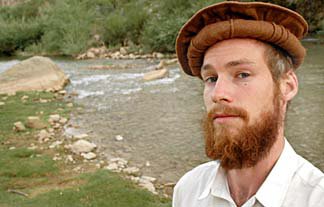
Those questions come to mind when I think of Colin Crowley, the recipient of the 2010 TONY Award for excellence in local journalism. In prior TONY Award columns, “local” literally meant working in Wisconsin. Colin Crowley hails from Oshkosh, though he’s not lived here since taking off for Afghanistan in 2005 to work as a video documentarian for Shelter For Life, International (then headquartered in Oshkosh).

So why should someone who calls Nairobi, Kenya home receive the 2010 TONY Award?

To answer that question requires a candid assessment of the state of news media today. Largely irrelevant in the lives of too many people, news media frustrate the hell out of the shrinking numbers of folks that rely on it to meet civic and personal needs. Becoming “relevant” invariably means catering to the lowest common denominator while cutting the budgets necessary to cover seriously domestic and foreign policy stories that matter. The result is devastating for “small-d” democracy. This critique isn’t new, but argued most cogently in Bob McChesney’s classic Rich Media, Poor Democracy (University of Illinois Press, 1999).

Colin Crowley holds a set of humane, “big picture” values that role model what journalism, corporate and independent, national and local, could be like if it could find a way to escape from the clutches of profit motive and the resulting pandering and pettiness. Though he no longer calls northeast Wisconsin home, Colin’s got a thing or two to teach us locals about what 21st century journalism could be.

In 2005 Colin kept the “Colin’s Story” blog to keep followers up to date on his Afghanistan work. I lost touch with him until May of this year, when we exchanged emails. I learned that since April of 2008 he’s been employed with the British NGO Save the Children UK (STC) as a multimedia officer. In that role he creates photo essays, makes videos, writes case studies, serves as a chaperone for international journalists when they visit STC programs, and contributes international media pieces on humanitarian crises.

Since 2008 Colin's covered China’s earthquake, Myannmar’s cyclone, a war in the Congo, cholera outbreak in Zimbabwe, food crises in Ethiopia and Northeast Kenya, the catastrophe in South Sudan, and Haiti right after the earthquake. I last heard from him in July as he documented a food crisis in Niger that received scant coverage in the US.

Because it conflicted with the Olympics in South Africa occurring simultaneously, Niger’s food crisis almost disappeared from the global media radar. For Britain’s Sky News, Colin worked on some of the only interviews and video footage of the crisis. STC UK reported a large spike in donations from the British public in the 24 hours following the broadcast. Colin says that “it’s a good feeling to think that this kind of reporting can make a bit of a difference.

Colin has become quite knowledgeable and articulate about the nature of the global food crisis. His analysis is hard to find in the mainstream press:

I don't think Americans realize how inefficiently their taxes are used when it comes to food aid. I can't tell you how ridiculous it feels to be standing in a World Food Program warehouse in Zimbabwe, Sudan, Northeastern Kenya, and other places and see tons and tons of bags of grain that was grown in Nebraska, Iowa, etc., and costs billions of dollars to transport while people all around are starving and local farmers are sitting on empty stores for a lack of fertilizer, modern farming tools, seeds, or irrigation systems. It invariably brings to my mind a seemingly simple question: ‘Rather than paying farm subsidies and shipping companies billions of dollars to grow this grain in the US and then transport it to Africa, couldn't we take a fraction of that money and just invest it into local agriculture?’”

Colin advocates replacing the current food aid system with one that many NGOs now endorse: simply provide cash to people to support local market. This would inject needed dollars into local economies and be much less expensive than traditional food aid programs. The problem, according to Colin, “is that it would threaten farm subsidies and profits of shipping companies.”

The human catastrophes covered by Colin Crowley exist largely because of lack of awareness. Awareness leads to outrage. Outrage leads to collective action. Collective action leads to social justice. The great tragedy of modern media is in its failure, in some cases purposeful failure, to use its remarkable powers of creating awareness for the common good.

Lewis Hine was an Oshkosh son whose photojournalism helped end the scourge of child labor in the early 20th century United States. For bringing the humanitarian spirit of Lewis Hine to a global level, Colin Crowley is the recipient of the 2010 TONY Award. You can congratulate him by making a contribution to Save the Children. (http://www.savethechildren.org/).

Note: Past TONY Award recipients can be found here, here, here, here, here, here, here, and here.

Saturday, October 30, 2010

Media Rants: Happy Anniversary to (Me)dia Rants

The following piece will appear in the November 2010 edition of The Scene.

Happy Anniversary to (Me)dia Rants

Media Rants

By Tony Palmeri

The first Media Rants column appeared in the August 2002 issue of The Scene. By my calculation, that makes this November column the 100th (!) rant. When the column debuted, I wasn’t sure I’d have the discipline demanded by 10 rants, let alone 100. But here we are, 8 years later, still trying to shed light on the ways in which corporate establishment media can, in the words of the late and great Madison Capital Times editor Bill Evjue, be “used to reduce the people to conformity and dumb acquiescence.”

Given that the New York Times, Washington Post, regional Gannett tabloids, radio and television outlets, or even alternative web sources aren’t exactly lining up to talk to me about this most momentous anniversary, I guess I’ll have to interview myself. So here’s a retrospective of sorts on the last 99 columns.

Question: How did the Media Rants column get started?

Answer: In the summer of 2002 then SCENE editor Tom Breuer called and asked if I’d be interested in writing for the paper. Back then I wrote a weekly electronic newsletter to accompany a television program called “Commentary” I hosted and produced with my heroes Doug Freshner and Jim Mather. Somehow Tom got on the newsletter email list, and he liked it enough that he thought I might be able to contribute something worthwhile to the Scene. The name “Media Rants” was Tom’s idea. The first column was a critique of the local press’ annual and shameful subservience to the Experimental Aircraft Association.

Question: What writers have influenced your thinking and style?

Answer: All conscientious media critics owe a debt to the late George Seldes. Probably the greatest investigative journalist in American history, Seldes in the 1940s published a newsletter called “In Fact” which is now widely regarded as the prototype for how to expose the shortcomings of the establishment press.

Given that Media Rants is a monthly essay, stylistically I’ve been guided by my favorite essayists. I respect and admire the rebel passion of Thomas Paine, the moral clarity of George Orwell, the principled prose of I.F. Stone, the sheer eloquence of Christopher Hitchens, the wisdom of James Baldwin ("I love America more than any other country in the world, and, exactly for this reason, I insist on the right to criticize her perpetually."), the unpredictability of Alexander Cockburn, the stinging humor of Molly Ivins and Maureen Dowd, and the in-your-face rhetorical flourishes of James Howard Kunstler. I’ve disagreed with each of these wordsmiths at various times yet stand in awe at their contributions to the craft of writing.

Question: Do you have any favorite Media Rants columns?

Answer: My favorites are the ones that make at least some minor contribution to our understanding of local history (“Press Coverage of McCarthy” from April of 2006; “Earth Day at 40” from April of 2010; “King Karma: Yesterday and Today” from March of 2003), challenge local and state establishment media to do better (“The Magruder Media’s Ethical Compass” from November of 2002; “Northeast Wisconsin’s Iron Triangle” from August of 2003; “It’s Not a Witch hunt if There’s a Witch” from June of 2004), counter the insane pro-war journalism of the last 8 years (“Will We Hear the Winter Soldiers?” from March of 2008; “Media AWOL on National Guard Coverage” from March of 2009), and take a stand for rational public discourse (“Fighting Reactionary Politics: Real Conservatives, Real Liberals, and Real Radicals Must Work Together” from April of 2005). I also look fondly on the tributes to Robert L. “Doc” Snyder and Doug Boone, and interviews with my friends Curt Andersen, Stephen Richards, Jo Egelhoff, and Ron Hardy.

Question: Most memorable Media Rants moment?

Answer: UW Oshkosh Professor of Political Science James Simmons found the essay “Deconstructing Don Kettl” (July 2004) interesting and asked me to publish a revised version of it in the Wisconsin Political Scientist Newsletter. The essay situated Professor Kettl, formerly of UW Madison and widely recognized as governor Tommy Thompson’s most revered academic, as a symbol of the extent to which UW profs had become tools of power rather than challengers to it. Some of Professor Kettl’s colleagues at UW Madison lambasted Dr. Simmons for publishing the piece, reducing it to nothing more than a cheap-shot personal attack. The irony was that the tone and vacuity of their complaint validated the thrust of the essay better than anything I could have said or written.

Question: What kind of response has Media Rants received over the years?

Answer: Though it’s now conventional wisdom to say “no one reads anything longer than a Facebook wall post anymore,” the fact that Media Rants does have an audience keeps me writing it. When the Appleton Public Library invited me to participate in a debate about the movie “Good Night and Good Luck” in 2006, I was pleasantly surprised at the number of people in attendance who recognized and appreciated the column. Media Rants columns also led to several invitations to lead discussions at the Harmony Café in Appleton, as well as numerous appearances on Wisconsin Public Radio.

Question: Any final thoughts?

Answer: I just want to thank everyone who has supported Media Rants over the years, especially those readers who take the time to offer constructive feedback. Many thanks also to Scene publisher Jim Moran and current editor Jim Lundstrom for making space every month.

Rant On!

Thursday, October 07, 2010

Two Screenings of "Mad City Chickens"

From citizen Dan Hoyt:

On behalf of the citizen group calling ourselves "Oshkosh Backyard Chickens" I would like to invite you to a free, public showing of the documentary film titled "Mad City Chickens".

This feature length production, with a total run time of 79 minutes, will be shown at the UW Oshkosh Reeve Union Theater on Friday, October 22 at 7:00 p.m. and again on Tuesday, October 26 at 3:00 pm. The times were chosen to allow for different schedules so the film would have opportunity for public viewing before the Oshkosh Board of Health meets on October 27th.

"Mad City Chickens" documents how the citizens of Madison, Wisconsin organized and worked to change their local ordinance to allow for "urban chickens" to be kept as pets. This film addresses all of the major concerns regarding "backyard" chickens including noise and enforcement issues among many other things.

Mr. Ronald Kean, the UW Extension Poultry Specialist, is interviewed in this film as are many local residents of Madison, a pet store owner and city officials. The film contains lots of great information, plenty of facts and a good dose of humor as well.

I encourage everyone to pick the time best for them and make a point of attending this free event. Also, please spread the word to your friends and neighbors as all are welcome. The Reeve Union theater, located on the 3rd floor of the student union on the UW Oshkosh campus, holds 196 people in comfortable, stadium style seating.

This event is being sponsored by the UW Oshkosh Student Environmental Action Coalition and (hopefully) many local businesses who would be happy to see chickens in Oshkosh.
For more information about this event contact me by reply email.

Thank you and I look forward to seeing you at the show!

Dan

Wednesday, October 06, 2010

Compulsory Voting on WPR Thursday Morning

I'll be on Wisconsin Public Radio Thursday morning at 6 a.m. (yikes!) talking about compulsory voting with Joy Cardin. http://www.wpr.org/cardin/

Thursday, September 30, 2010

Media Rants: For Compulsory Voting

The following piece appears in the October 2010 edition of The SCENE.

For Compulsory Voting

Media Rants

By Tony Palmeri

The day after the September primary, Gannett’s Appleton Post-Crescent reported that “A projected record turnout of voters in Tuesday's election never materialized as only about 1 in 5 eligible voters cast ballots.” The 19 percent turnout fell short of the Government Accountability Board’s 28 percent prediction, which would’ve been the highest since 1964.

Nationally, the professional punditocracy insists that Tea Party activism and anger at Obama energizes Republican voters. Yet “record” turnouts in partisan primaries remained abysmally low; in some states a whopping 10 percent participation. If turnout nationally in the November midterm elections reaches 50 percent, professional election watchers will consider that “high.”

Even though voting in presidential elections has been on the increase, the 61 Percent turnout that brought Barack Obama to the White House in 2008 still fell short of the 64 percent in 1908 that propelled portly William Howard Taft over Bible thumping William Jennings Bryan. Is it not astonishing that in 100 years we have never had more than 64 percent of eligible voters cast a ballot for the highest office in the land?

Let’s face it: voter turnout in the United States, the country calling itself the greatest representative democracy in the world, is an international embarrassment. Elected federal officials wield immense power, yet low vote totals rarely provide them with a clear mandate to govern in any particular policy direction. In some ways the situation is worse at the local level: officials who set your property tax rates, (de)fund your child’s school, and approve crazy corporate welfare schemes usually get elected on the strength of less than 20 percent voter turnout.

But the lack of a mandate to govern is only one negative effect of low turnout. Over the last 20 or 30 years we’ve seen the makings of something much more nefarious. The sophistication and refinement of market research techniques now allow political operatives on the Democratic and Republican sides to discover quite easily what the “likely voter” wants to hear, and then tailor messages to that group. In a system dominated by petty partisan political hacks, what candidates stand for is always secondary to the need to “get our voters to the polls.” The result, always, are campaigns long on schmoozing and short on issue specifics, with obnoxious telephone, Email, and snail mail reminders to “get out and vote” for candidates so tightly scripted they might as well be running for a seat on the screen actors’ guild board of directors.

The system of political hackery is aided and abetted by the fact that in the USA voting is conceived of not as a duty of citizenship, but as a civil right that adults can choose not to use. Unfortunately, the system of voluntary voting isn’t working; we need a dramatic rethinking of citizenship expectations.

Think about it: if a person responded to a jury duty summons by saying, “I don’t feel like serving, “ or “I don’t care about the justice system,” or “I’m not well informed,” or “I don’t like the prosecution or defense,” we would laugh. We compel people not only to serve on juries, but to educate their children, pay taxes, and even keep their lawns trimmed. Oddly, we don’t compel people to have to go out and vote in elections the results of which will determine what kind of justice, education, taxation, and public works programs we have.

More than 30 countries require citizens to vote. In places like Brazil and Australia, voter turnout is well over 90 percent and thus the results more accurately reflect the “will of the electorate.” In Brazil, President Luiz Inacio Lula da Silva comes from a personal background of extreme poverty and stands for a set of leftist ideals that make USA liberal Democrats look like Rush Limbaugh. Right wing, corporatist leaders can and do get elected in places with compulsory voting (Silvio Berlusconi in Italy is one example), but at least no one can argue it’s because voters stayed home. In the USA, they merely need to spend lots of cash hiring field organizers, make large media buys to propagate mindless advertisements, and pay for other “get out the vote” activities.

The major arguments against compulsory voting are that it infringes on liberty, “ignorant” people will be forced to vote, and that there’s no one worth voting for. Let’s address each in turn.
First, non-voting has infringed on our liberties much more than a compulsory voting system ever could. The greatest assaults on our liberties, from the Espionage Act of World War I to McCarthy era mania to the post 9/11 homeland security excesses, were all put in place by elected officials who had no clear electoral mandate.

As for “ignorant” voters, they exist prominently in our current system. A compulsory system of voting results in more issue based elections; perhaps we’d see a drop in ignorance.

For voters who feel there is no one worth voting for, commentators from Ralph Nader on the left to the editorial page of the Wall St. Journal have argued that there ought be a “none of the above” option on the ballot. I agree.

It will probably be years before we see a serious discussion of compulsory voting. Until then, please VOTE!

Wednesday, September 22, 2010

The Joys of Teaching

One of the great joys of teaching is the experience of reading critical commentary written by former students. We (teachers) usually don't know if the student was already an astute critical thinker before enrolling in our classes, but we like to tell ourselves that the classes had something to do with the former student's current critical faculties.

What's even better is when a former student demonstrates that he or she has the "lights on" even when there's no homework assignment. That is, the critical mindset has become a distinct part of their persona.

I thought about all this an hour ago when an email came in from a former student who is now in her first semester of graduate school at Marquette. Here's part of her brief email:

Last week, I had the opportunity to attend a conference here in Milwaukee featuring several famous speakers: Steve Forbes, Laura Bush, Colin Powell, and Rudy Giuliani. Fascinating to say the least, and a case study on how resting solely on one's perceived ethos is devastating to a decent speech. If I may, I'll just give you my tongue-and-cheek summaries: Laura read from a manuscript, trying hard to convince us that she & George are normal people who wear fuzzy slippers, drink coffee, and write their memoirs, all while reassuring themselves they made 100% justifiable decisions while in office. Steve Forbes tried hard to convince the audience that socialism is inherently evil, while generic, wealthy Republican interests are universal interests in America. Powell & Giuliani's speeches groaned with anecdotes and were boringly uncontroversial. I know you have more experience talking and listening to politicians than I do. Perhaps I was expecting too much?

No, I don't think she was expecting too much. In fact, I'd say her "tongue in cheek" observations are more on-point than 99 percent of what we get from the professional punditocracy. She's clearly a very good "crap detector." Good for her, good for society at-large, and a good feeling to know that I might have had some minor role in motivating her to think critically about public discourse.

Tuesday, September 14, 2010

Neumann Deserves To Win Republican Primary

I don't think he will, but Mark Neumann does deserve to win today's Republican primary for governor of Wisconsin. Several reasons:

*Neumann is the only candidate to release plans--fairly detailed--specifying what he would do if elected governor. The Scott Walker campaign, which is based largely on bumper sticker slogans and silly soundbites, responded not with detailed plans of their own but by calling Neumann an "egomaniac." I disagree with probably 80 percent of Neumann's 210 page position manual, but applaud the candidate for taking some stands. We need more of those kinds of "egomaniacs" in contemporary politics.

*Neumann's campaign, unintentionally I think, has exposed how out of touch the Republican Party hierarchy is with the average voter on the street. The effort on the part of the party insiders to ensure that they get a nominee (i.e. Scott Walker) who represents no threat to Wisconsin Manufacturers and Commerce or other pet establishment insider groups has been nothing short of sickening. (Which is not to say that Neumann IS a threat to those groups; of course he is not. But at least in the campaign he has shown some ability to be independent.).

*Scott Walker's advertising might be the worst in the history of Wisconsin politics. Virtually everything is a gimmick (e.g. the "brown bag movement" nonsense), low level pandering (e.g. he'll appoint someone to guarantee more deer for hunters), or the most vile kind of "gotcha'" politics (e.g. Neumann's vote for a 1998 transportation bill while in Congress).

*Walker's performance as Milwaukee County Executive is a case study in the perils of governing with your eye aimed at someday running for higher office. Any person looking honestly at Walker's record as County Executive has to conclude that, in order to be able to posture as a fiscal tough guy, he has forced the County Board of Supervisors to do virtually all of the heavy lifting. Early in the campaign Neumann went after Walker on this point, but then backed down for reasons that are not very clear (I suspect he might want to run for another office someday and does not want to completely alienate the hacks in the party establishment.).

Recently the Walker campaign has trotted out the theory that Democrats will cross party lines to vote for Neumann because they think he (Neumann) will be a weaker candidate against Tom Barrett. If there is such a Democratic conspiracy in place, it's an extraordinarily stupid one. Scott Walker is the weakest Republican candidate since Scott McCallum (McCallum, you might recall, spent most of his campaign trashing state workers and the shared revenue program.).

Neumann v. Barrett would represent the best chance for an issue based fall campaign instead of the bumper sticker nightmare we'll get with Walker in the ring. I hope I'm wrong, but I think we're headed for the latter.

Monday, August 30, 2010

Media Rants: The New(t) Know Nothings

The following essay will appear in the September 2010 edition of The Scene.

The New(t) Know Nothings

Media Rants

By

Tony Palmeri

In the mid-nineteenth century United States the “Know Nothing” movement emerged in opposition to European, primarily Catholic immigration. Vicious, widespread intolerance led historian Arthur Schlesinger, Sr. to call anti-Catholicism “the deepest held bias in the history of the American people.”

Know Nothing “leaders” like former president Millard Fillmore and congressman Lewis Levin argued that “Popery” could not coexist with representative democracy. Telegraph inventor Samuel Morse in a famous 1835 essay wondered if it were even possible for “Papists” to “repudiate” certain “noxious” Catholic principles. (Had Sam been a complete dimwit like a recent Republican Vice Presidential candidate, he might have said “refudiate.”).

Virulent anti-Catholicism existed into the twentieth-century, exemplified by the Ku Klux Klan’s overt and effective role in crushing Al Smith’s 1928 presidential campaign. Anti-Catholic fear mongering almost derailed John F. Kennedy’s 1960 campaign and forced delivery of a speech establishing that if elected President he wouldn’t be the Pope’s point main in the White House.

Kennedy’s “Address to the Greater Houston Ministerial Association” celebrates its 50th birthday on September 12. In it he said “I believe in an America where religious intolerance will someday end, where all men and all churches are treated as equals.” The fact that six Catholics sit on the US Supreme Court offers proof that irrational anti-Catholicism is a thing of the past.


But the controversy surrounding the location of an Islamic community center near Ground Zero in lower Manhattan suggests we still have a long way to go to meet JFK’s ideal.

Looking back on the Know Nothings it’s easy to recognize the movement as a product of a combination of factors including fear of the unknown, bigotry, xenophobia, scapegoating, political opportunism and cowardice. Contemporary Islamophobia in America represents a vile kind of Know Nothingism, more frightening than its 19th century anti-Catholic counterpart in large part because of the ease with which major media can literally overnight transform fringe positions into the mainstream. The old Know Nothings had to organize at the street level; newbies need only feed the right wing blogosphere and radio circuit and wait for the establishment media to exploit cyber feuds and twitter feeds for ratings points.

Former House Speaker and probable 2012 GOP presidential contender Newt Gingrich, the Millard Fillmore of the mosque controversy, so thoroughly and shamefully demagogues the Manhattan mosque that even uber-conservative Pat Buchanan labels him a political opportunist. From making Nazi analogies to deconstructing “Cordoba House,” Newt’s rhetoric is like Know Nothingism on steroids.


Since September of 2001 the corporate media has done a poor job of calling out Islamophobic demagogues and opening up dialogue about the religion. Mix that with the cheerleading for wars against two Muslim countries and the result is an irrational, but completely understandable given the media environment, opposition to new mosques around the country. This excerpt from a recent New York Times article about opposition to a proposed mosque in Staten Island is heartbreaking in its depiction of vitriol that must have met plans to build Catholic churches in the 1840s:

The tenor of the inquiry became so fraught that the meeting eventually collapsed in shouting around 11 p.m., prompting the police and security guards to ask everyone to leave.
But just 20 minutes earlier, as Bill Finnegan stood at the microphone, came the meeting’s single moment of hushed silence. Mr. Finnegan said he was a Marine lance corporal, home from Afghanistan, where he had worked as a mediator with warring tribes.


After the sustained standing ovation that followed his introduction, he turned to the Muslims on the panel: “My question to you is, will you work to form a cohesive bond with the people of this community?” The men said yes.

Then he turned to the crowd. “And will you work to form a cohesive bond with these people — your new neighbors?”

The crowd erupted in boos. “No!” someone shouted.

Those who doubt the media’s influence should consider the lingering confusion about Barack Obama’s religious beliefs. According to the Washington Post, “The number of Americans who believe, wrongly, that President Obama is a Muslim has increased significantly since his inauguration and now account for nearly 20 percent of the nation's population . . . The number of people who now correctly identify Obama as a Christian has dropped to 34 percent, down from nearly half when he took office . . . Among those who say Obama is a Muslim, 60 percent say they learned about his religion from the media, suggesting that their opinions are fueled by misinformation.”

If the polls are accurate, today’s Know Nothing movement might make huge gains in the November elections, from the US House and Senate to state legislatures to governors offices. Abe Lincoln’s 1855 letter to Joshua Speed is instructive:

As a nation, we began by declaring that ‘all men are created equal.We now practically read it "all men are created equal, except negroes.’ When the Know Nothings get control, it will read ‘all men are created equal, except negroes, and foreigners, and Catholics.’ When it comes to this I should prefer emigrating to some country where they make no pretence of loving liberty, to Russia, for instance, where despotism can be taken pure, and without the base alloy of hypocrisy.”

Saturday, July 31, 2010

Media Rants: WikiLeaks vs. Corporate Media

Note: The piece below appears in the August, 2010 edition of The Scene. It was submitted for publication before WikiLeaks' release of thousands of pages of classified Afghanistan War documents. Perhaps the most insightful perspective on those documents is by NYU journalism professor Jay Rosen, who refers to WikiLeaks as the "world's first stateless news organization."

WikiLeaks vs. Corporate Media

Media Rants

by Tony Palmeri

WikiLeaks, a kind of Wikipedia for whistleblowers directed by Australian activist Julian Assange, represents a set of journalistic values radically at odds with the values of the corporate press.

According to the UK Guardian’s Stephen Moss, “Assange unveiled wikileaks.org in January 2007 and has pulled off some astonishing coups for an organisation with a handful of staff and virtually no funding. It has exposed evidence of corruption in the family of former Kenyan president Daniel arap Moi, published the standard operating procedures for the Guantánamo Bay detention centre, even made public the contents of Sarah Palin's Yahoo account. But what has really propelled WikiLeaks into the media mainstream is the video it released in April of a US helicopter attack in Baghdad in July 2007, which killed a number of Iraqi civilians and two Reuters personnel, Saeed Chmagh and Namir Noor-Eldeen.”

The release of the leaked attack video (called “Collateral Murder”) led to the arrest of its alleged source, US Army intelligence specialist Bradley Manning. PFC Manning spent 30 days in a Kuwaiti jail without charges, and now faces court martial for downloading and releasing classified information.

Mainstream coverage of the video focused on the conditions of its release and whether or not Manning and WikiLeaks harmed national security. Those hoping for a discussion of the war’s morality or legality, or whether its architects should be charged with war crimes, were left disappointed.

On its website, WikiLeaks offers a compelling case for its encouragement of “principled leaking.” They say:

“Principled leaking has changed the course of history for the better; it can alter the course of history in the present; it can lead us to a better future . . . The power of principled leaking to embarrass governments, corporations and institutions is amply demonstrated through recent history. The public scrutiny of otherwise unaccountable and secretive institutions forces them to consider the ethical implications of their actions. Which official will chance a secret, corrupt transaction when the public is likely to find out? What repressive plan will be carried out when it is revealed to the citizenry, not just of its own country, but the world? When the risks of embarrassment and discovery increase, the tables are turned against conspiracy, corruption, exploitation and oppression. Open government answers injustice rather than causing it. Open government exposes and undoes corruption. Open governance is the most effective method of promoting good governance . . . We propose that authoritarian governments, oppressive institutions and corrupt corporations should be subject to the pressure, not merely of international diplomacy, freedom of information laws or even periodic elections, but of something far stronger — the consciences of the people within them.”

Time Magazine said that WikiLeaks “could become as important a journalistic tool as the Freedom of Information Act.” New media technology scholar Clay Shirky tweeted that WikiLeaks “has had more scoops in 3 years than The Washington Post has had in 30.” Salon’s Glenn Greenwald writes that there are very few entities, if there are any, which pose as much of a threat to the ability of governmental and corporate elites to shroud their corrupt conduct behind an extreme wall of secrecy.”

That WikiLeaks is on the radar screen of the US government was confirmed in 2008, when a leaked classified report written by the Army Counterintelligence Center placed the site on "the list of the enemies threatening the security of the United States." In what is an apparent attempt to intimidate potential whistleblowers, press reports revealed a Pentagon “manhunt” for Assange, who briefly seemed to go into hiding. Meanwhile, the Obama Administration’s policy toward whistleblowers appears to be the harshest in US history.

I see three major differences between WiliLeaks’s values and the corporate press. First, the corporate press would rather talk about transparency than actually make it a central component of journalistic practice. The mainstream press annually promote “Sunshine Week,” but for Wikileaks every day is dedicated to shining light on corrupt governments and corporations.

Second, WikiLeaks has no interest in “building relationships” with power. Contrast that with the White House press corps, a largely sycophantic bunch enamored with shooting hoops with the prez or otherwise being privy to the world of the “insiders.”

Third, WikiLeaks encourages maximum transparency as a means to pursue the end of justice. Since the end of corporate media is profit, it has difficulty shining light on big corporations that might cut off advertising or other forms of support. Do not be surprised if the majority of useful information regarding BP’s actions in the gulf gets released on WikiLeaks before the mainstream press.

Taking on WikiLeaks style values might help restore the credibility of the establishment press. Owners and editors are slowly starting to understand. Case in point: the Washington Post in July published an excellent multi-part series on “Top Secret America.” The series “describes and analyzes a defense and intelligence structure that has become so large, so unwieldy, and so secretive that no one knows how much money it costs, how many people it employs, or whether it is making the United States safer.”

About the WP series, WikiLeaks tweeted: “Real change begins Monday in the WashPost. By the years end, a reformation. Lights on. Rats out.” Let’s hope.

Friday, July 02, 2010

BID requests 50 grand from taxpayers

July 2, 2010

City Council Members
P.O. Box 1130
Oshkosh, WI 54903-1130

Dear Council Members,

I would like to make a formal request, on behalf of the Downtown Oshkosh Business Improvement District (BID), for funding from the City of Oshkosh in the amount of $50,000 to support beautification and revitalization efforts on Main Street. The City of Oshkosh hired Ken Saiki Design Firm out of Madison, Wisconsin to design and make recommendations for placement of the following beautification elements which are not only enhancements but necessities to our Main Street.

Ken Saiki Design recommended adding benches, bike racks, flower pots, and trash receptacles to Main St.

The Oshkosh Business Improvement District (BID) has currently secured a 2 to 1 matching grant from the Oshkosh Area Community Foundation (OACF) in the amount of $25,000. In order to secure this grant the OACF would like to see $50,000 raised. In addition the Oshkosh Area Economic Development Corporation (OAEDC) has pledged $5,000 and the BID will continue efforts to raise an additional $25,000 plus for decorative banners and other beautification items. The BID is requesting $50,000 for the cost of the material. In addition to our fundraising efforts the BID will maintain all the planters, watering, and all bump outs and grass areas in the district.

Thank you for your consideration on this important aspect to Oshkosh’s Main Street. Please refer any questions or concerns that you have to me at (920) 303-2265 ext. 11. I look forward to working with you.

Sincerely,


Maureen Lasky
Downtown BID Manager
Oshkosh Area Economic Development Corporation

Cc: Mark Rohloff, City Manager
Jeff Nau, City of Oshkosh Planning
Dave Sparr, BID Board Chair
Megan Hoopman-Lang, BID Board Vice-Chair
Rob Kleman, OAEDC

Thursday, July 01, 2010

Media Rants: LZ Lambeau and The Good Soldier Consensus

The following piece appears in the July, 2010 edition of The SCENE.

LZ Lambeau and The Good Soldier Consensus

Media Rants

By Tony Palmeri

From May 21-23, thousands of Wisconsinites attended LZ (“Landing Zone”) Lambeau. Flyers printed in advance urged readers to “Be part of Wisconsin’s official Thank You event at Lambeau Field, honoring our Vietnam veterans for their service and sacrifice.”

Vietnam Army vet Will Williams originally supported the event. He told WLUK television that he turned against it when "The idea of welcoming home Vietnam veterans morphed into a promotion of militarism and support for the current wars and recruitment of young people."

Veterans for Peace echoed Williams. Spokesperson and Army vet Leslie “Buzz” Davis said that attendees would get an incomplete picture of the war: "They won't be presented with the lying politicians, they won't be presented with the power of the military industrial complex."

I believe LZ Lambeau organizers, including Wisconsin Public Television and the Wisconsin Historical Society, sincerely wished only to honor Vietnam vets. WPT’s documentary “Wisconsin Vietnam War Stories” is powerful and deserves a wide audience. Unfortunately and despite good intentions, LZ Lambeau reinforced what has become a disturbing mainstream consensus on the treatment of soldiers in our society. I’ll call it the “Good Soldier Consensus.”

According to the Good Soldier consensus, the military ought to be able to recruit workers just like any other employer. Especially in de-industrialized and economically depressed parts of the country, military service becomes a way of obtaining education and job training.

Upon signing the dotted line, the new soldier agrees to follow orders. In return, the Good Soldier Consensus holds that the soldier is owed: proper training, modern equipment, nondiscrimination in housing and employment, access to high quality medical facilities and full coverage of treatment, education benefits, and other resources to maximize the chances of survival in war while easing the transition from battlefield back to home.

Virtually all establishment politicians and press adhere to some version of the Good Soldier Consensus. Indeed, establishment propaganda and the promise of good benefits attract thousands of young people to military careers.

The problem with the Good Soldier Consensus, other than the fact that the politicians can’t even guarantee the benefits promised, is that it allows political hacks in the White House and Congress and their corporate press cheerleaders to portray themselves as “pro-soldier.” But can political hacks (many of whom did whatever they could to avoid military service) really be “pro-soldier” if they support the continuance of illegal, immoral, never ending wars? Can press hacks be “pro-soldier” if they continue to minimize or censor the heroic stories of soldiers who refuse to follow orders that their conscience tells them are illegal?

Those who believe it naïve or dangerous to expect soldiers to question their orders don’t understand the lessons of World War II. After the war, the Nazis put on trial at Nuremberg for war crimes repeatedly justified their horrific treatment of civilians on the grounds that they were “just following orders.” In response, the Nuremberg tribunal released a list of principles to guide future conflicts. Principles IV states "The fact that a person acted pursuant to order of his Government or of a superior does not relieve him from responsibility under international law, provided a moral choice was in fact possible to him.”

What happens to a young American who tries to act in accordance to the Nuremberg Principles? The case of Army Lieutenant Ehren Watada is instructive. Watada invoked the Nuremberg Principles in refusing to deploy to Iraq on the grounds of the war’s illegality and immorality. Though the US government eventually dropped its case against him, Military Judge John Head held that the issue of the legality of war is a “nonjusticiable political question.” In other words, American soldiers who act on conscience will not be able to count on the judiciary to challenge abuses of power emanating from the executive and/or legislative branches.

What about the case of Pvt. Travis Bishop? Amnesty International labeled him a “prisoner of conscience” after he was jailed for refusing to fight in Afghanistan. After joining the military, Bishop reflected on his Baptist upbringing and came to the conclusion that Jesus’ message is one of pacifism. He could not fight in Afghanistan because “I had to get right with God in case I died or in case I had to kill someone.” His lawyer wants the courts to order the military to make it mandatory for soldiers to be briefed about conscientious objector status in the same way they are briefed about other benefits.

The website Courage To Resist (http://www.couragetoresist.org/) includes additional, detailed stories about modern soldiers who refuse to fight unjust wars. Another great resource is the award winning film “The Good Soldier” (www.thegoodsoldier.com/).

As for establishment media, we get more of the same: on the front page of the June 14th New York Times, the paper announced the “recent” discovery of a trillion dollars worth of minerals in Afghanistan; that nation could become the “Saudi Arabia of Lithium.” The subtext was that struggle over these materials will provide a pretext for the US to stay in that country for another generation.

Political and press hacks will not end the occupations of Iraq and Afghanistan, but soldiers of conscience and active citizens might. That’s what got us out of Vietnam.

Thursday, June 24, 2010

I'll be on Friday's "Week in Review"

I'll be on Friday's WPR Week in Review tomorrow (June 25) opposite former WI state senator and Lieutenant Governor Margaret Farrow. Gene Purcell will be hosting the show in place of Joy Cardin. You can call in live at 1-800-642-1234 or email talk@wpr.org

Friday, June 04, 2010

Jim Joyce's Lessons For Politicians

By now everyone knows that umpire Jim Joyce's blown call cost the Tigers' Armando Galarraga a perfect game. Umpire Joyce's recognition of his error has earned him praise from Mr. Krause and many others.

They/we probably won't, but politicians can learn two important lessons from the Joyce Affair.

Lesson Number One: Don't Pander; Call 'em as you see 'em: Joyce's blown call occurred with two outs in the top of the 9th inning, in Galarraga's home park, with the crowd cheerleading for the perfect game. Especially on such a close play, the easiest thing for Joyce to do would have been to call the runner out even if his eyes and heart told him the runner was safe. Instead of pandering to the crowd, he called the play as he saw it and suffered the immediate consequences.

Contrast that behavior with the norm in contemporary American politics. Pandering to cheerleaders--who are frequently well connected insiders with a vested interest in the outcome of policy deliberations--is the way the game is too often played. (That's essentially Madison and Washington politics in a nutshell.).

No one should be surprised that pandering to the powerful is the norm in Madison and Washington, but one of my biggest wake-up calls since getting on the City Council has been the extent to which that dynamic plays out locally too. Just raising questions about Oshkosh Corporation, EAA, and other entities backed up by well connected cheerleaders is extremely difficult.

Lesson Number Two: Evidence Matters. What's significant about Joyce's change of mind on the call is not just that he admitted error, but that he changed his mind after being confronted with contrary evidence. Even though the video evidence seemed pretty conclusive, Joyce could have easily said something like, "the video is misleading; if you'd been standing where I was you would have agreed that the runner got there first." Instead of spinning and rationalizing, Joyce accepted that the video evidence suggested that the runner was probably out.

Contrast that with the "dumbassification" that we see in American politics. Facts and evidence often mean nothing, especially if they get in the way of a good smear or a catchy, poll-tested slogan. (Probably the best current example of this phenomenon is the repeated attempts by Obama's opponents to label him a "Socialist" in spite of the fact that his economic policies were developed by Wall St. insiders and outfits like Goldman Sachs and JP Morgan Chase have been among his biggest contributors.).

American politicians tend to change positions not because further study reveals powerful counter evidence, but because of some need to pander to a cheerleader perceived as powerful. That's why we justifiably refer to position-changing pols as "flip-floppers."

Integrity means not only the willingness to take heat for a controversial stand, but also the courage to change course when contrary evidence emerges. Jim Joyce showed that kind of integrity. How sad that the modern Democratic and Republican parties have no room for that kind of individual.

Tuesday, June 01, 2010

Media Rants: Justice Stevens' Uneven First Amendment Legacy

Update July 17, 2019: Yesterday Justice John Paul Stevens passed away at the age of 99. I wrote this piece in June of 2010, shortly after Stevens retired from the Supreme Court. Justice Stevens continued to have an impact on legal thinking after he left the Court, including what I believe to be a persuasive argument for repealing the Second Amendment. We should never forget that Justice Stevens, who the popular press insisted on calling "liberal" but was in fact a fierce independent, was appointed by a Republican president (Gerald Ford) who understood the terrible impact on representative democracy and the rule of law when judges were perceived as partisan hacks. Today it is virtually impossible to imagine someone like Stevens appointed by a Republican president. --Tony Palmeri

Justice Stevens’ Uneven First Amendment Legacy

Media Rants

By Tony Palmeri
From the June 2010 issue of The SCENE

Disgust with the Supreme Court’s rightist RATS (Roberts, Alito, Thomas, Scalia) often leads leftish legal pundits to exaggerate the accomplishments of the Court’s so-called liberal bloc.

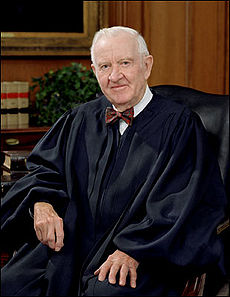
Nowhere is this tendency clearer than in the reactions to Justice John Paul Stevens’ retirement announcement. Senator Dick Durbin’s (D-IL) comments were typical: ''Justice Stevens' commitment to expanding freedom, safeguarding our rights and liberties, and understanding the challenges faced by ordinary Americans will be his legal legacy. He has had no judicial agenda other than fidelity to the law and the Constitution."

Appointed by President Ford in 1975, Stevens labeled himself a “centrist” and early in his term authored conservative opinions on affirmative action, the death penalty, and other hot button issues. His views on the death penalty and coercive state power in general evolved over time, so that by the 1990s media depictions almost unanimously recognized him as the Court’s liberal leader. Indeed, Stevens deserves kudos for being a voice of reason against Bush-era executive branch excesses in Hamdan v. Rumsfeld (2006).


As regards freedom of speech and the First Amendment, Stevens’ legacy is mixed. I believe his passionate and superbly argued dissenting opinion in the recent Citizens United v. FEC case will in future years have an impact not typical of minority opinions. In that case, the RATS were joined by Justice Anthony Kennedy in outlawing virtually all restrictions on corporate involvement in elections. Wrote Stevens: “The Court’s ruling threatens to undermine the integrity of elected institutions across the Nation. The path it has taken to reach its outcome will, I fear, do damage to this institution.”

Even more powerfully, Stevens dissent featured a rare example of a judge questioning the “personhood” of corporations:

The fact that corporations are different from human beings might seem to need no elaboration, except that the majority opinion almost completely elides it . . . It might also be added that corporations have no consciences, no beliefs, no feelings, no thoughts, no desires. Corporations help structure and facilitate the activities of human beings, to be sure, and their ‘personhood’ often serves as a useful legal fiction. But they are not themselves members of ‘We the People’ by whom and for whom our Constitution was established.”

Should the Supreme Court ever break free of its dominant RATS/moderates coalition, Stevens’ cogent understanding of the nature of corporations might serve as a foundation on which to reclaim the Constitution for “We the People.”

Stevens First Amendment contribution with the most practical and positive impact is probably his majority opinion in Sony Corporation of America v. Universal City Studios (1984). In that case, a court majority led by Stevens rebuffed Hollywood’s attempt to outlaw video tape recorders on the grounds that they could be used for copyright infringement. In a victory for consumers, Stevens wrote: "the sale of copying equipment...does not constitute contributory infringement if the product is widely used for legitimate, unobjectionable purposes, or, indeed, is merely capable of substantial noninfringing uses."

Unfortunately Stevens did not apply the same logic in MGM Studios v. Grokster (2005), joining the majority in refusing to apply the Sony standard to file sharing technology. Holding narrowly that file sharing technology was legitimate but that Grokster’s “crime” was in encouraging copyright infringement, the Court guaranteed only that entertainment companies would continue to use the courts to stifle what they perceive as illegal downloading. The result? Tens of thousands of lawsuits filed against music fans, against everyone from teen students to grandmothers.

Stevens’ two worst First Amendment opinions dealt with flag desecration and “indecent” media, respectively. In Texas v. Johnson (1989), Stevens was one of four justices disagreeing with the majority opinion that flag desecration constituted expression worthy of First Amendment protection. In a dissent that sounded more like Archie Bunker than a great civil libertarian, Stevens insisted that requiring he who desires to burn a flag use an alternative method for expressing his ideas is a “trivial burden” on free expression.

Stevens’ First Amendment opinion with the most negative impact can be found in Federal Communications Commission v. Pacifica Foundation (1978). The case dealt with the FCC’s power to prevent broadcasters from airing “indecent” material such as George Carlin’s famous “Filthy Words” monologue. Writing for the majority, Stevens insisted that the pervasiveness of mass media, along with government’s legitimate interest in protecting children, allowed the FCC to restrain the broadcast of “indecent” materials without violating the First Amendment. Thanks to this decision, we’ve now lived through more than thirty years of the FCC in the role of a boorish Big Brother, anxious to level fines at broadcasts featuring penis jokes or anything else deemed “indecent” by bureaucrats and judges.
Perhaps Justice Stevens' worst First Amendment opinion was in FCC v. Pacifica Foundation. In that case five uptight old judges (including Stevens) demonstrated that they were . . . five uptight old judges. The decision turned a federal, politicized bureaucracy into a glorified Big Brother. The consequences have not been good for free speech. 
Justice Brennan’s dissent aptly smacked down the Court majority, finding in Stevens’ opinion “a depressing inability to appreciate that in our land of cultural pluralism, there are many who think, act, and talk differently from the Members of this Court, and who do not share their fragile sensibilities.”

At his best, John Paul Stevens defended the Constitution against government and corporate attempts to bend and subvert it for their own purposes. Should Elena Kagan be confirmed as his replacement, let’s hope she is Stevens 2.0 instead of a RATS clone or Stevens-lite. [Update July 2019: In her recent dissent against the court majority's recent refusal to reign in hyper partisan gerrymandering, Justice Kagan showed signs of being a Stevens 2.0.].